
God creates the cosmos, then woman & man
Note this: Adam & Eve are not just humans. They are Humanity.
Two creation stories in Genesis
 The first story of creation: Genesis 1:1-31 and 2:1-4a.
At some point in time there was only primal chaos, a vast abyss of confusion and disorder… Then out of this hellish void came kosmos: order, symmetry, nature: the Garden of Eden. Everything in its natural place, with the potential for a right and ordered world.
What happened then?- The second story of creation: Genesis 2:4b-24 and 3:1-24.
God planted a garden in Eden with every good thing. All was as it should be, ordered and calm.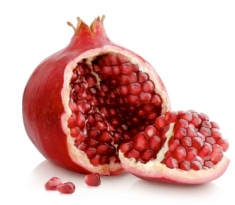
Pomegranate, a symbol of fertility in ancient pagan religions. Apples do not grow naturally in the Middle East.
But God also created an independent and strong-minded woman who, like all humans, was both creative and destructive, clever and short-sighted. She was Eve, the first woman.
What happened then? - Eve explored the Garden, met and interrogated the snake, and made a decision.
Curious, she disobeyed God’s command. She ate the forbidden fruit, bringing major change in the Garden of Eden – and in human history.
God creates the Universe
Read Genesis 1:1-31 and 2:1-4a
In this elegant story, the creation of the whole universe unfolds. (Check out the Bible text: hardly anyone realizes how beautifully the story is structured)
And notice this: it’s astonishingly like modern theories about the beginnings of the universe. The Bible story
- begins with an empty void
- then energy appears
- the planets are born
- the continents emerge
- vegetation, animals and humans appear
Evolution, long before the scientists thought of it.
What is God?
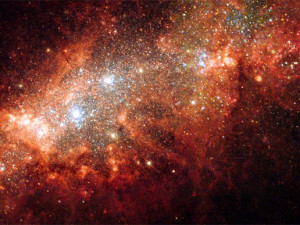
The cosmos
‘So God created humankind in his image,
In the image of God he created them;
Male and female he created them,
God blessed them, and God said to them
‘Be fruitful and multiply, and fill the earth.’
Read Genesis 1:1-31 and 2:1-4a
Note: God is a spirit, without gender. He is neither male nor female, but majestically ‘I AM’. But we use words such as ‘he’ and ‘his’ to describe God. This is incorrect, since God is neither male nor female, but we are echoing the ancient practice of anthropomorphism, when gods were portrayed as male or female with human personalities and characteristics.
God creates human beings
At the supreme moment of creation, God conceives a creature ‘in his own image’.
What does the phrase ‘in his own image’ mean? That people, like God, have a nature that is essentially creative. It is natural for them to imagine, invent and change the world around them, as God does in the Genesis story.
Humans are part of, expressions of, the creative energy of God.
And note this: Adam & Eve are not just humans. They are Humanity.
The Bible poses the question: how do people use their innate creativity? For good or evil?
Note: In this first telling of the story of creation, men and women are created at the same time. They are spoken of in equal terms: ‘male and female he created them’. They form part of the harmony of all creation.

Adam, Eve and the Serpent
See Bible text Genesis 2:4b:25 and 3:1-24
In this section of the story, God creates Adam but sees that there is something lacking.
‘So the Lord God caused a deep sleep to fall upon the man, and he slept; he took one of his ribs and closed up its place with flesh.’
So God created Eve, and completed the creation of the universe.
Read Genesis 2:4b-25
Eve is formed from the rib of Adam. They are of the same flesh and the same bone. From the moment of creation neither man nor woman can be complete without the other. Working together, they form the basic unit of society, the family.
 The story recognizes that men’s and women’s lives interlock so completely in economic and social matters, that neither can survive without the other.
Verse 25 makes a curious observation: neither the man nor the woman are aware of their own nakedness, as animals are unaware of their nakedness. Is this a hint that Adam and Eve are not yet ‘human’ in the way we understand the word? And that only events in the following chapter will make them human in the way that we are?
Eve and Adam are given a perfect world, but they are also given the power of choosing, making decisions.
‘Eve, it seems, was even more creative (and therefore God-like?) than her mate Adam. When a reptile in the Garden of Eden spoke to her, suggesting she try something new, she was intrigued.’
Bad Women of the Bible
One of the creatures in the Garden speaks to Eve, suggesting that God has duped her. If she eats the fruit that has been forbidden to her she will gain new understanding and wisdom — so profound that it will rival God’s.
Read Genesis 3:1-24
Because she has no experience of deceit, Eve believes the snake and makes her choice, deciding to seek knowledge of good and evil rather than be obedient. As humans, we continually test boundaries and try new ideas. In the Genesis story woman as ‘life-giver’ is the one who initiates this process.
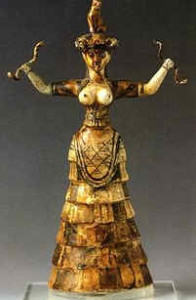
Minoan priestess holding two snakes, symbols of death and rebirth
It is a dangerous choice, reminding us that the quest for knowledge should always be balanced by wisdom. Eve will soon realize her mistake.
Adam eats the fruit without thinking or arguing. Like Eve, he misuses his ability to make decisions, never pausing to consider the consequences. Again, the quest for knowledge should go hand in hand with careful judgment.
Why is the snake used as a symbol of evil?
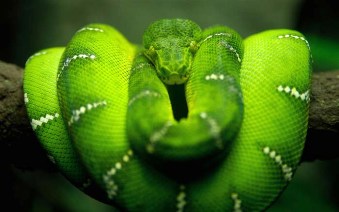
It was an important image in ancient pagan religions. The goddess Astarte, who represented the fertility of nature, was often portrayed with snakes. People saw the dead skins shed by snakes, and assumed that the snake had in some way died but then come alive again.
They saw the seasons of the year following the same pattern: in winter all things died, but in spring Nature mysteriously sprang back to life. So the image of a snake was used in fertility rituals, especially those relating to the seasonal cycles.
To the Hebrew people, the snake was a symbol of polytheism and paganism, the natural enemy of Jahweh and monotheism.
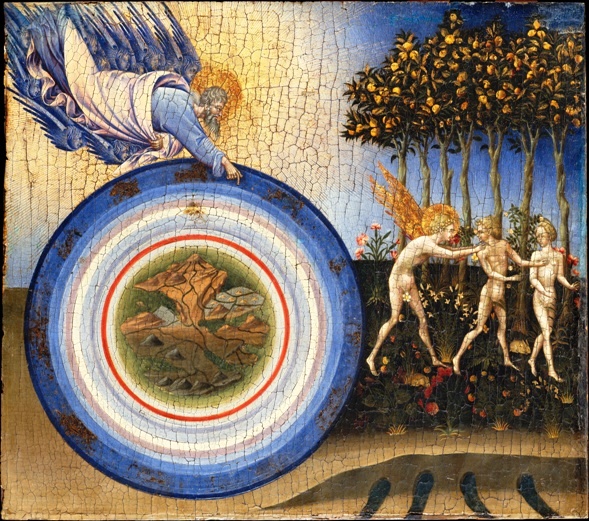
Expulsion from the Garden of Eden, Giovanni di Paolo
As the story continues, the original harmony between humanity and nature is disrupted. Both sexes become locked in fixed roles. In a fit of jealousy Cain murders his brother Abel.
In a perfect world, a world without sin, inequality, violence and injustice do not exist.
But the Garden of Eden has been lost.
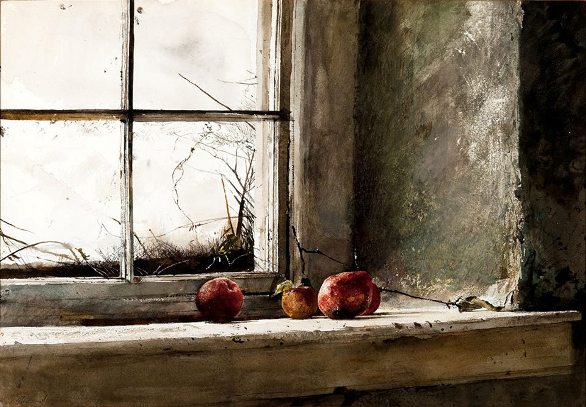
‘Frost-bitten’ by Andrew Wyeth, 1962 watercolor
Read about other fascinating women of the Bible
How to use this material?
Go to Activities for Bible Study Groups & Schools
About the Creation of Woman
‘It is not good that the man should be alone’ (Genesis 2:18). The remark amazes us. It is the only negative assessment in the creation narrative, and it is emphatically negative. By this divine reason of the creation of the woman, Scripture could not underline better the degree to which solitude contradicts the calling of humanity. From the very beginning, the human being is a Mitsein, a being-with; human life attains its full realization only in community. No man is an island, and everyone must discover himself to be his neighbor’s neighbor.’
‘In the Beginning‘, Henri Blocher, p96.
Information about paintings of Adam & Eve
-
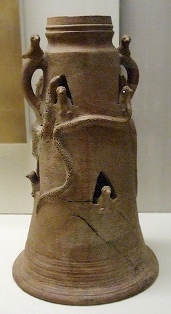
Ancient offering stand from Beth Shean
The serpent/snake was a symbol of evil and perversity because it was used in Canaanite religion – see the ancient Canaanite incense burner at right, covered with snakes. When Eve was approached by a serpent, she was toying with an alien religion; artists later used the serpent as shorthand for Evil.
- The Tree: there were two trees in the Garden of Eden: the Tree of Knowledge of Good and Evil, and the Tree of Life. The Tree of Knowledge made humans aware of the difference between good and evil. The Tree of Life was a common symbol in ancient religions.
- The Fruit was not an apple, though it is always shown like this in European paintings. It was a pomegranate, an ancient symbol of fertility and plenty in pagan religions.
- The Garden: Nothing seemed more beautiful to desert nomads than a lush green garden. The name ‘Eden’ comes from a Hebrew word meaning ‘to be fruitful or plentiful’, and the gardens of the Persians were called ‘paradeisoi’.
- Adam’s rib: Eve’s creation from a part of Adam (see the Michelangelo painting) recognizes that men and women’s lives interlock so completely that neither can survive without the other.
- The Angel: see Angels for the different types of angels in the Bible,
- or Angel Paintings for twenty famous images
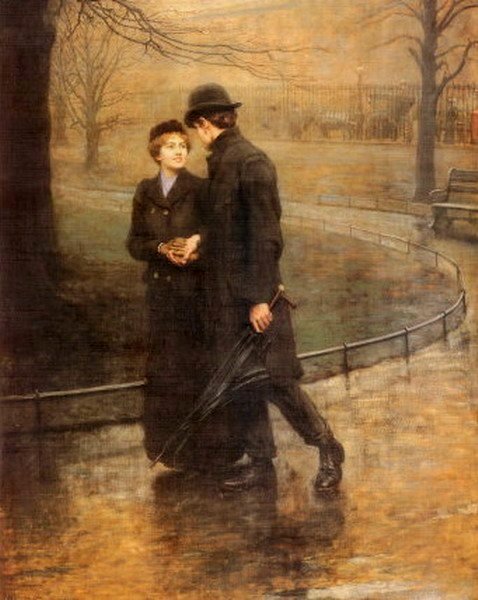
The Garden of Eden, by Briton Riviere
Eve – First Woman
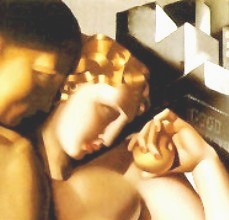
Eve and Adam, painting by Tamara de Lempicka, 1932
- Eve means ‘life-bearer’. Eve is the Great Mother, Everywoman.
- Adam is Adham, meaning ‘dust of the earth’.
- God is the the most powerful force in the universe, more powerful than Evil.
- Satan (the Devil). Evil could challenge but never conquer God.
In ancient times, giving something a name showed your power over it. Adam showed his power by naming Eve, but only after they disobeyed God and fell into sin.
What is the story of Eve about?
- Creation of the universe. This mythic story about Eve describes the creation of humanity and the universe. In a way it is similar to modern Science, which searches for answers to the question of how the earth and everything on it came to exist. In fact, science is now saying what the Bible has said for thousands of years: that at the beginning of time there was a day without a yesterday…

In the beginning…
- The nature of God. It asks questions like ‘What is ‘God’? What do we mean when we use the term? OR What does it mean to be human? What are the best and worst things about us? How are we made ‘in God’s image’?
Eve, Adam links

Bible Bad Women
Eve gets blamed

The First Murder
Cain and Abel

Families
in ancient Israel
How were they different to us?
Movies

Have a look at some clips from movies with ‘Eve’ in the title:
All About Eve
What’s the main message they’re giving about Eve/Everywoman?
The first murder
Famous paintings of Cain & Abel
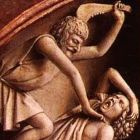
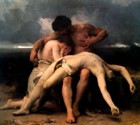
Cain and Abel are the sons of Adam and Eve, who commit the first sin.
Cain murders Abel, the second sin.
Now people have sinned against God and against each other.
At the heart of the story is a new idea: lawlessness is contrary to the will of God, and when it happens the good will suffer as well as the wicked.