
Bathsheba’s story
Bible study questions
- Who was Bathsheba? Why is she so famous?
- Who seduced who in this famous story?
- Why is this questionable story in the Bible?
- Which person in the story would you like to have met? Why?
The story of Bathsheba has two parts:

1 Bathsheba and King David (2 Samuel 11:1-26, 12:15-25)
Bathsheba was a beautiful, clever and unscrupulous woman. She was seen by King David as she bathed, desired by him, and subsequently became pregnant to him even though married to the soldier Uriah. Uriah was murdered by David, and she then married the King. Her baby died. She had a second son, who was called Solomon.
2 The struggle for the throne (1 Kings 1:1-37, 2:10-25)
David lost his sexual potency, and therefore his political power, in old age. In a palace coup Bathsheba and her adviser Nathan manoeuvred to secure the throne for Solomon, even though there was an older, more popular brother who was expected to succeed King David.
Solomon took the throne, honored his mother, and was advised by her. She took part in court intrigues, occupying the most prestigious position a woman could hold, Queen Mother. She and Solomon organized the death of Solomon’s older half-brother who had been the popular choice to succeed King David.
- For a map of the city of Jerusalem at the time of David, go to Bible Maps
Bathsheba & David
Bathsheba was the beautiful grand-daughter of Ahitophel, a shrewd military and political counselor of David. She belonged to an elite warrior family, and her husband Uriah was a high-ranking professional soldier, one of the respected warriors called The Thirty.
Her father and husband were stationed at Jerusalem, directly under the control of the king. They were David’s personal bodyguards, his champions, renowned for their bravery.
So she was a member of an elite warrior family, something like the wife of a high-ranking samurai. Since her grandfather, father and husband were close allies of David’s, it is safe to assume that she and David had already met before the famous scene where David sees her bathing.
It happened late one afternoon, when David rose from his couch and was walking about on the roof of the king’ house, that he saw from the roof a woman bathing; the woman was very beautiful. David sent someone to inquire about the woman. It was reported ‘This is Bathsheba daughter of Eliam, the wife of Uriah the Hittite’. So David sent messengers to get her, and she came to him, and he lay with her.’ Read 2 Samuel 11:2-4.
The Seduction
Bathsheba was most probably on the house’s flat roof, a tented area often used by the women of the family for a variety of tasks.
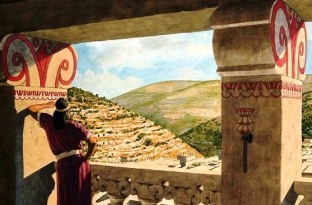
David looks out from the palace balcony.
In this case Bathsheba was washing herself after her menstrual period. The text makes a point of this post-menstrual purification, to show she was not carrying Uriah’s child, but was at the stage in her menstrual cycle when she was likely to conceive.
King David was on the roof terrace of the palace above, looking down. The terrace may or may not have been screened by latticework (the mother of Sisera in Judges 5:28) watched the road through a lattice, and a statue found in the northern city of Ugarit shows a woman at a latticed window).
The text does not tell us whether Bathsheba knew she was being watched. David may have been screened from sight by a lattice, so that she was unaware of his presence. Or she may have been quite aware she was being watched.
King in Sex Romp with Naked Woman!
In any case, David saw her young body and desired her. At the time, Bathsheba’s husband Uriah was away, fighting with the army – something David knew.
Bathsheba was summoned to the palace. She went.
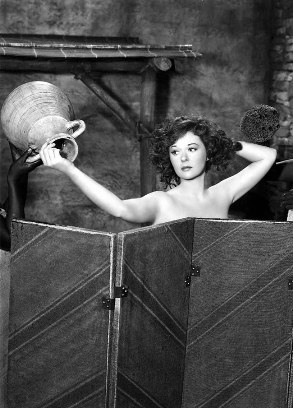
Bathsheba, a still from the movie ‘David and Bathsheba’
Did she go willingly? Feminist literature likes to think she was a victim taken to the palace against her will, but the text gives a clue that she went willingly.
The sentence reads ‘…David sent messengers to get her, and she went‘, suggesting that, though young, she was ambitious and strong-willed enough to seize her chance – even though it must have meant ignoring the pleas of the other women of Uriah’s household.
While she was at the palace she and David had sexual intercourse. Afterwards, she returned to her home, and we hear no more until a few months later, when she realized she was pregnant.
She sent a message to David to tell him, and David responded by sending for Uriah.
When the soldier-husband arrived in Jerusalem and reported to David, the king told him to down to his home and wife. He hoped that Uriah would make love to his wife, and that the child might be passed off as Uriah’s.
‘But Uriah slept at the entrance of the king’s house with all the servants of his lord, and did not go down to his house.’
Read 2 Samuel 11:6-13.
Uriah, the wronged husband
Uriah seems to have known what was going on, and why he was summoned. There were plenty of people to tell him – outraged family members who had seen Bathsheba go to the palace, or soldier-friends who had watched her pass through the guard-house at the entrance of the palace.
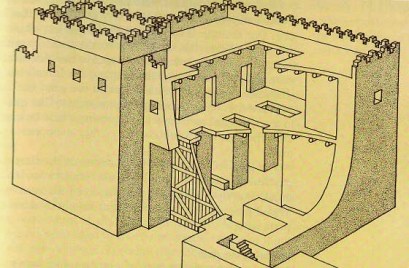
Reconstruction of the ancient gates at Gezer. Bathsheba would have passed through a gate like this to get to the palace.
The reconstruction of the gates at Gezer (at right) shows the sort of gates Bathsheba had to pass through. Note the compartments at the side of each gate. These provided shelter for guards on duty, and she and David’s messenger could not have passed through without the soldiers seeing them. The events of that night would have been known to many people.
But Uriah did not confront David with what he knew.
Instead, he took the line of passive resistance. He told David he would not break the rules of soldiers on active service – ancient people believed that sexual intercourse robbed a man of some of his physical strength, so during active service soldiers were required to abstain from sexual intercourse.
Uriah would not visit his wife and have intercourse with her, since he was still technically on active service.
David Murders Bathsheba’s Husband Uriah
Despite every inducement, Uriah stuck to this line of behavior, and David found himself backed into a corner.
Enraged, he secretly ordered that Uriah be killed in battle. He gave Uriah a sealed letter addressed to Uriah’s commander, ordering him to arrange Uriah’s death.
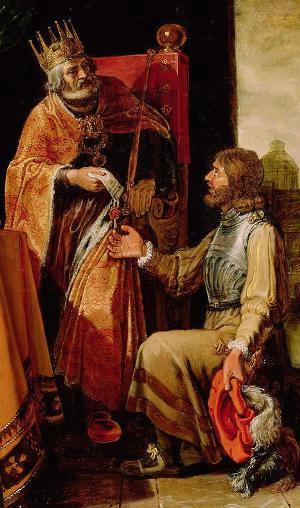
David gives the letter to Uriah,
Pieter Lastman
When, soon after Uriah had returned to the army and delivered the letter, he was sent into battle to storm the walls of a city. Following David’s instructions, the soldiers around Uriah pulled back and left him alone, so that he was surrounded by the enemy and cut down.
‘When the wife of Uriah heard that her husband was dead, she made lamentation for him.’
- Did Bathsheba know that David had arranged to have her husband killed?
- Did she mourn for the death of a good man?
- Or was her mourning just pretence? It is impossible to tell.
So what’s the truth?
The story of Bathsheba’s seduction as we have it in the Bible was edited by court story-tellers during the reign of her son Solomon, and doubtless influenced by Bathsheba and her son.
This is why it is so hard to tell what really happened. We only know two things: what Bathsheba wanted us to know, and what she was forced to acknowledge because it was already public knowledge.
With Uriah now dead, David married Bathsheba and she went to live in the harem of the palace – a relatively small harem, since Israel at the time was only an emerging power.
The baby she was expecting died soon after birth, but she had a second son.
She named him Solomon, ‘his replacement’ – a replacement for the baby who died, or for her murdered husband? The choice of name is ambiguous.
Read 2 Samuel 11:14-27, 12:15-25
The Struggle for the Throne (1 Kings 1:37, 2:10-25)
Years passed, and Bathsheba and King David grew older. We hear nothing about Bathsheba’s life during these long years, and know only that she lived in the royal harem and produced a number of children to David.
Eventually, concerns arose about the king’s continuing virility – in ancient Middle Eastern societies the sexual potency of the king was closely linked with the state of the nation.
If the king was no longer able to have sexual relations, it was a bad omen for the well-being of the country.
‘So they searched for a beautiful girl throughout all the territory of Israel, and found Abishag the Shunammite, and brought her to the king. The girl was very beautiful.’
Read 1 Kings 1:1-37
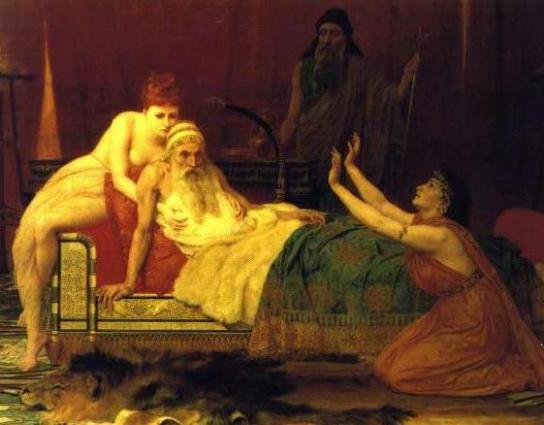
Bathsheba begs the dying David to name Solomon his heir,
from a painting by Goodall
When, despite her beauty, the king could not have sexual relations with Abishag, it was considered time for a co-regency. This meant that someone would rule alongside David, to help him.
Most people took it for granted that this co-regent would be the next king. David’s oldest surviving son was Adonijah, a young man impatient for power. Not waiting for David to die, he proclaimed himself king and was accepted as such by many people.
The text implies this was done without David’s knowledge. It was a palace coup.
Bathsheba and Solomon did not support him, because if Adonijah became king they would almost certainly be killed. Solomon must also have been seen as a contender for the throne, and in this particular grab for power, the loser would die.
But Bathsheba was not going to give in without a struggle.
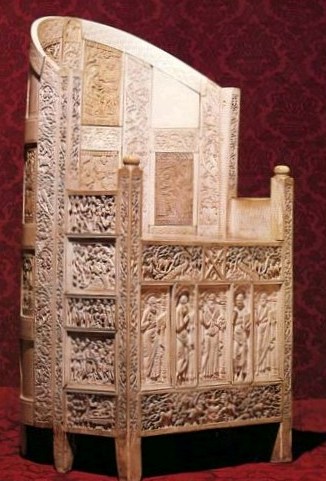
A throne covered with ivory plaques
‘So Bathsheba went to the king in his room. She bowed and did obeisance to the king, and the king said “What do you wish?” She said to him “My lord, you swore to your servant by the Lord your God, saying: Your son Solomon shall succeed me as king, and he shall sit on my throne. But now suddenly Adonijah has become king, though you, my lord the king, do not know it”‘
Read 1 Kings 1:15-40.
Working with her chief adviser Nathan, Bathsheba warned David what was happening behind his back. In a brilliant speech,
- she made him suspicious of Adonijah by describing the young man’s support among the army
- she told him that almost alone among his children, Solomon remained loyal.
- she appealed to his protective nature by telling him she feared for her own life and
- she astutely reminded David that he, not Adonijah, was king.
David names Solomon as king
David roused himself from senility and swore to her that her son Solomon would rule as king. He ordered this to be announced to all the people.
With the authority of a royal command and the backing of David’s well-disciplined mercenary troops, Bathsheba outmanoeuvred Adonijah in his attempted coup d’etat and secured the throne for her own son.
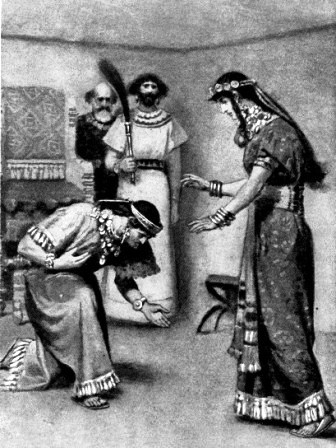
Adonijah begs for Bathsheba’s help
After David’s death Solomon became king and Bathsheba accepted the title of Queen Mother – the most powerful position a woman could hold and the first woman in the history of Israel to hold this title.
Solomon’s hold on the throne was not initially strong enough for him to kill his half-brother outright, though this would have to be done if Solomon was to have a firm grasp on power.
So after he ascended the throne, Solomon allowed his half-brother Adonijah to live – for the time being.
But the situation had to be resolved, and no-one knew this better than Bathsheba. The text at this stage contains an episode that is, at the very least, hard to believe.
According to the Bible, Adonijah approached Bathsheba with an odd request: to help him get Abishag as his wife.
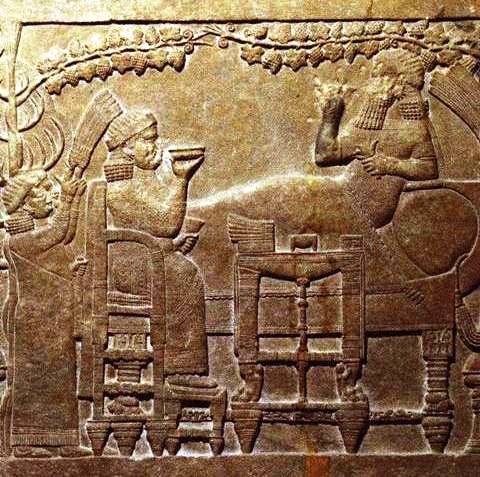
On the surface, this seems a harmless thing to ask. But Abishag was considered one of David’s wives, and marriage to a widow of the previous king was a way of making a claim on the throne.
It is very, very hard to believe Adonijah would have made such a request, to Bathsheba of all people. She knew only too well that Adonijah was very dangerous and could never marry Abishag.
The whole episode seems to be an invented pretext to execute Adonijah. Solomon may have been reluctant to do this (or have wished to appear so) and it may have taken a public accusation of treason, made by Bathsheba, to give him a reason for killing his half-brother.
‘So Bathsheba went to King Solomon, to speak to him on behalf of Adonijah. He rose to meet her, and bowed down to her; then he sat on his throne, and had a throne brought for the king’s mother, and she sat on his right.’
Read 1 Kings 2:10-25.
Prodded into action by his mother, Solomon snuffed out the threat posed by his half-brother by ordering his death. There was no trial, just a swift execution.
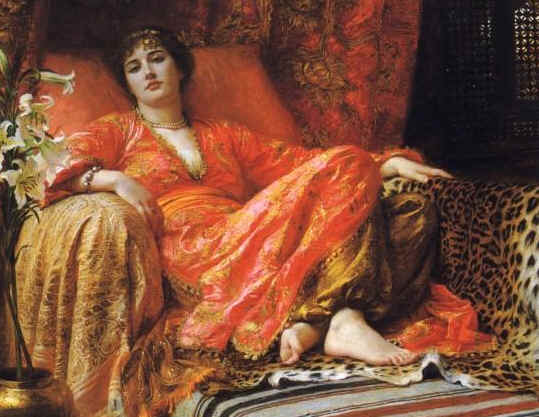
This is the last we hear of Bathsheba. Her son was secure on the throne and her own position was safe. She could rest on her laurels.
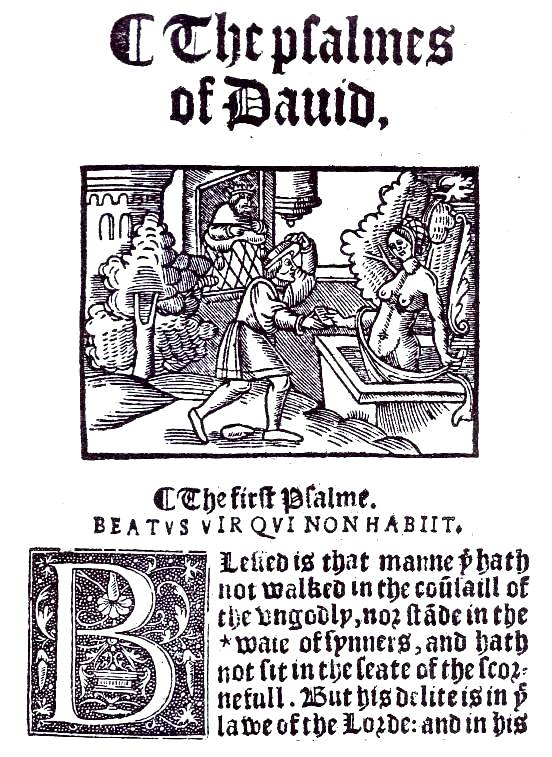
Bathsheba, David. Illustration from one of the first English translations of the Bible. Bathsheba rises from her bath.
(Above) Illustration from one of the first English translations of the Bible. This picture appears at the beginning of the Book of Psalms, attributed to King David. It shows David’s invitation being delivered by a servant to Bathsheba, rising naked from her bath. Notice that ‘King David’ bears a striking resemblance to King Henry VIII as he appeared at the time of the Bible’s publication. Cheeky…
What are the main ideas in Bathsheba’s story?
- The legitimacy of King Solomon. Solomon was not the eldest son of his father King David, and had not been elected by popular acclaim. He had taken the throne by force and by political intrigue, and had executed his older brother Adonijah. It was therefore necessary to provide a story that justified his being king.
- The virtue of King Solomon and his mother Bathsheba. Their stories are part of the royal chronicles of Israel, and show Bathsheba as capable, ambitious, and gifted. She produced a son, Solomon, noted for his wisdom and intellectual brilliance. Her son presided over a court famous for its literature, culture, wealth, architectural achievements, and consolidation of Judah-Israel as a nation-state.
- Bathsheba has special significance for Christians. In the gospel of Matthew, four women are included in the genealogy of Jesus (Matthew 1:2-17). Bathsheba is the fourth of these women
Name meanings in Bathsheba’s story
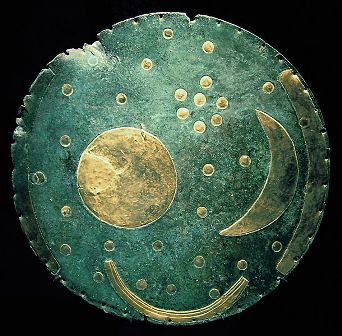
The Nebra Disk
Bathsheba: Bat ‘daughter of’, sheba ‘abundance’. The Book of Chronicles changed her name to Bathshua, since ‘sheba‘ might link her with the sibitti, the Seven Demons of Babylonian mythology, or with the constellation of the Seven Sisters, the Pleiades, shown on the Nebra Disk at right.
The disk (1,600BC) shows the Pleiades stars, whose position at a certain time of year meant it was time to harvest. In changing her name to Bathshua, the writer of Chronicles tried to distance Bathsheba from worship of agricultural gods.
Solomon, Hebrew ‘shelomoh‘, means ‘his replacement’, perhaps referring to Bathsheba’s first baby who died soon after birth.
Uriah, Bathsheba’s first husband, means ‘Yahweh is my light’.
David means ‘beloved’.
Abishag, a beautiful girl, tried to restore David’s sexual vigour. See Abishag: Youtube.
Bible Study Resource for Women in the Bible: Women of the Old Testament
Bathsheba, wife of King David and mother of King Solomon
Bathsheba links












‘The throne room in Solomon’s palace was probably similar, in size if not in decoration, to the throne room at Knossos’.
King Solomon’s Palace