
Judith: sex, courage, murder
 Who was Judith in the Bible? Judith was a beautiful, clever, cool-witted widow in the ancient town of Bethuliah.
She was brave as a lion. When her town was besieged and death stared them all in the face, Judith hatched a plan to save herself and the townspeople. She coolly seduced, then murdered the enemy general Holofernes and hung his severed head on the city walls. Seeing it, the enemy soldiers were thrown into a panic and fled.
Bethuliah was saved. Judith was a heroine.
Judith’s story has four parts:
- Nebuchadnezzar’s War (1-7:32) There is a Persian invasion of Israel. Led by Holofernes, the Persians besiege the hilltop town of Bethulia – where Judith lives. The townspeople beg their leaders to surrender. Playing for time, the leading citizen Uzziah asks God for a further five days. If God does not save them, they will surrender.
- Judith and the Elders (8:1-9.14) The beautiful and respected Judith, a wealthy widow of Bethulia, confronts the town leaders. Their plan, she says, is not the right course of action. She has her own secret plan, which she begins to put into action: she grooms herself so that she is alluringly beautiful, then leaves the city during the night.
- Judith and Holofernes. Judith meets Holofernes, who is bowled over by her beauty. He plans to seduce her, but she turns the tables on him. After a lavish dinner, she waits until he is drunk, then she kills him by hacking off his head.
- Aftermath, and the Song of Judith. She and her faithful maid wrap up the head of Holofernes and take it back to Bethulia. Then they hang it on the outer walls of the town. When the enemy troops see it they panic, and are easy prey for the Israelite troops. Judith has saved her people, and is hailed as a national heroine.
Youtube video of a 1914 B/W movie of Judith – you should have a look at this!! Hollywood certainly took liberties with the story!!
Nebuchadnezzar takes revenge
There is a war between two ancient kings, Nebuchadnezzar and Arphaxad – see Bad Men in the Bible: Nebuchadnezzar for information about Babylon and its king.
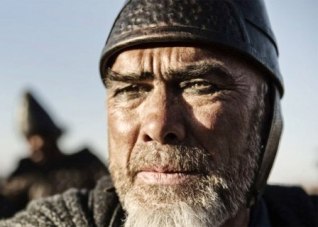 At the start of this war Nebuchadnezzar orders all the city states in surrounding kingdoms to send him a levy of soldiers, but they flout his command. Eventually, without their support, he wins the war, and when it is over he decides to take his revenge, to teach them a lesson in respect.
He summons the leader of his army, Holofernes, and orders him to lead a vast army against those states who have ignored his original command. Holofernes sets out, burning, murdering and plundering as he goes. All those who will not submit to Nebuchadnezzar are destroyed.
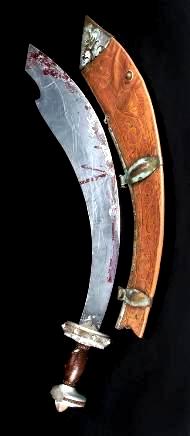
Blood-stained sword with its sheath
Eventually he comes to the sea coast near Sidon and Tyre, and the people there send messengers, suing for peace. Holofernes spares them, but destroys all their sacred temples and shrines: they must henceforth worship Nebuchadnezzar alone.
The Israelites tremble
The Israelites living in Judea know that their turn is coming. They are distraught, since they have only recently returned from exile in Babylon and rebuilt their Temple, which Nebuchadnezzar will of course destroy if he captures the city.
They devise a plan: they will retreat to the hill-tops, fortify and provision them, and wait it out. Hilltop towns in Judea guarded the roads below and had to be taken by any invader who wanted to secure the transport routes.
The High Priest Joakim writes to the Israelites, among them the people of Judith’s home town Bethulia (a curious name, similar to the Hebrew word for ‘young unmarried woman’). He orders them to pray for deliverance, and this they do most fervently, fasting and wearing sackcloth and even draping the altar with sackcloth.
They know only too well that Bethulia guards the route to Jerusalem, and that if their town is overrun Jerusalem and its Temple will be sacked and destroyed.
The Bible says that at the siege of Jerusalem Sennacherib’s officer, taunting the Jews who stood on the city wall, assured them that they were doomed to ‘eat their own faeces and drink their own piss’ (2 Kings 18:27). Unpleasant yes, but this does seem mild compared with the fate described in inscriptions at Nineveh.
Holofernes is told that the mountain passes have been closed and the hilltop villages fortified. He is outraged and calls a meeting of all the princes of the Moabite and Ammonite city states. Who are these hilltop ragamuffins to flout him? He is, after all, Nebuchadnezzar’s top general.
Achior begs for mercy for the Israelites
One of the princes, Achior of the Ammonites, steps forward and tells him about the Israelites – their origins and history, including the stories of their flight from Egypt and exile in Babylon. He praises them as a people, and begs Holofernes to pass them by without harming them.

Wolf with bared teeth
Holofernes does not respond well to this plea. He reasons that sheer strength of numbers will guarantee him success in any battle, and that the Israelites settlements will be easy prey: ‘we the king’s servants will destroy them as one man. We will overwhelm them; their mountains will be drunk with their blood, and their fields will be full of their dead. Not even their footprints will survive our attack; they will utterly perish.’
He is not pleased with Achior either: if Achior likes these Israelites so much, he might as well join them, and die with them. Achior is seized, taken to Bethulia and left, tied up, outside the walls of the town.
The townspeople retrieve him and take him inside the walls of Bethulia where Uzziah, the chief magistrate of the town, pumps him for information. Achior tells him about Holofernes and his intentions, and the grateful townspeople reassure him and make him welcome.
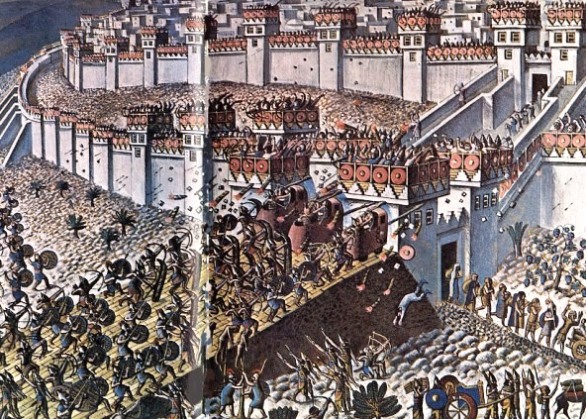
In a siege, the attackers built a causeway of rammed earth and rubble, strengthened with wood. These earthen bridges filled any obstacle, such as moats, so that the attackers could traverse the gap and apply scaling ladders and battering rams to the walls.
Holofernes prepares to attack
Holofernes then musters his entire army. The figures given, 170,000 infantry and 12,000 cavalry are surely an exaggeration, but they indicate that the mountain town is vastly outnumbered.
On the other hand the walls of Bethulia are strong, and so there is, for the moment, stalemate. Holofernes decides that the best tactic is to lay siege to the town.
For thirty-four days the people of Bethulia hold out, until every water container in the town is dry and even the underground cisterns are almost empty.
The children are listless and the people begin fainting, collapsing in the streets. They blame Uzziah for not submitting to Holofernes in the first place, and saving them from death.
True, they would have had to abandon worship of Jahweh and pray to Nebuchadnezzar instead, but this now seems preferable to death by thirst.
They urge Uzziah to surrender the town to Holofernes. It will mean slavery for them, but at least they will be spared from seeing their children die of thirst.
Uzziah urges them to hold out for five more days. If God has not saved them by then, he promises the town will be surrendered.
Beautiful Judith enters the scene
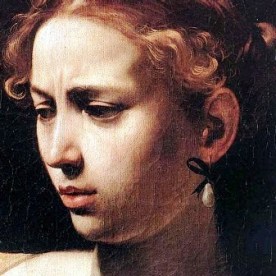
Caravaggio’s image of Judith
(Paintings of Judith concentrate on the moment, later in the story, when she kills Holofernes in the dimly lit tent. But in my opinion the most important part of the story lies here, where she talks about the nature of God: what God is and is not.)
At this stage in the story Judith of Bethulia makes her entrance. She is a woman of impeccable background and character, and a great beauty.
She is also a widow – this is important to the story, because she must be highly moral but also sexually experienced. Her husband has died three years previously of sunstroke, but has left her financially independent.
Despite her wealth, she lives a simple, almost Spartan life in a shelter on the rooftop of her house, fasting and praying most of the time.

Open air rooftop room, common at the time in the Middle East
Judith is of course aware of what is going on around her in the town of Bethulia. Her maid seems to have been a consummate gossip, and through her Judith learns of Uzziah’s promise to surrender the town after five days if God has not saved it.
She sends for the elders, including Uzziah, and when they come to her in her rooftop room she remonstrates with them.
Judith prays to God
What follows is one of the great statements about what God is and is not (8:12-17). God is not a human being to be bargained with, or put to the test, nor can we ever hope to understand God’s mind.
We do not know what the person beside us is thinking, even if it is someone we love – just as they do not really know what we are thinking. How then can we expect to know what is in the mind of God?
See Bible Heroines: Judith for the words of this significant Bible passage.
Uzziah brushes off her advice. She is after all only a woman, so he tells her that the best thing she can do is pray, leaving decision-making to the men.
Judith, in turn, calmly brushes off his advice. She decides to act on her own initiative, telling Uzziah to meet her at the town gate so that she and her maid may leave the town that night.
But she does not tell them what she plans to do.

Judith’s prayer to God
When the men are gone, she prostrates herself on the ground and makes a prayer to God.
She describes the terrible things that have happened to women during war, and says she does not pretend to understand them, but accepts that they are somehow part of God’s ultimate design and plan.
Then she describes the present predicament of the townspeople, helpless prey to the Assyrians.
She urges God to break their power by putting strength instead into the hands of a widow, herself. She audaciously asks God to make her a good liar – the only such prayer in the Bible.
It is important here to keep in mind that deceit was a recognized and admired strategy in ancient warfare.
Seduction, murder in the Bible
When she has finished her prayer she rises from the ground and calls her maid. Together they begin to prepare to carry out the plan.

Richly woven fabric
- She bathes her whole body – a terrible waste of precious water in the besieged town – then
- she perfumes herself
- dresses her hair with a tiara
- puts on one of the extravagant robes she wore when her husband was alive
- and decks herself with jewelry – anklets, bracelets, rings, earrings and other assorted pieces.
After that, she and her maid gather an assortment of ritually pure food and put it all in a large bag.
Thus prepared, they made their way through the darkness to the town gate, where Uzziah and the elders are waiting.
The town gates are opened, and she and her maid leave, heading down the valley towards the Assyrian camp.
Judith meets and charms Holofernes
Almost immediately she and her maid run into an Assyrian patrol, which challenges them. She tells the soldiers she is fleeing from the townspeople in Bethulia, and will give Holofernes secret information that will help him capture the town without losing a single soldier.
The soldiers are bowled over by her beauty, and escort her immediately to the tent of Holofernes. The general is resting on his luxurious bed, but he comes to the front of the tent and greets her.
Both of them then begin telling a sequence of lies –
- he starts off by saying that she has nothing to fear, since he has never hurt anyone who serves Nebuchadnezzar
- she responds by saying how much she admires Nebuchadnezzar and Holofernes, and how much she has heard about his wisdom and clever military strategies.
Beguiled, he tells her that he has never met a woman who is as beautiful in appearance and wise in speech as she is.
Judith the pious Jewess
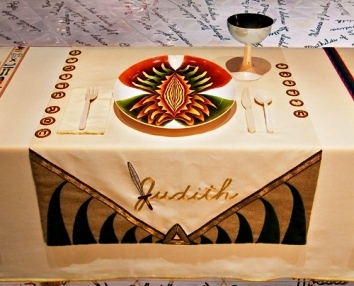
The Judith Table,
from Judy Chicago’s The Dinner Party
He then tells his servants to set out food for her and let her use his own silver dinnerware.
She delicately declines, pointing to the food she has brought, and the reader is thus aware that she is a pious Jew who will not eat ritually unclean food.
After eating, she sleeps until midnight, then, accompanied by a guard, she goes to the nearby spring to wash herself and pray.
During each of the three days she is in the camp she stayed in the tent during daylight hours, and ate her own food each evening.
On the fourth day, Holofernes invites her to an informal banquet in his tent.
As he observes to his servant, it would be a disgrace to let her go without seducing her. She dresses in all her finery and presents herself at his tent, where her maid has laid Judith’s sheepskin bedding on the ground in front of Holofernes.
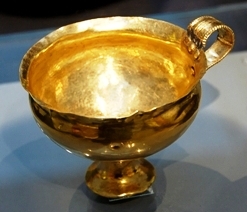
Gold drinking goblet
Seduction – then murder
When Judith comes into the tent and lies on the sheepskins, Holofernes is besotted. He offers her something to drink, but she drinks only the wine given to her by her maid – was it watered down so she could stay sober? Holofernes, on the other hand, gets down to some serious drinking.
Eventually the servants discreetly withdraw, and Judith is left alone in the tent with Holofernes, now dead drunk, stretched out on his bed. The moment has come for Judith to act.
But first she prays, asking God to give her strength for what she must do. She braces herself, then lifts down Holofernes’ gleaming sword, hanging in its sheath from the bedpost, and raises it high above her head.
She strikes once with all her strength, and then strikes again. With this, his head falls away from his body.
She then rolls the headless body off the bed and pulls down the luxurious bed curtains, bundling them up so they can be carried.
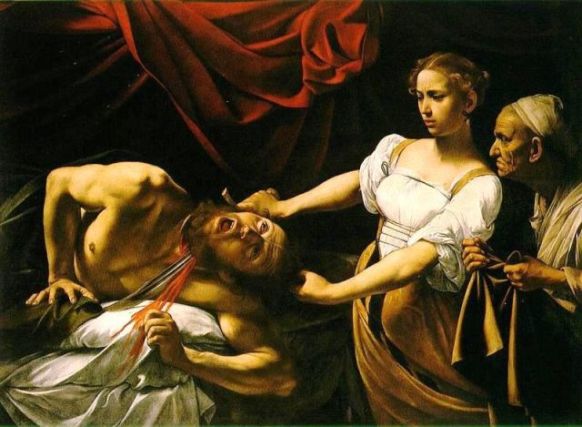
Caravaggio, ‘Judith Beheading Holofernes’, 1599.
Pausing for a moment to gather her strength, she picks up the twitching head and takes it out to her maid, who places it in the food bag.
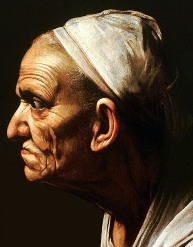
Judith’s faithful maid Abra holds the bag to receive the head of Holofernes, from the painting by Caravaggio
(This bloodthirsty incident has been popular with artists. See Bible Art: Judith for about thirty paintings of Judith by some of the world’s great painters.)
Judith makes her escape
Without arousing suspicion, the two of them pass through the camp as they have done on the previous nights, but instead of heading towards the spring they circle up the mountain towards Bethulia.
Once there, they call to the guards to open the gates and let them in. Inside the safety of the walls Judith pulls out the grisly contents of the bag and shows it to the people, who are astounded by what she has done.
A national heroine
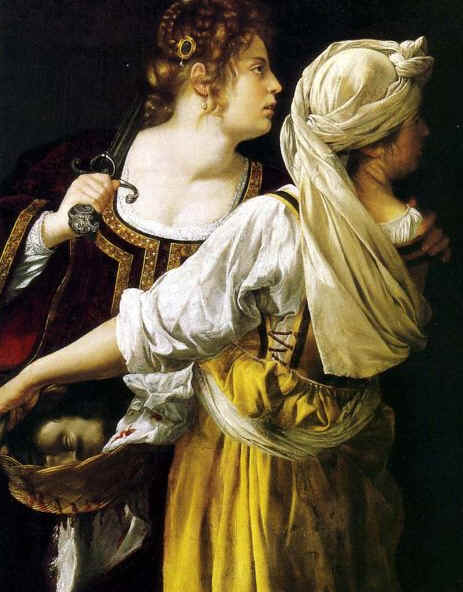
Artemisia Gentileschi, ‘Judith and her Maidservant with the head of Holofernest’, 1613-14
You would think this was enough for one night, but Judith knows the battle is not won. She tells the people to hang Holofernes’ head in full view on the battlements, then she gives them instructions for the next morning. At dawn they are to make a loud noise with their weapons as if they are about to attack.
She knows the Assyrians in the valley below will run to alert Holofernes.
Of course, they will find only his headless body and this, she hopes, will create a panic among the Assyrian soldiers, who will flee.
This is exactly what happens. In the ensuring hours the disordered Assyrian army is easy prey for the Israelites, who are familiar with the terrain and wage guerilla warfare on the hapless, leaderless soldiers.
Judith becomes a national heroine, lauded by everyone. Joakim, the high priest of Jerusalem, comes to Bethulia to pay homage to this extraordinary woman.
Judith and the grateful people celebrate
In the final scene of the story, Judith leads a dancing procession of women, singing a hymn of praise to God, towards Jerusalem. 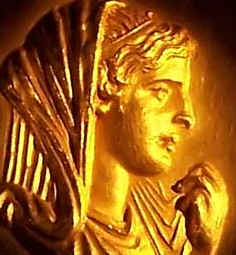 The lavish bed curtains from Holofernes’ tent are given as an offering in the Temple.
When they have all worshipped there for three months they return, and Judith retires to her estate in Bethulia. She lives there, still much loved, until she is very old – one hundred and five. The faithful maid is set free, and Judith is eventually buried in the tomb of her husband.
She never remarries.
Judith means ‘the Jewess’
Holofernes means ‘stinking in hell’ – no prize for guessing who’s the villain
Nebuchadnezzar means ‘may the god Nebu protect you and your possessions’
Uzziah means ‘the Lord is my strength’
Achior means ‘brother of light’
Main themes in Judith’s story
- The nature of God. In Chapter 8 Judith rebukes the town officials for trying to make God in their own image It’s a remarkable description of what God is and is not.
- Making the best of what you’ve got. Judith was not a soldier, but she killed a fearsome warrior of the ancient world. She did this by using the gifts she had: beauty, intelligence, and ruthless cunning.
- Ingenuity (and faith in God) are better than brute strength. Judith’s story is a variant on the David and Goliath story, where a seemingly weak person triumphs over a person of superior strength.
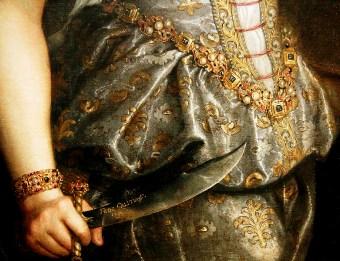
Judith and Holofernes,
detail of hand with knife, Galizia, 1596Judith is a symbol of the Jewish people, who relied on God’s help and their own abilities to overcome their enemies. They were surrounded throughout their history by huge and fearsome kingdoms, but God stood by them when they called on his help.
Note: The Book of Judith was never intended as factual history – it is more like fiction with a theological message. Many of the historical details are incorrect – for example, Nebuchadnezzar was a Babylonian, but the story presents him as ruler of the Assyrians.
Note: The Book of Judith is not included in the Protestant or Jewish Scriptures, perhaps because of its sexual content. Readers may have found its irony hard to swallow: Judith is a virtuous woman but also a murderess, and the basic message of her story is that the end justifies the means.

The ‘Judith’ plate, from The Dinner Party by Judy Chicago
Judith – Bible Woman – Women of the Old Testament; Bible Study Resource
Judith beheads Holofernes, saves her people
This page
Judith links


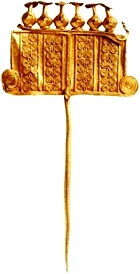
Ancient Jewels
The sort of jewelry
Judith might have worn
Movies
Make a list of movies about women who, like Judith, had to kill an enemy to save their people
Bible Art
Judith
20 famous paintings of
this bloodthirsty story