
Who was Rachel?
- Rachel met Jacob at the well. He fell passionately in love. Genesis 29:1-14
- Jacob was tricked into marrying Rachel’s older sister Leah. After seven years he married Rachel too. Genesis 29:15-30
- Rachel had a son, Joseph, Genesis 29:31-15, 30:1-24
- Rachel and Leah left their homeland with Jacob, Rachel stealing the sacred household shrine. Genesis 30:25-43, 31
- Rachel had a son, Benjamin, but she died giving birth to him. Genesis 35:16-30
The twelve sons of Jacob were the forefathers of the Twelve Tribes of Israel.
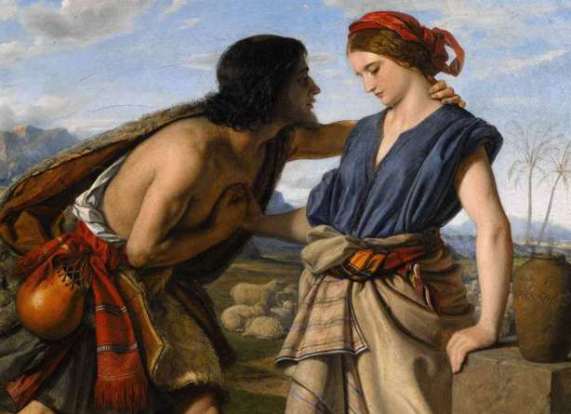
The Meeting of Jacob and Rachel, William Dyce
Boy meets girl: Rachel & Jacob at the well
Every afternoon, a young woman called Rachel watered her flock of sheep at a well near Haran, an outpost of the ancient city of Ur.
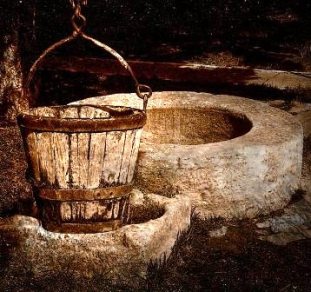
Stone well with wooden bucket
Wells were covered with a broad flat stone, too large for one man to move. So the shepherds who gathered there waited until there was a group to move it.
On this particular afternoon, a young traveller called Jacob was there too. He chatted with the shepherds, telling them that his family had originally come from this area. They pointed towards a woman in the distance, saying she was the daughter of his mother’s brother.
While they waited for her to arrive, Jacob rather tactlessly commented that it is too early in the day to fold the sheep, a not-very-subtle way of telling them they were slacking at their job.
Why is this detail about Jacob in the story?
It is a signal to the reader that Jacob had already developed the work ethic. He did not need a master to tell him what should be done, so he would be a good provider for any woman who chose him.

Cascade
The text suggests that Rachel may have heard this interchange between Jacob and the shepherds, and been favorably impressed.
Jacob falls in love
When Jacob saw Rachel at close quarters, he was smitten. In an act of bravado, he removed the great stone single-handed, hoping to impress the young woman. He was successful.
‘Now when Jacob saw Rachel, the daughter of his mother’s brother Laban … he went up and rolled the stone from the well’s mouth, and watered the flock of his mother’s brother Laban. Then Jacob kissed Rachel, and wept aloud.’
Jacob had made a long and arduous journey of about five hundred miles, and now found himself at journey’s end, with the woman of his dreams. He was in the right place, with the right person, and his emotions spilled over.
How does Rachel respond to Jacob?
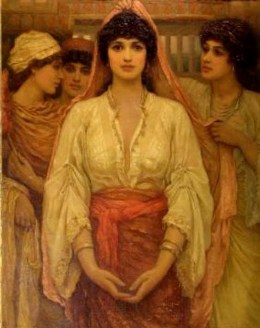
The Bride, Edward Goodall
In response, Rachel ran to her father’s house and told him about the young man. Her father, Laban, ran out to meet Jacob, welcoming him warmly.
The text keeps repeating that Jacob is the son of Laban’s sister: in many ancient societies, the relationship between a child and its mother’s brother, the maternal uncle, was considered even more important that between a child and its father. This makes Laban’s later betrayal of Jacob even more repugnant.
Jacob stayed with Rachel’s family for a month, and during this time he fell deeply in love with Rachel.
Read Genesis 29:1-14
Leah and Rachel marry Jacob
Rachel and Jacob were in love, so Jacob approached Laban for permission to marry her.
Money was involved in a marriage. A Jewish family tried to provide each daughter with a dowry, which was property handed over by her family and afterwards owned by the wife. It was her share of the family inheritance, enough to act as an income for her should she be abandoned or widowed.
A prospective bridegroom was expected to give financial compensation to the family of the bride, to make up for the loss of their daughter. (You can read more about this at Money and Marriage.)
But Jacob had come empty-handed, and could not produce the normal bride-price for Rachel.
So Laban agreed that his daughter might marry Jacob but stipulated that, as a bride price, Jacob must contract to work for him for seven years (the seven year cycle was a sacred one in the ancient world).
Jacob agreed, and he and Rachel settled down to wait. He loved her so much, the story tells us, that the seven years seemed only like a few days.
Here’s where the story gets sticky
What neither of them realized was that Laban had agreed to let ‘his daughter’ marry Jacob, but had not specified which daughter it would be.
Rachel had an older sister Leah, not so beautiful (see her story at Leah, mother of many sons) and Laban had quietly pointed out that the older sister in a family was usually married before her younger sister.
Neither of the young lovers had understood the implications of this statement.
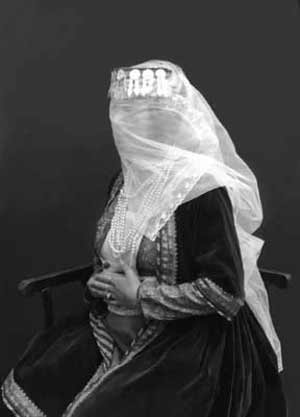
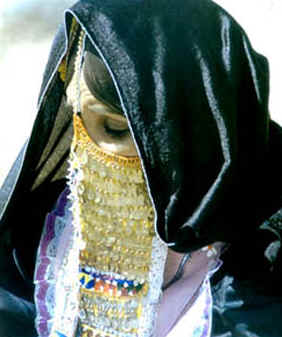
Veiled woman
When the seven years were over Jacob demanded his bride, and Laban prepared a wedding feast – though the Hebrew words suggest it was more of a drinking banquet.
The bride was dressed in the finest clothes, including a rich head-dress and veil that covered her face.
When the feasting was over her father led her, still veiled, into the room of her bridegroom, and the bride and Jacob made love. By this time, Jacob may have had a considerable amount to drink.
What Jacob didn’t realize until the morning dawned was that the bride in his bed was not Rachel, but Leah. He had been tricked into marrying the wrong sister.
Jacob the trickster is tricked
Jacob, who had with the help of his mother outwitted his brother Esau, was now outwitted by someone even wilier than himself. Moreover, he had been fooled with the same trick:
- he had pretended to be his brother Esau
- and now he was fooled when Leah pretended to be her sister Rachel.
Who says the Bible has no sense of humour?
Jacob’s marriage starts badly
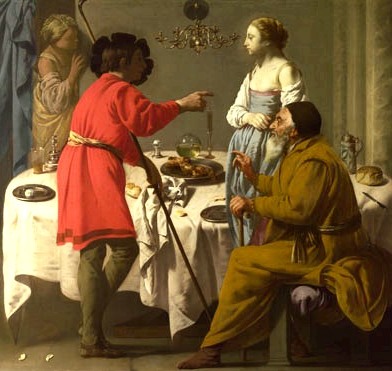
Jacob reproaches Laban, Brugghen
It was a terrible start to their marriage: his new wife Leah had colluded with her father to deceive him. This soured their relationship from the start.
Where Rachel had been while all this was happening, we are not told, but it is hardly likely she willingly agreed to go along with her father’s plan.
The furious Jacob confronted Laban. ‘What is this you have done to me? Did I not serve with you for Rachel? Why then have you deceived me?’
Too late to go back
But there was not much that could be done. During the night he had taken Leah’s virginity, and in tribal society this meant she was his wife, like it or not.
But he never forgave her for what she had done – she is usually described as ‘unloved’ in the English translation of the story, but the original Hebrew word is better translated as ‘hated’.
The upside was that polygamy was acceptable, and Jacob now insisted that Rachel become his wife as well.
Agreed, said Laban, but you must work another seven years for her. Jacob had no choice, and had to accept Laban’s bargain. So after the ceremonial week of the wedding to Leah was over, Rachel married Jacob, becoming his second but most-loved wife.
Read Genesis 29:15-30
Rachel has a son, Joseph
Rachel may have been the more loved of the two women, but she was not the most fertile. Though she and Jacob were deeply in love, she did not conceive for many years.
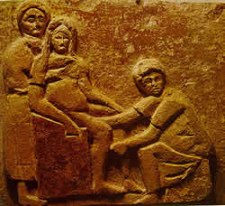
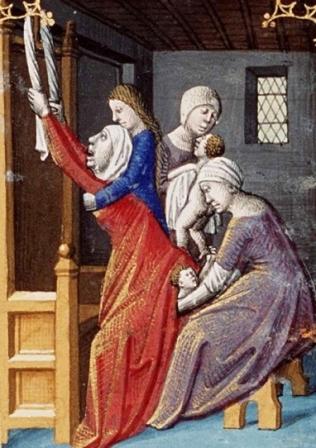
In primitive times, women hunched themselves over a hole in the ground, standing on bricks or stones placed at either side. They gave birth in a squatting position, with relatives and friends taking turns to support them.
Childbirth in ancient times
Leah on the other hand had no problem in bearing children. Almost immediately after marrying Jacob and despite the fact she was ‘unloved’, she became pregnant and gave birth to a series of male babies.
This was important for her, since a woman’s status depended to a large extent on the number of male children she produced.
This may seem sexist to modern eyes, but it was practical at the time. In nomadic society there was no-one to enforce the law, no police, no protection from outsiders, and a woman was better off if she had a number of males to defend her – the more the better.
Leah’s own story is filled with pathos. She bore Reuben, then Simeon, then Levi, then Judah. Each time she had another son she prayed that Jacob would finally love her. He did not.
Her pitiful words emphasize her isolation and longing for love, love she would never receive, no matter how many sons she gave Jacob. He would never trust her, and Rachel was still the one he loved.
Many sons, but none for Rachel
Rachel faced a different problem. No matter how she prayed to God, no matter how much she was loved by Jacob, Rachel did not conceive.
In desperation she gave her maid Bilhah to Jacob, so that he could conceive a child with Bilhah as a surrogate mother for Rachel. This practice was common in the ancient world; the woman became a concubine instead of a servant, and it was a step up the social ladder for her. She might become the mother of the future tribal leader.
Bilhah had a son, whom Rachel named Dan. Then she had a second son, and Rachel called him Naphtali. In response, Leah gave her own maid Zilpah to Jacob, and this resulted in yet more sons: Gad and Asher.
A bitter rivalry grew up between the two women.
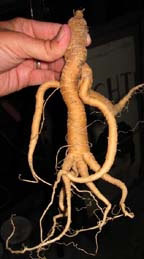
A mandrake root
One day, Leah’s son Reuben found some mandrake roots in the fields. Mandrake roots were a popular aphrodisiac in the ancient world, probably because they looked like the sexual organs of a well-endowed man. Reuben took the mandrakes to his mother, and when Rachel saw them she asked Leah if she could have some of them.
Leah agreed, on condition that Rachel commanded Jacob to have sexual intercourse with Leah that night. Rachel complied, and this resulted in a fifth son for Leah. She called him Assachar. Later, another son arrived for Leah, whom she called Zebulun. Finally, she bore Jacob a daughter, Dinah (see Dinah’s tragic story).
Only then, at the end of this long wait, did Rachel finally become pregnant.
She conceived and bore a son and said, ‘God has taken away my reproach’; and she named him Joseph, saying ‘May the Lord add to me another son!’
Rachel and Leah flee with Jacob
The birth of Rachel’s son Joseph seemed to jolt her family into action. All of them decided to break away from Laban’s tribe and go out on their own.
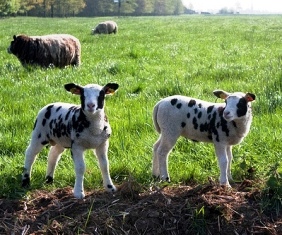
Speckled lambs
Jacob first asked Laban’s permission to leave and take a proportion of the flocks with him as his wages. A certain amount of haggling ensued and once again Laban tried to trick Jacob.
Because of the mutual suspicion between the two men and double-dealing on both sides, there could be no amicable resolution of the matter.
Jacob won the battle of wills because he was quick-witted and skilled in animal husbandry. He knew about cross-breeding techniques for his flocks and was able to develop a particular type of animal that Laban had previously agreed Jacob might keep.
Naturally, Laban and his sons resented Jacob’s success.
Rachel steals the sacred household icons
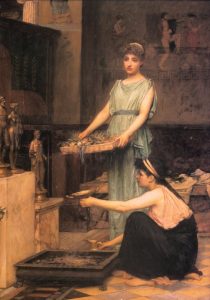
John William Waterhouse, The Household Gods.
At this stage, Jacob felt God calling him to return to his homeland. Rachel and Leah were also dissatisfied by the way things were panning out financially, and felt they are not getting what they were entitled to as Laban’s daughters.
It was time to go. They both urged Jacob to take action.
Read Genesis 30:25-43, 31:1-21
It seems that Rachel in particular was still angry at her father for what he had done to her. Before they set out, she took the small figurines that represented the spirits of ancestors and the protective deities of her father’s family (the teraphim), telling no-one at all what she was doing.
Why did Rachel steal the household gods?
This was not a random act of malice, for years ago on what should have been her wedding night, Laban had stolen Rachel’s happiness. Now she stole something that was precious to him – pay-back for a life-time of bullying.
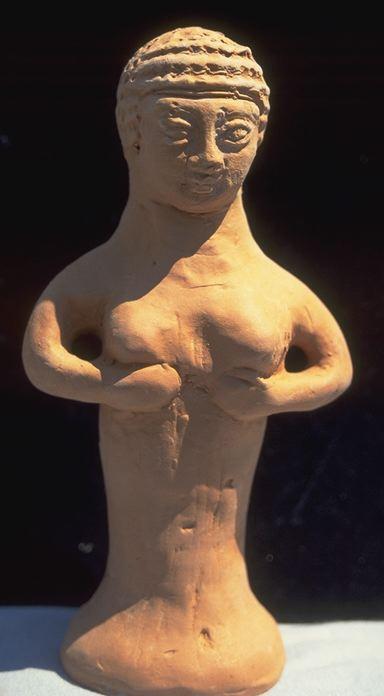
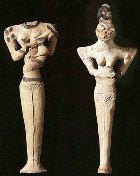
Ancient clay statuette of Asherah, possibly similar to the terephim stolen by Rachel
But her act had wider significance than this, because the teraphim were a form of title deed, and the person who possessed them could claim the tribe’s wealth. Ownership of the household deities was the prerogative of the head of the family, and by taking them Rachel secured this position for her husband.
The whole family group assembled, ready to return to the land of Jacob’s father, Isaac. They crossed the Euphrates and headed towards the hill country of Gilead.
But it was not going to be as easy as that. Laban pursued them, caught up with them, and confronted them. Where were the household gods? They were missing and Laban wanted them back.
This was news to Jacob. He did not know Rachel had taken them, since she had kept them hidden and had not told anyone what she had done.
Tempting God
Jacob then made one of those foolish pronouncements that give the reader a hint that something bad is coming: he indignantly denied knowledge of the theft, and said that whoever had done such a thing should die.
Laban searched the tents of Jacob, Leah, and the two maids to find the teraphim– each woman in a polygamous marriage had her own separate tent.
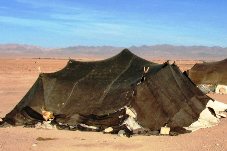
The front section of the tent was the public area, open to visitors. The men of the family lived there. The rear part of the tent was private. It was here that the women, children and babies lived and slept.
Laban found nothing. Then he went into Rachel’s tent, where the teraphim were hidden.
What he did not know was that Rachel had hidden them in the saddle-bags of her camel. She greeted her father respectfully but did not rise from where she was sitting. She explained demurely that she could not do so, since she was menstruating.
‘Let not my lord be angry that I cannot rise before you, for the way of women is upon me.’
Menstruation has its uses…
This meant that the cloth on which she was sitting was ritually unclean, and could not be touched by anyone. Most ancient tribes had customs that allowed menstruating women to withdraw from physical contact with the tribe while they had their periods, and women welcomed this time of rest from their usual tasks.
Rachel’s manner towards her father was so sweet and yielding that Laban did not argue or tell her to move, and the upshot was that he left her tent empty-handed. She had used the laws of ritual cleanliness to her own advantage.
The irony was that it was a lie. She was already pregnant with a son.
Since Laban could not find the teraphim, he had to back down. The two men made a face-saving covenant, and early the next morning Laban said good-bye to them all, and left.
Read Genesis 31:22-35
Rachel has a son, Benjamin, and dies
 When Laban was gone Rachel’s family moved on, and on the way to Ephrath she went into labor. This time things did not go well for her. The pains were very bad, and Rachel suffered terribly. To comfort her the midwife told her it would be a boy. It was, but Rachel would not live to see him grow. She died in childbirth.
Read Genesis 35:16-30
Earlier in the story, Rachel said she would die if she had no sons (Genesis 30:1).
In the end it was having sons that killed her.
People in Rachel’s story
 Rachel means ‘ewe’, a female sheep, a symbol of prosperity and security for nomadic people
Leah means ‘cow’
Jacob means ‘he who grabs’, either his brother’s heel at the moment of birth (see Rebecca) or his brother’s inheritance later on; the name also means ‘deceiver’
Laban means ‘white’; it was often linked with leprosy
Reuben means ‘look, a son!’
Joseph means ‘increaser’
Main themes of the story
- The foundation of the twelve tribes of Israel. They are united (they have a common origin) and separate (the descendents of Jacob’s twelve very different children)
- The consequences of sin – in this case, lying. Laban’s deception causes destructive rivalry – between two women, the beautiful Rachel and her plain sister Leah, and between two men, Jacob and his father-in-law Laban.
Bible Study Resource for Women in the Bible
Rachael – Rachel, her sister Leah, her husband Jacob, her sons Joseph and Benjamin
Rachel – links



Movies

Is it ever right to lie to someone for their own good?
Make a list of films that explore this question.
Looking for a mediation on
Rachel’s story?
Try WHY, GOD?