
Potiphar’s Wife cries ‘Rape!’
The story of Potiphar’s wife has 3 parts: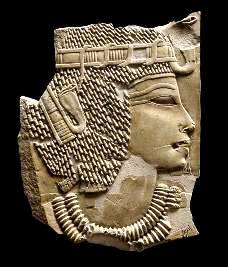
1 We are in the household of a rich Egyptian man, Potiphar. He owns many slaves. One of these is the Hebrew Joseph, who had been placed in control of Potiphar’s large estate and household. Potiphar’s wife has no children and does not seem to love her husband. In short, she has no purpose. Rich, bored and idle, she becomes infatuated with Joseph. Genesis 39:1-6
 2 She tries to seduce Joseph but he, sensibly, is having none of it. He refuses her advances and runs from the room. Genesis 39:7-12.
3 Furious, she takes her revenge by accusing him of attempted rape. Genesis 39:13-20
A Woman’s Slave
Joseph was the first son of the Hebrew heroine Rachel. He had every God-given advantage: he was handsome, intelligent, shrewd – a born leader. He also had God’s special favor.
But he was a slave. His owners could do what they wanted with him.
His master was a wealthy officer in Pharaoh’s service, Potiphar.
By dint of hard work and his own intelligence, Joseph rose through the ranks of the household slaves, eventually becoming overseer of  Potiphar’s household and estates. Under Joseph’s supervision, everything ran smoothly, and Potiphar was left free of responsibility, able to devote himself to his one great passion, food. The Bible says of Potiphar
‘…he had no concern for anything but the food that he ate.’
There is nothing wrong with enjoyment of food, but the implication of the text is that Potiphar had no interest in any of the other normal pleasures of life, including sex with his wife.
The Hebrew text uses the word ‘saris‘ to describe him. This can mean ‘courtier’, ‘someone who belongs to the king’, or ‘captain of the guard’, but elsewhere in the Old Testament ‘saris‘ is used to describe a eunuch. There may be a sly suggestion here that Potiphar’s sexual prowess was not all it could have been. Read Genesis 39:1-6.
 For a while, nothing happened. But during this period the third person in the story, Potiphar’s Egyptian wife, noticed Joseph. Since Joseph ran the household, she was in constant contact with him.
Read Genesis 39:7-12
What was she like?
She seems to have been a lonely, bored woman thrown into the company of an unusually handsome, attractive man, a Brad Pitt of the ancient world.
Potiphar’s wife realized that what she’d wanted out of life did not match up with what she’d got.
Potiphar’s Wife tries to seduce Joseph
In Israelite and Egyptian culture, a slave girl was automatically assumed to be sexually available to her master (see Exodus 21:9-11), as were boy slaves, though of course sex with boys was forbidden by the Israelite moral code.
See Slaves in the Bible for information about slavery in the ancient world.
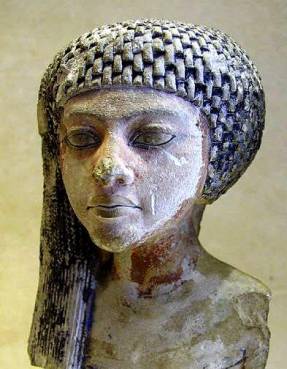
Ancient Egyptian statue
of an Amarna princess,
possibly Meritaten Tasherit
Potiphar’s wife seems to have decided that what was good for the gander was good for the goose – a male slave should be available to her if she wished, as a female slave was available to her husband. See Erotic Egyptian Love Songs.
But the biblical narrator does not share that idea: according to the Hebrew way of thinking, a woman was the exclusive sexual property of her husband.
The Egyptian wife did not sees things like this. Neglected as she was by her husband, she lost her head. She made some kind of sexual approach to Joseph, which the text rather baldly sums up as
‘Now Joseph was handsome and good-looking. And after a time his master’s wife cast her eyes on Joseph and said “Lie with me”.’
As far as the narrator was concerned, this was a straightforward attempt by a woman to use her sexual and social power to dominate a man, and as such it was definitely A Bad Thing.
Joseph was in a delicate situation. He had to either offend the wife or betray her husband. He judged that the former was less dangerous, and repulsed the woman.
The wife was now in the grip of uncontrollable infatuation. She again begged Joseph to respond to her desire with the urgent ‘Lie with me’, but he avoided all possible contact with her, as far as he was able.
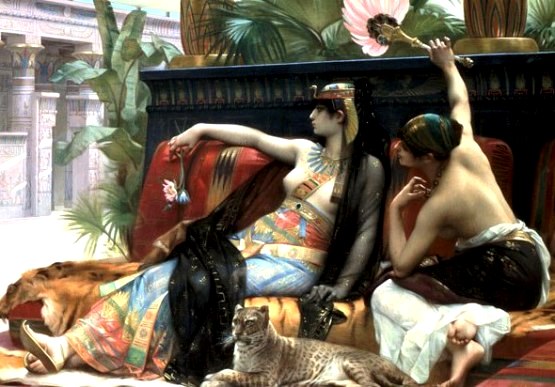
One day when they were alone in the house she again begged for his love. In the physical tussle that followed, she pulled off the linen kalasiris that was the normal clothing of an Egyptian man or woman.
Naked, Joseph ran out of the room and then out of the house altogether, leaving his kalasiris behind. Read Genesis 39:7-12
The Wife takes revenge
Read Genesis 39:13-20
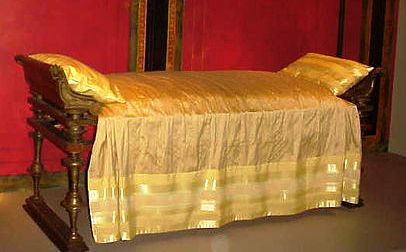
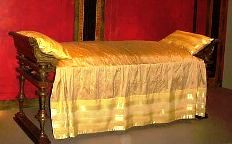
Reconstruction of an ancient, richly decorated bed
‘When she saw that he had left his garment in her hand and had fled outside, she called out to the members of her household and said to them “See, my husband has brought among us a Hebrew to insult us! He came in to me to lie with me, and I cried out with a loud voice; and when he heard me raise my voice and cry out, he left his garment beside me, and fled outside”.’
Suddenly, the passion she had felt for Joseph was transformed into hysterical rage. She had been humiliated by a slave, and she knew it. What was more, she knew that she had no-one to blame but herself.
In her escalating fury she lashed out at Joseph. She called out to the members of the household (but weren’t we just told there was no-one in the house?) that she has been attacked by Joseph, who had tried to rape her.
She held up Joseph’s loin-cloth to prove her point, suggesting that only her screams had prevented him abusing her.
Then she waited until her husband came into the house, and told him the same story, blaming him for bringing trouble to their house in the form of this foreign slave.
See Bible Art: Potiphar’s Wife‘ for illustrations of this scene – for example, Tintoretto’s painting. Potiphar’s naked wife is pulling the outer garment away from Joseph’s shoulders as he backs away from her. Where previous painters had shown Potiphar’s wife as merely en déshabillé, Tintoretto shows her as a voluptuous nude. Unlike Joseph, Tintoretto has let himself succumb to the sensuality of the story…’
Her husband was enraged – at Joseph? at her? The text leaves this question unanswered.
He too faced a dilemma:
- should he discredit and divorce his wife and retain a valuable servant, one who has made his life much more comfortable, or
- should he believe his wife, punish the servant and thus lose the comfort and order he valued more than anything?
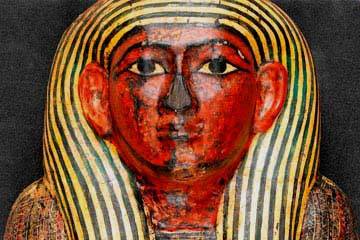 He (probably reluctantly) chose the latter course of action, impelled by the fact that the incident was now common knowledge and that he would, as a cuckold, become the object of ridicule. He charged Joseph with the attempted rape of his wife, and put him in prison.
This relatively lenient punishment suggests that his wife may have sought to fulfil her needs with other men before.
We hear no more of Potiphar’s wife.
Contrast Potiphar’s Wife with Ruth, one of the good women of the Bible, despite her foreign origins. The Book of Ruth was written at a time when ordinary Jewish families were trying to defend the foreign women who had married their sons during the Exile in Babylon. In contrast to the story of Potiphar’s Wife, foreign wives were presented as loyal and virtuous.
‘In the Joseph story, good things happen to bad people, bad things turn out to be good things by misadventure. It is no coincidence that just after the sale of Joseph into slavery, Judah enters into ambiguous sexual relations with a Canaanite daughter-in-law, Tamar.
This is a comment on events in Samuel, transposed into the Joseph story, but indirectly. In fact, these very stories may be the springboard for the Shakespearean world-view: scum at the bottom, scum at the top.’ (Quoted from David’s Secret Demons, Baruch Halpern, p.360)
Main themes of the story
- The decadence of Egypt. The sophisticated Egyptian culture always posed a danger to Israel.
 The Israelites led by Moses would eventually flee from it, just as in this story Joseph fled from an alluring Egyptian woman.
 - The contrast between Egypt and Israel. They had different ideals, different cultures, different practices. For an example, see the love poems from ancient Egypt. Contrast them with the love poems in the Song of Songs.
- Israel’s ability to resist. Though in an apparently vulnerable position, Joseph was able to resist the allure of a foreign woman and a foreign culture. Both tried to entice him, but he stayed true to the Israelite moral code.
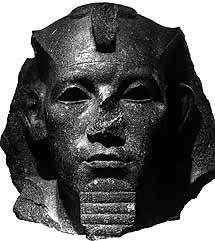
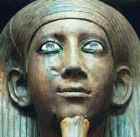
The story seems to be set during the Middle Kingdom, somewhere between 2030BC to 1640BC. Potiphar may have been ‘Ptahwer’, an officer of Pharaoh Ahmenemhet III (pictured at right).
Names in the story
Potiphar’s wife has no name. This is a way of making her seem less real. Her version of what happened is ignored by the story-teller, since it does not serve the narrator’s purpose. On the other hand, there is no doubt that she stands as a symbol of Egypt – decadent and cruel.
Potiphar or Potiphera is an Egyptian name meaning ‘he whom the god Ra has given’
Joseph means ‘God increases or adds to’
Read about more of the fascinating women of the Bible
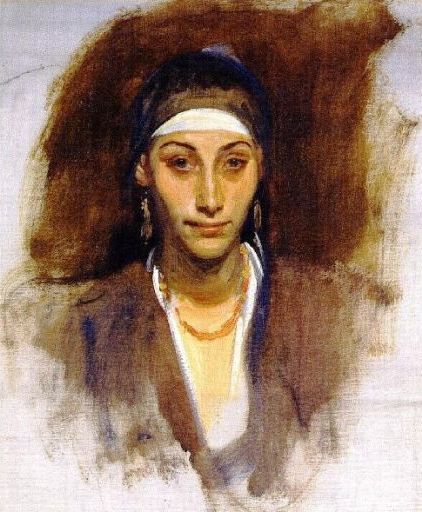
John Singer Sargant’s Egyptian Woman with Earrings
Bible Study Resource for Women in the Bible: Potiphar’s Wife
Seduction of Joseph; Potiphar’s Wife Cries Rape; Bible Study Resource
Potiphar’s wife, links





Movies

There are many popular movies about people like Joseph, who overcome adverse circumstances.
__________
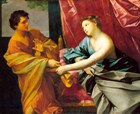


‘Potiphar had a beautiful wife, a woman used to getting her own way. She was lonely, bored and thrown into the company of an unusually handsome man, a Brad Pitt of the ancient world.’
Read more…