Who was Mary of Nazareth, Jesus’ mother?
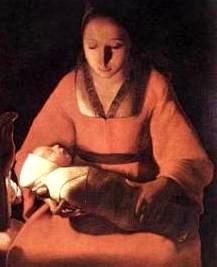
Mary with the infant Jesus, George de la Tour
- Who was Mary? She was a peasant woman living in first-century Galilee. If it weren’t for her son Jesus, she would have lived and died in obscurity – see The Real Mary of Nazareth.
- How do we know about her? From the stories of the New Testament – they tell us what she said and did. The trouble is, the four gospels give four quite different images of the woman called Mary.
- There is also quite another woman: Mary the Madonna, venerated in the Christian Church as the Mother of God and at some stages of history seen almost as a goddess.
What do we know about Mary?
- Mary was a Jewish peasant girl in a small village called Nazareth. Soon after puberty she became pregnant and married a young man called Joseph.
 She bore a son called Jesus.
- Her son was extraordinary. She watched as he taught and preached in the Galilean countryside.
- A good Jewish mother, she anguished as she saw him make powerful enemies.
- One Passover in Jerusalem her son was arrested for sedition, and crucified. She could do nothing to prevent it. Her emotions are unimaginable.
Mary in the four gospels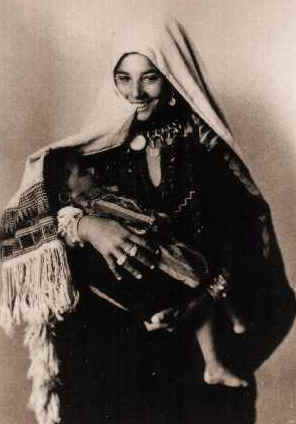
It’s frustrating, trying to find the real Mary in the four different accounts of Matthew, Mark, Luke and John.
But you have to keep in mind that they were writing about Jesus, not Mary. For them, she was unimportant. Jesus was the central figure.
So they only include stories about Mary when it throws light on the actions or words of Jesus
The result is that you can’t quite get a handle on who she was or what she really thought. But it’s all we’ve got, so we have to make the best of it.
Mary in Mark’s Gospel
There are two stories about Mary in Mark’s gospel, and they are rather shocking:
- Mark 3:31-35 the family of Jesus are worried about him, and go looking for him; he tells them his family is anyone who believes
- 6:1-6 Jesus is rejected at Nazareth; Mary is not mentioned by name, but she was almost certainly there.
In the first incident, Mary is a good Jewish mother at the centre of her family. She visits Jesus when he is preaching. She does not seem to understand what he is doing, or why. ‘A crowd was sitting around him, and they said to him “Your mother and your brothers and sisters are outside, asking for you”.’ Click here to read Mark 3:31-35
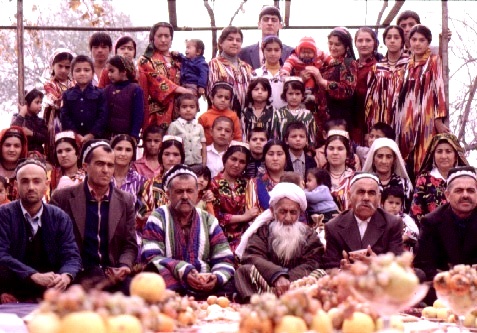
A large Middle Eastern family
Jesus’ answer is blunt. His family is no longer just his blood kin. It is anyone who believes in him.
You can’t help wondering what Mary thought of this…
In another story, Jesus returned to his home town, Nazareth. He had been living the life of an itinerant preacher. When he returned, he was at first greeted warmly, but then rejected and violently expelled from his own home town. Read Mark 6:1-6
The experience must have been shattering for Mary.
What are we to make of these two stories? They don’t fit in with the traditional image we have of Jesus, or of Mary either. But Mark’s image of Mary may be the closest to the historical Mary of Nazareth.
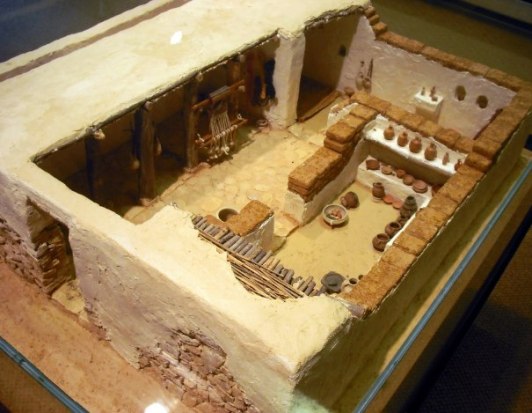
Layout of a middle-sized house in 1st century Nazareth
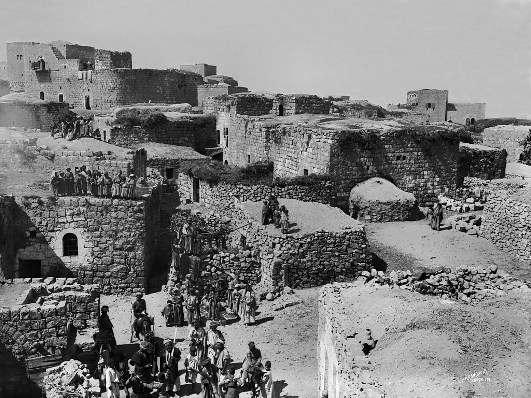
Nazareth at the time of Jesus may have looked something like
this 19th century photograph of a Middle Eastern village
Mary in Luke’s Gospel
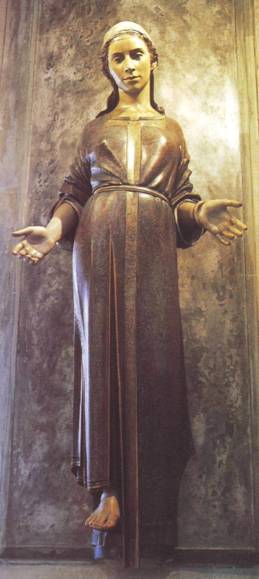
Madonna, by John Elliott, Cathedral of St Stephen
Luke’s gospel has all the stories we’re familiar with from Christmas celebrations. There’s:
- 1:26-38 the Annunciation
- 1:39-56 Mary visits her cousin Elizabeth
- 2:1-7 the birth of Mary’s son Jesus
- 2.21-38 Mary takes Jesus to the Temple
- 2.41-52 Mary and Joseph lose Jesus during a visit to Jerusalem
- 4.16-30 Jesus is rejected at Nazareth
- 8:19-21 the family of Jesus visit him during his ministry.
Mary & the Angel Gabriel
The gospels say that an ‘angel’ came to Mary (see what is an angel?), telling her that she was to be the mother of an extraordinary man, one who would be called the Son of God. This event was called the Annunciation.
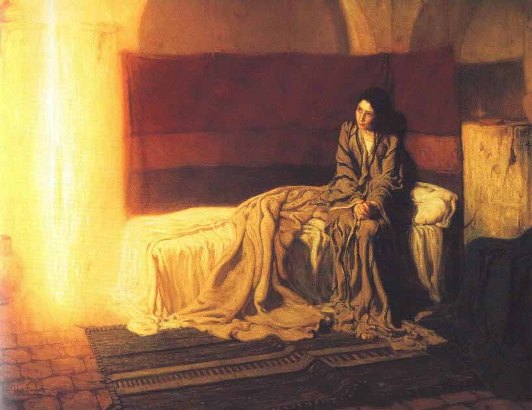
The Annunciation, by Henry Ossawa Tanner
What the gospel writer meant exactly when he used to word ‘angel’ we do not know. A modern writer might say that a profound conviction settled on the person, so profound that it seemed God-given. They knew they must do something special, that it was God’s will.
‘The angel said to her “Do not be afraid, Mary, for you have found favor with God. And now you will conceive in your womb and bear a son, and you will name him Jesus”.’ Read Luke 1-26-38
Mary became pregnant, even though she and Joseph had not had sexual intercourse.
Being an unmarried mother in that culture was very difficult, much more so than in today’s society. People were not seen as individuals as they are now, but members of their group/clan, and any action of an individual reflected on the whole group.
Mary’s family would have found it very hard to believe that there was no human father; her pregnancy brought dishonor to them all.
Why did Mary visit her cousin Elizabeth?
Soon after she became pregnant Mary went to visit an older cousin, Elizabeth.
Perhaps the visit was a way of getting her out of harm’s way. Honor killings are not a modern invention. An unmarried pregnant girl like Mary was in real danger from outraged relatives, and Elizabeth’s house may have been a safe haven for the young girl.
Read Luke 1:39-56
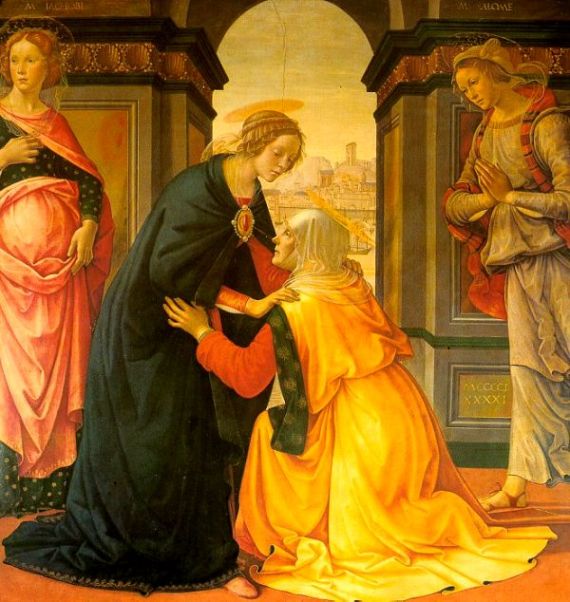
The Visitation, Ghirlandaio
When Mary and Elizabeth met, there was a moment of mutual recognition, where each woman realized that the child of the other would be a person of great importance. Mary spoke the words of a beautiful prayer, expressing her wonder at what had happened. The prayer is called the ‘Magnificat’.
Where was Jesus born?
Mary and Joseph had to attend a census-taking in Joseph’s ancestral town, Bethlehem, and Mary gave birth to her son there.
This census may or may not be an historical fact: possibly it was a device to situate them in Bethlehem, from which the Messiah was to come, for the birth of Jesus.
But note that Bethlehem is near Jerusalem, where Elizabeth’s husband was a priest of the Temple – and Mary had been staying in this house.
Read Luke 2:1-7
 In traditional pictures of the birth of Jesus, Mary and Joseph are the only family members present.
In fact, Mary would have been helped during the birth by a group of her female relatives. You can read about giving birth at Childbirth in the ancient world (preparing for the birth, midwives, the delivery, care of the newborn baby, and ancient forms of birth control).
All the stories about Jesus’ early life convey the idea that he was extraordinary. Their message is that Jesus was more than an inspired teacher and thinker. While he was fully human, he also came directly from God, and represented God in a unique way.
Luke injected this idea into his gospel by giving us the stories of Jesus’ birth.
The Presentation in the Temple
After the birth of Mary’s son, he was taken to the Temple in Jerusalem.
Read Luke 2:21-38
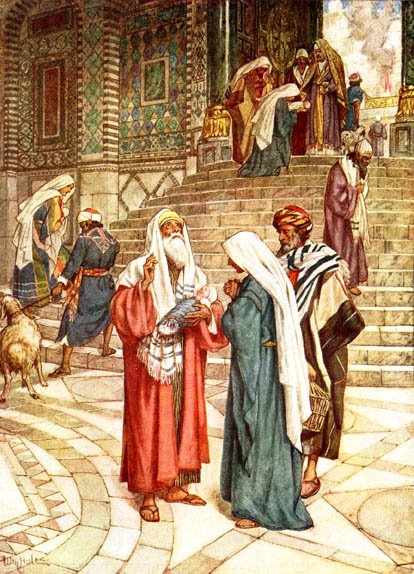
The Presentation in the Temple, by William Hole
The artist used authentic details, such as the fifteen semicircular steps leading from the Women’s Court into the Court of the Israelites, through the Nicanor Gate to the Court of the Priests and the Altar of Sacrifice – notice flames through the upper doorway.
A religious ceremony for the woman followed the birth of a Jewish child. This marked the end of the post-partum period, and the resumption of sexual relations between wife and husband.
As a devout Jewess, Mary observed the rituals surrounding the birth of a child (Leviticus 12).
During the ceremony in the Temple two people, Anna the prophetess and Simeon foretold an extraordinary future for Mary’s son.
After this, Mary and Joseph returned to the little town of Nazareth, where they lived with their family. During these years, Mary lived the normal life of a Galilean peasant woman.
As a traditional Jewish woman, she had the responsibility of giving her son his basic education. Jesus’ introduction to the richness of Jewish religious ideas came initially from his mother, with male teachers later teaching him about Torah.
Jesus, the Lost Boy
According to Luke’s gospel, Jesus was about twelve when he and his parents made a journey to Jerusalem. They travelled with a group of pilgrims to visit the great Temple and make sacrifices there. Read Luke 2:41-52
For a woman from a small town in far-off Galilee, Jerusalem would be confusing, noisy, full of strangers, but also exciting, with strange sights and new experiences.
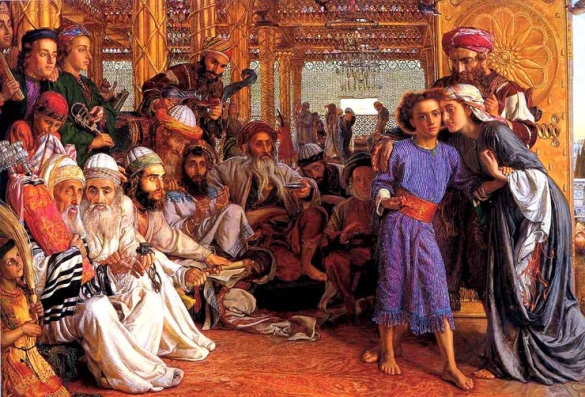
Think of an intelligent twelve-year-old in a provincial village. He frequently travels to Jerusalem because his parents are devout Jews. Each time they are in Jerusalem, the boy is taken to the Temple. He sees the academies there, set up to teach young men. He wishes he could join them. While his parents are busy elsewhere, he goes into one of the academies to listen. He finds himself drawn into the discussion. He is so absorbed in debate he does not notice his parents have left… Reconstruction: the lost boy in the Temple
On this particular visit, Mary’s son Jesus stayed behind when the other members of his family set out for home. His absence was not noticed for some time. See The Lost Boy
Life in Nazareth
Men and women spent the major part of their lives in groups of their own sex. As a boy who had just turned twelve, Jesus could have been with either group. As a child, he spent most of his life with the women’s group, but as a boy near adulthood, he could have been with the men’s group.
Mary and her family eventually found Jesus, and they all returned to Galilee. Mary continued her life as a normal Jewish/Galilean woman.
Now read Luke 4:16-30, where Jesus was rejected at Nazareth, and Luke 8:19-21, where the family of Jesus visited him during his ministry.
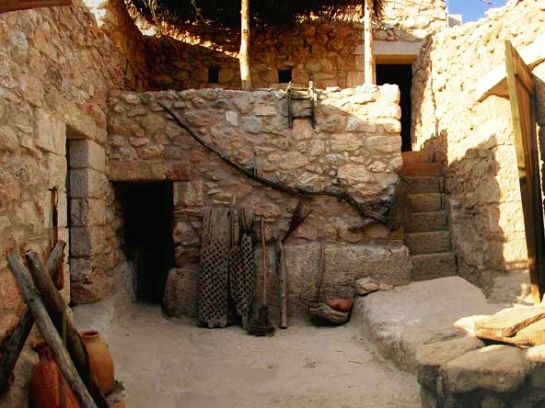
Reconstruction of a middle-sized house in 1st century AD Nazareth
Mary in Matthew’s Gospel
Matthew’s gospel contains several stories not found in the other gospels. In Matthew’s gospel, the references to Mary are:
- 1:18-25, the birth of Mary’s son Jesus
- 2:13-21, Mary, Joseph and Jesus flee to Egypt
- 12:46-50, the family of Jesus visit him during his ministry
- 13:53-58, Jesus is rejected at Nazareth
What about Joseph?
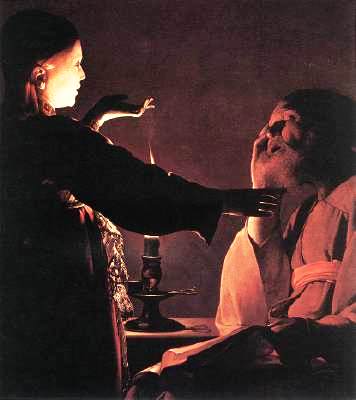
‘The Dream of St Joseph’, George de la Tour
So far we’ve heard very little about Joseph. But in the gospel of Matthew, the story of Jesus’ birth is told from Joseph’s point of view, not Mary’s.
The story is preceded by a genealogy, in which Joseph is named as the legal father of Jesus.
In the Jewish world, a genealogy established social position and religious identity. Including one, as Matthew did, shows the difference between Luke’s and Matthew’s accounts.
In Matthew’s gospel, Mary was in a vulnerable position because her culture emphasized family honor. Her pregnancy could bring dishonor to her whole family.
At first, Joseph was reluctant to marry, knowing that he was not the father. But in a dream he realized that what was happening was remarkable and amazing, and could not be treated as ordinary.
So Mary and Joseph were married.
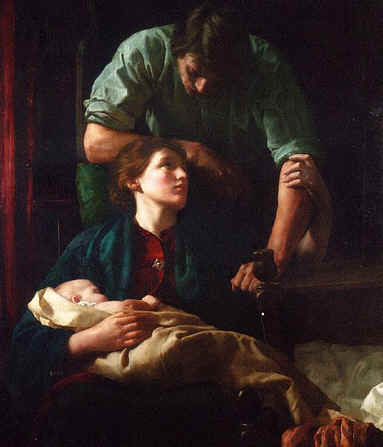
‘The Family’, by John Dickson Batten
‘When Joseph awoke from sleep, he did as the angel of the Lord commanded him. He took her as his wife, but had no marital relations with her until she had borne a son.’
Read Matthew 1:18-25.
In Matthew 2:13-21, Mary, Joseph and Jesus fled to Egypt.
The story about Jesus’ escape to Egypt paralleled other escape stories in the Hebrew Scripture:
There is no mention of Joseph in the later stories about Jesus.
What happened to Mary?
In her maturity, Mary may have been widowed, or Joseph may have travelled to surrounding villages and towns to look for work. Builders, stonemasons and carpenters from Nazareth would have been hard-pressed to support themselves if they worked only in their own village.
There was plenty of work at Sepphoris, four miles north of Nazareth. The Romans rebuilt this town with a Greek-style theatre and temples during Jesus’ boyhood, so there would have been jobs there for building tradesmen.
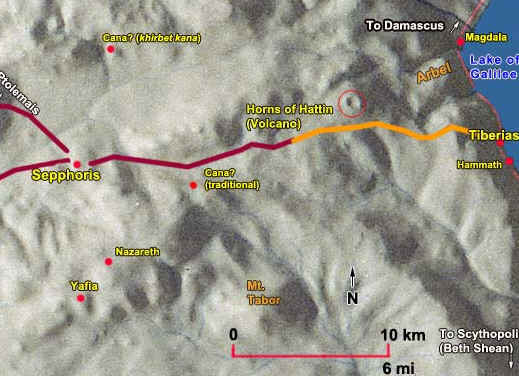
Nazareth, Sepphoris, Magdala, Cana and the Lake of Galilee
See MAPS for Israel and the city of Jerusalem at the time of Jesus
Mary in John’s Gospel
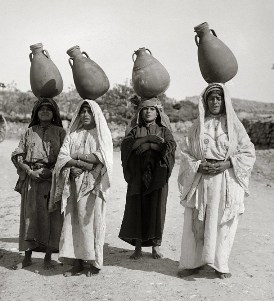
19th century photograph of Palestinian women with water jars
John’s gospel contains stories not found in the other gospels. The references to Mary in John’s gospel are:
- 2:1-11 Mary and Jesus attended a wedding at Cana
- 19:25-27 Mary witnessed the crucifixion of her son.
The gospel of John developed complex ideas about Jesus: who he was, and how this was evident in his life. The emphasis was on the divinity of Jesus, with not many stories about Mary.
But the stories we have show a woman who was sure of herself, and confident about her place in the community.
Mary at the wedding in Cana
One story tells about a wedding that she and Jesus attended in a town in central Galilee, called Cana.
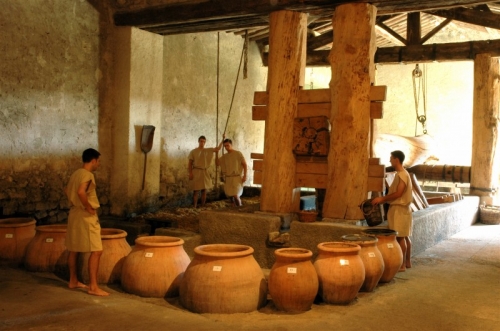
‘When the wine gave out, the mother of Jesus said to him “They have no wine.” And Jesus said to her “Woman, what concern is that to you and to me? My hour has not yet come.” His mother said to the servants “Do whatever he tells you.” Now standing there were six stone water jars for the Jewish rites of purification, each holding twenty or thirty gallons. Jesus said to the “Fill the jars with water.” And they filled them up to the brim.’
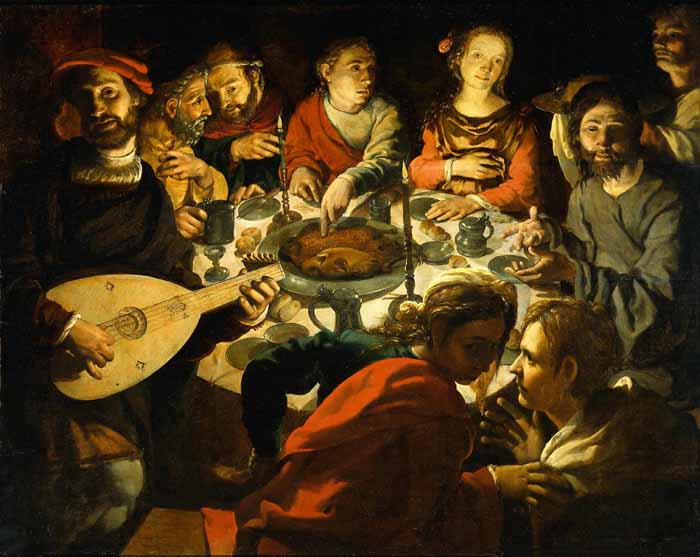
‘Wedding Feast at Cana’, Jan Vermeyen
Read John 2:1-11
The story of the wedding at Cana gives us an example of Mary’s assertiveness as she insists that Jesus help in a difficult situation.
Mary has often been represented as quiet and submissive in iconography and tradition. As a Jewish peasant woman, it is unlikely that she was either of these things.
See Bible Heroines: Mary for the text of this story, with comments.
Mary watched her son during the three years he spent teaching and traveling around the country. She saw that the authorities viewed his actions and words with mounting hostility.
Why were the authorities hostile to Jesus?
The Jewish authorities were in a difficult situation. They were trying to maintain a delicate balance of political stability between the Romans and the Jewish population. They saw Jesus as a threat to this stability.
Mary saw the danger coming, but was unable to protect her son. Eventually, during an incident in the crowded city of Jerusalem, Jesus was arrested, given a swift trial, and executed in the hideous manner reserved for 1st century AD terrorists.
‘Meanwhile, standing near the cross of Jesus were his mother, and his mother’s sister, Mary the wife of Clophas, and Mary Magdalene. When Jesus saw his mother and the disciple whom he loved standing beside her, he said to his mother “Woman, here is your son.” The he said to the disciple “Here is your mother.” And from that hour the disciple took her into his own home.’
Read John 19:25-27
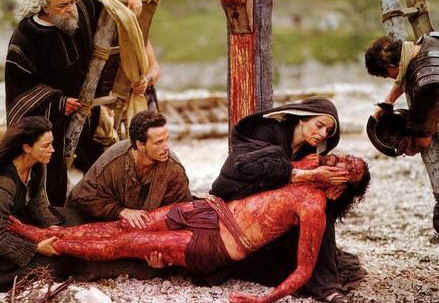
Mary of Nazareth, mother of Jesus, holds her dead son after the crucifixion; from the film The Passion of the Christ
Mary saw her son tortured and killed. Jesus had been her baby, the boy she educated, the young man she was so proud of. She now saw him tormented and executed by brutal soldiers.
It is impossible to imagine how Mary felt as she watched the full horror of the crucifixion.
After the death of her son, she lived in the home of one of his friends.
AND A GOOD FRIDAY WAS HAD BY ALL
by Bruce Dawe
You men there, keep those women back
and God Almighty he laid down
on the crossed timber and old Silenus
my off-sider looked at me as if to say
nice work for soldiers, your mind’s not your own
once you sign that dotted line Ave Caesar
and all that malarkey Imperator Rex
well this Nazarene
didn’t make it any easier
really – not like the ones
who kick up a fuss so you can
do your block and take it out on them
Silenus held the spikes steady and I let fly
with the sledge-hammer, not looking
on the downswing trying hard not to hear
over the women’s wailing the bones give way
the iron shocking the dumb wood.
Orders is orders, I said after it was over
nothing personal you understand – we had a
drill-sergeant once thought he was God but he wasn’t
a patch on you
then we hauled on the ropes
and he rose in the hot air
like a diver just leaving the springboard, arms spread
so it seemed
over the whole damned creation
over the big men who must have had it in for him
and the curious ones who’ll watch anything if it’s free
with only the usual women caring anyway
and a blind man in tears.
Mary in the Acts of the Apostles
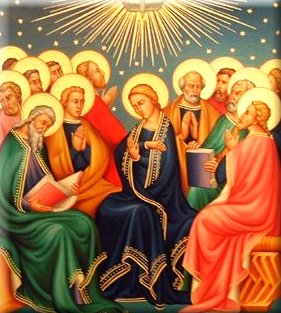
Mary at Pentacost, icon
Read Acts 1:13-14 for Mary’s role in the early Christian communities.
Keep in mind as your read this passage from Acts that it was written before the gospels were written.
Mary is shown as a mature woman who devoted herself to prayer within the early Christian community. She thus lived out the Jewish ideal of holiness.
Jews believe that holiness is found in active participation in the life of the community. Holy people do not avoid the company of others. They share the happiness and sadness of the people around them, because they believe that God is found in humanity, not in isolation.
Mary is shown within a community, focused on God.
What did their names mean?
Mary, from the Hebrew Mariamme, means ‘wise woman’ or ‘lady’. Mariamme was the recently murdered queen of the hated King Herod the Great. Mariamme or the shortened Mary was a popular protest name at the time, which is why there are several ‘Marys’ in the gospels.
Jesus means ‘God saves’ or ‘God is generous’.
Joseph means ‘May God add….’ (other children); this may mean Joseph was the eldest son in his family.
Elizabeth means ‘My God is generous’.
Anna means ‘favour’.
Simeon means ‘God has heard’.
John means ‘God has shown favour’.
What do we really know about Mary?
- Mary of Nazareth is one of the few women in the ancient world whose life story we know: as girl, mother and mature woman.
- Even so, the gospels are about Jesus, not his mother. Her appearances are limited, and this makes it difficult to know what the real woman was like.
For more information, see the website
Bible Study Resource for Bible Women
Annunciation & Birth of Jesus, Wedding at Cana, Mary in the Gospels



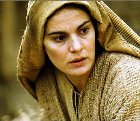
Bible Heroines: Mary
To the rescue at Cana
Ancient Buildings
A village like Nazareth


Meditation for Parents
Looking for a meditation
on Mary’s story?