
Who was Mary Magdalene?
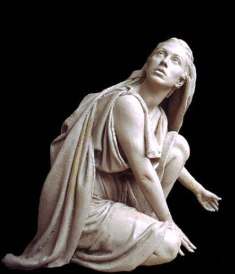 1 Mary Magdalene was a follower of Jesus of Nazareth, who cured her of an unknown illness. She led a group of women who provided for Jesus and his followers from their own resources. She was there during his ministry in Galilee and Judea, heard him teach, and may have been his financial backer, dealing with the practical details of looking after a travelling group of men and women. See Luke 8:1-3.
2 Mary was at the crucifixion – each of the four gospel accounts of the crucifixion and death of Jesus show her there. She was faithful to the end. See Mark 15:40-41, Luke 23:49, Matthew 27:55-56, John 19:25
3 Mary prepared Jesus’ body for burial and watched as Jesus’ body was sealed inside the tomb of Joseph of Arimathea. She could confirm that he was really dead. She and the other women prepared the spices needed for proper burial of a body. See Luke 23:55-56, Matthew 27:61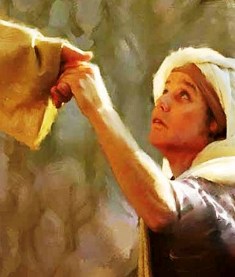
4 Mary witnessed the resurrection on Easter morning when she discovered that Jesus’ body was missing from the tomb. She was the first person to speak to Jesus after the Resurrection. She is called ‘Apostle to the Apostles’, because the risen Jesus told her to ‘go and tell’, apostellein in Greek. See Mark 16:1-11, Luke 24:1-11, Matthew 28:1-10, John 20:1-18
* All Bible texts at Mary Magdalene in the gospels
Mary Magdalene, disciple of Jesus
Who was Mary Magdalene?
As Jesus moved throughout the country, teaching and talking about God, he was accompanied by a group of women. Mary Magdalene was the main woman in this group.

Read what modern writers say about Mary Magdalene
‘Soon afterwards he went on through cities and villages, proclaiming and bring the good news of the kingdom of God. The twelve were with him, as well as some women who had been cured of evil spirits and infirmities: Mary called Magdalene, from whom seven demons had gone out, and Joanna the wife of Herod’s steward Chuza, and Susanna, and many others, who provided for them out of their resources.’ (Read Luke 8:1-3 at Mary Magdalene in the gospels).
Why was she called Mary Magdalene?
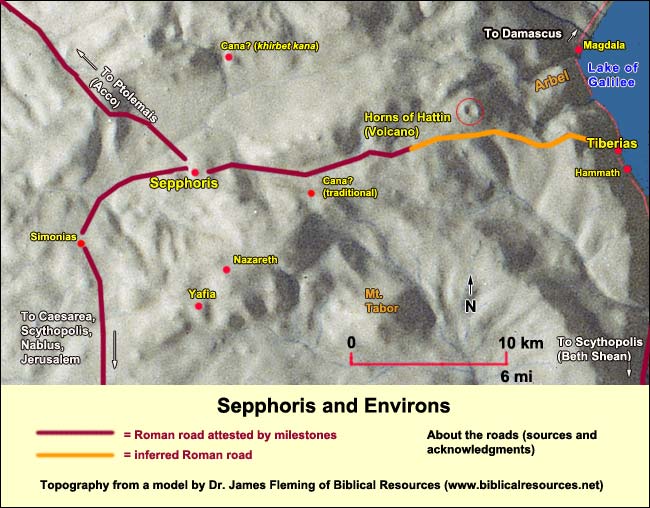
 Mary came from the town of Magdala in Galilee. It was a thriving center of the fishing industry, producing smoked fish in large quantities – not very romantic, but a good, steady trade.
It was also known as a manufacturing center for fine wool and woolen dyes. Mary seems to have been financially independent, so she probably lived in a comfortable village house.
Many Greeks lived in Magdala, and the town had a worldly Hellenistic culture. This was quite different to a traditional, conservative village like Nazareth, Jesus’ home town.
Remains of ancient Magdala still exist, about two kilometers from the modern village of Migdel Nunya (meaning ‘fish tower’). This village was almost completely destroyed in the Arab-Israeli war.
What was Mary’s mysterious illness?
Mary had a serious illness, caused by ‘seven demons’ who entered her.
From the earliest times, people believed that spirits and demons caused many illnesses. It was one way of explaining sickness and evil. According to the thinking of the time, specific demons caused specific illnesses, for example schizophrenia, blindness, heart disease and epilepsy. These malevolent spirits could be
- people no longer living, hostile to those who were still alive
- the surviving spirits of feared animals, for example wolves, bears and snakes
- malevolent beings that entered a person and caused physical or psychological illness.
This third type of demon was thought to have entered Mary Magdalene. Mary had seven demons tormenting her, the number ‘seven’ indicating the severity of the illness.
How did Mary Magdalene meet Jesus?
Magdala was quite close to Nazareth and Cana, and Jesus probably visited the region a number of times. At some point in her life, Mary met Jesus, and he cured her of a severe illness. We do not know what the illness was, or whether the cure happened in one moment or over a period of time. Perhaps it occurred gradually, as her knowledge of Jesus developed.
In any event, she became the leader of a group of women who travelled with Jesus, and who supported him financially.
Mary Magdalene travelled with Jesus
Two groups traveled with Jesus:
- a group of men led by the apostle Peter and
- a group of women led by Mary Magdalene.
It was the common practice for men and women to accompany each other when traveling, but they moved in separate groups.
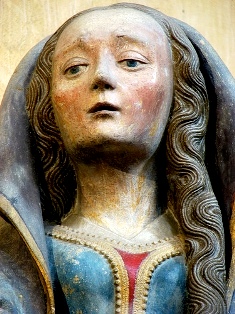
Medieval wood carving of Mary Magdalene
Mary and Peter seem to have been the leaders of these two groups. Unfortunately, the words and actions of the men were recorded, and the women’s were not. Nevertheless, Peter and Mary should probably be seen as equal in their support for Jesus’ work, each contributing different things.
Other women with Jesus
Other named women in the group led by Mary were Joanna and Susanna.
Joanna, the wife of Herod’s steward (Luke 8:3) was of high social standing, with connections at the royal court. She probably lived in the upper part of the city of Jerusalem in one of the grander houses in the Upper City. A woman like this would not travel without a retinue of servants, including a recognized chaperone.
This was an important point, as far as Luke was concerned. One of the purposes he had in writing his gospel was to make Jesus acceptable to a wide audience, including the Gentile population of the Roman empire.
At the time Luke recorded the stories, everyone knew that Jesus had been executed as a criminal by the Romans. Many people in the 1st century Roman world found it difficult to reconcile this fact with the belief that he was the Son of God. So Luke took pains to show that Jesus was supported by well-connected, law-abiding people during his life.
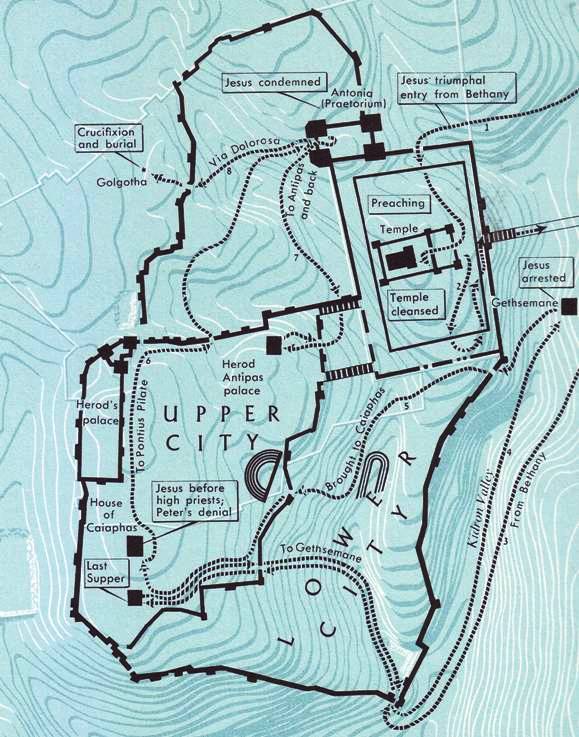
Jerusalem, scene of Jesus’ trial and death. King Herod doubled the size of the Temple Mount and surrounded it with a high wall with massive gates. The Temple was raised, enlarged, and faced with white stone. Its courtyards served as a gathering place and its shaded porticoes sheltered merchants and money changers. Jesus’ confrontation with the money changers, and with the Adulterous Woman, happened against the backdrop of a brand new building.
Mary and other women at the Crucifixion
All four accounts of the crucifixion and death of Jesus say that women were at the scene, and Mary Magdalene was prominent among these women.
She had been close to Jesus during his life. She stayed close to him as he faced death.
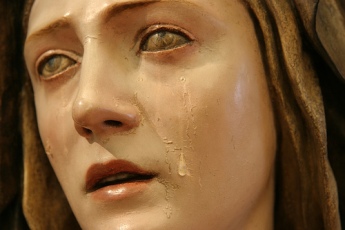
Mary at the crucifixion
‘There were also women looking on from a distance. Among them were Mary Magdalene and Mary the mother of James the younger and of Joses, and Salome. These used to follow him and provided for him when he was in Galilee. And there were many other women who had come up with him to Jerusalem.’ (Read Mark 15:40-41
Crucifixion – what happened? describes the horrific process of crucifixion, based on archaeological evidence.
 Which women were there?
There are three groups of women mentioned in these verses from Mark:
- the inner core of women who were close friends or relatives of Jesus
- the women who provided for him from their financial resources
- the women who came up with Jesus to Jerusalem, just prior to his execution.
Matthew 26:56 makes the point that all the male disciples deserted Jesus and fled for their lives. But the women remained, standing as near as they dared to the spot where the soldiers were carrying out the brutal execution.
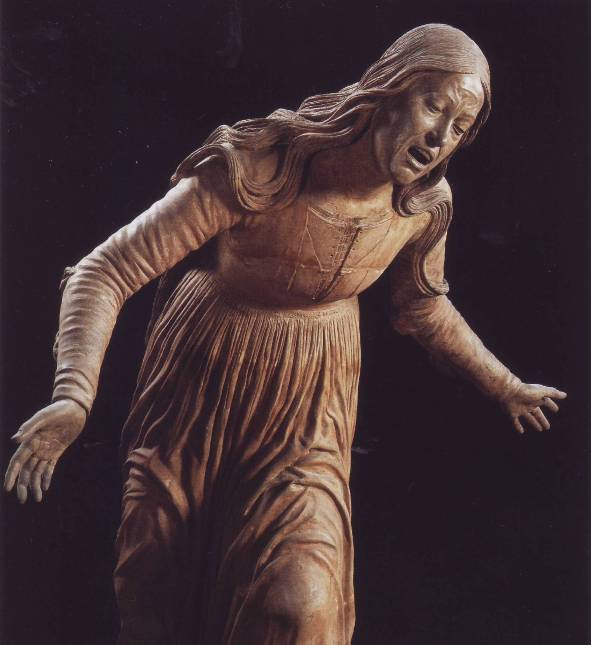
Lamentation for the dead Christ, by Guido Mazzoni
Why weren’t Jesus’ disciples there?
This does not mean that the men were more cowardly than the women. It was simply more dangerous for them to be near the execution site.
The Romans saw Jesus as a dangerous rebel leader, and so they viewed Jesus’ male friends with suspicion. The male disciples might easily have been arrested as co-conspirators, so they kept their distance. Women were seen as less threatening and so their presence was tolerated.
Note: Modern film-makers and photographers have created some extraordinary images of Jesus. They show a Jesus who is strong and handsome, but also confronting and controversial. See some of these images at Modern Images of Jesus.
AND A GOOD FRIDAY WAS HAD BY ALL, by Bruce Dawe
You men there, keep those women back
and God Almighty he laid down
on the crossed timber and old Silenus
my off-sider looked at me as if to say
nice work for soldiers, your mind’s not your own
once you sign that dotted line Ave Caesar
and all that malarkey Imperator Rex
well this Nazarene
didn’t make it any easier
really – not like the ones
who kick up a fuss so you can
do your block and take it out on them
Silenus held the spikes steady and I let fly
with the sledge-hammer, not looking
on the downswing trying hard not to hear
over the women’s wailing the bones give way
the iron shocking the dumb wood.
Orders is orders, I said after it was over
nothing personal you understand – we had a
drill-sergeant once thought he was God but he wasn’t
a patch on you
then we hauled on the ropes
and he rose in the hot air
like a diver just leaving the springboard, arms spread
so it seemed
over the whole damned creation
over the big men who must have had it in for him
and the curious ones who’ll watch anything if it’s free
with only the usual women caring anywhere
and a blind man in tears.

The Dead Christ, Hans Holbein the Younger
The Burial Preparations of Jesus’ body
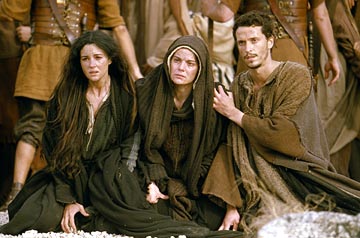
Mary Magdalene, Mary of Nazareth, and John in the film ‘The Passion of the Christ’
In this part of the story, Mary
- was present at the temporary burial of Jesus and saw him placed in the tomb, then
- returned to the place were they were staying and collected the materials needed for a proper burial (see Death & Burial).
‘The women who had come with him from Galilee followed, and they saw the tomb and how his body was laid. Then they returned, and prepared spices and ointments.’ (Read Luke 23:55-56, Mark 15:47, Matthew 27:61 at Mary in the gospels)
The burial seems to have been done hastily, either because it was night or because of the approaching Sabbath.
Pilgrims who died in Jerusalem and people who were executed were temporarily buried in graves for non-residents, and then later removed to the tomb of their family.
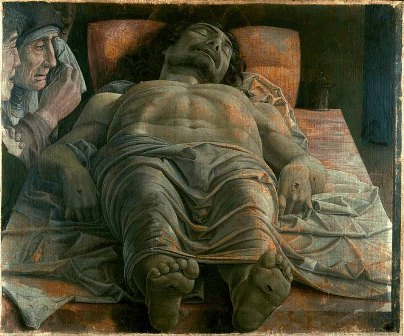
The Dead Christ, by Andrea Mantegna
The presence of the women at the tomb of Jesus was meant to highlight the factual nature of the burial: that Jesus was indeed dead, and that his body had been buried in the normal manner.
This point was later disputed by people who said that Jesus had not been dead, but merely unconscious.
Since women’s testimony was not given the same weight as men’s in courts of law, this might have been a problem. Deuteronomy 19:15 stipulated that at least two or three witnesses were needed to prove that something had happened.
But the gospels stress that as well as the women, Joseph of Arimathea, a respected member of the Council, was there, so the required number of witnesses was present at the tomb of Jesus to verify that he was really dead.
Note: Tombs were visited and watched for three days by family members. On the third day after death, the body was examined. This was to make sure that the person was really dead, for accidental burial of someone still living could occur.
See Major Events: Death and Burial in ancient times
Did Mary witness the Resurrection?
According to Jewish law, ointments and spices could not be bought or sold on the Sabbath.
But Jesus’ death had been sudden, unexpected. There had been no time to prepare. The women did not have the necessary burial spices.
So they waited until the Sabbath was over, bought the spices, and went to the tomb.
But when they got to the tomb, they found it empty of Jesus’ body.
At this moment Mary had a profound revelation where she ‘saw’ and ‘heard’ Jesus. She understood in a way that is not easily explained that Jesus was no longer dead, but alive. She experienced what the gospels call an ‘angel’, a message from God that gave her an unshakeable conviction that Jesus lived.
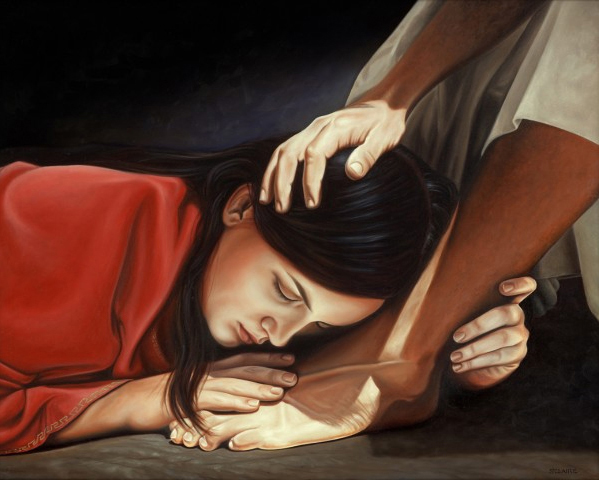
How do the gospels describe it?
‘But Mary stood weeping outside the tomb. As she wept, she bent over to look into the tomb, and she saw two angels in white, sitting where the body of Jesus had been lying, one at the head and the other at the feet
They said to her “Woman, why are you weeping
She said to them “They have taken away my Lord, and I do not know where they have laid him”.
When she had said this, she turned around and saw Jesus standing there, but she did not know that it was Jesus.
Jesus said to her “Woman, why are you weeping? Whom are you looking for?”
Supposing him to be the gardener, she said to him “Sir, if you have carried him away, tell me where you have laid him, and I will take him away”.
Jesus said to her “Mary!”
She turned and said to him in Hebrew “Rabbouni!” (which means Teacher).
Jesus said to her “Do not hold on to me, because I have not yet ascended to the Father. But go to my brothers and say to them “I am ascending to my Father and your Father, to my God and your God.”
Mary Magdalene went and announced to the disciples “I have seen the Lord”. And she told them that he had said these things to her.’
Read John 20:11-18, Mark 16:1-11, Luke 24:1-11, Matthew 28:1-10 at Mary in the gospels
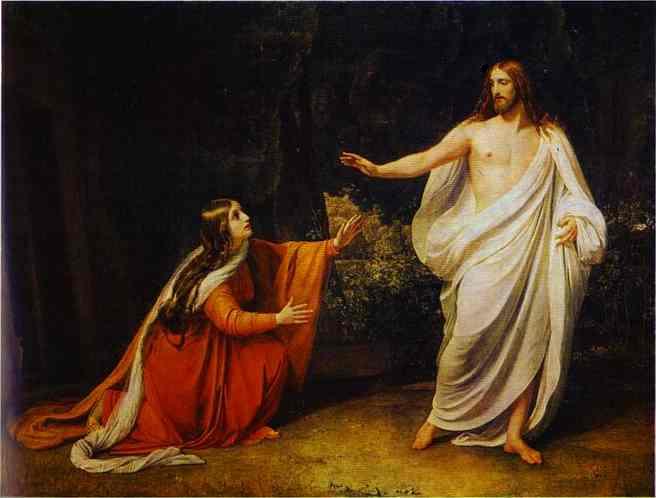
Jesus warns Mary Magdalene not to touch him: Noli me tangere”
Mary saw and heard Jesus. She was the first witness of Jesus’ Resurrection.
She was convinced that he was alive, although she was too distraught to recognize him immediately.
It is interesting that in this moment of extreme emotion she calls him ‘rabbouni‘, the title his disciples would have used.
She did not call him by his own personal name of ‘Jesus’, which she surely would have done if she and Jesus had had the sort of intimate relationship that has been suggested in popular novels. She used the word she had always used as his name, ‘rabbouni‘, teacher
What is the lesson for us?
Jesus told Mary not to cling to him, but to let him go. He was telling her that their former way of life has ended, that she must let go and move on. They are words that are often said by those who seek to comfort and advise people who are grieving.
In a way the angel said the same thing: “Why do you seek the living among the dead?” Death had happened. Nothing would ever be the same. Your place is now with the living.
Mary Magdalene, first apostle of Jesus
At the tomb, Mary was given instructions. She was told by Jesus or by the angel to “Go to my brothers and say to them….” Mary then ‘went and announced’. With these words Mary was commissioned as an apostle of Jesus (‘go and tell’ is apostellein in Greek).
She was an apostle in the same way as the men (the Twelve and the other disciples) who were commissioned to spread the story of Jesus.
Until the third century, teachers in the Christian church referred to Mary as an ‘apostle’, and she is still called ‘apostle to the apostles’ by the Eastern Catholic churches. She has been one of the most revered figures in Christian history.
In his letter to the Corinthians, Paul does not include the women at the tomb among the witnesses to the Resurrection. According to his narrative, Jesus appeared to Cephas, and then to the twelve male disciples, then to 500 people, then to James, then to all the apostles. Mary of Magdala is not mentioned.
Paul was writing to Greeks in Corinth, and sadly his letter reflects the culture of the Greeks, who viewed the testimony of women as unreliable.
Some extra snippets
‘There is a good deal of evidence that in the Greco-Roman world in general women were thought be gullible in religious matters and especilly prone to superstititus fantasy and excessive in religious practices. Strabo, for example, points out that “in dealing with a crowd of women…. a philosopher cannot influence them by reason or exhort them to reverence, piety and faith; nay, there is need to religious fear also, and this cannot be aroused without myths and marvels” (Geog.1.2.8).
We are fortunate to have an example of this prejudice directed specifically against Mary Magdalene as an alleged witness to the resurrection by the second-century pagan intellectual despiser of Christianity, Celsus: “after death he rose again and showed the marks of his punishment and how his hands, had been pierced. But who saw this? A hysterical female, as you say, and perhaps some other one of those who were deluded by the same sorcery” (apud Origen.C.Cels.2.55).
Even allowing for Celsus’s polemical intent in focusing on a female witness of the resurrection, it is notable that the appearance to Mary Magdalene was sufficiently prominent that Celsus knew of the Christian claim about the resurrection of Jesus for him to be able to take it up in this way. There can hardly be any doubt that the gender of the “hysterical” or “crazed” woman is important to Celsus’s sneering polemic.’
(Quoted from ‘Gospel Women: Studies of the Named Women in the Gospels’, Richard Bauckham, p270-271)
Mary Magdalene: her name means?
Mary means ‘wise woman/lady’. It is a Greek form of the Hebrew Miriam or Mariamme, and was the most popular woman’s name at the time – perhaps a tribute to the young and beautiful Princess Mariamme, murdered by her husband King Herod in 28/27BC.
Mary came from a now-vanished town called Magdala, on the western side of the Sea of Galilee. She is often called Mary Magdalene.
What are the main themes in Mary’s story?
- Women are valid witnesses to Christ. The idea of women as primary witnesses does not seem unusual to people in the 21st century, but it was a revolutionary concept at the time. The testimony of women was not given the same weight as men’s, either personally or in a court of law. Mary’s witness to the Resurrection reversed this idea.
- The status of women in early Christianity was equal to men’s. When the Christian stories described Mary Magdalene and the other women as the first witnesses of the Resurrection, they were saying something important about the nature of women: that they were capable of being as fully Christian as men.
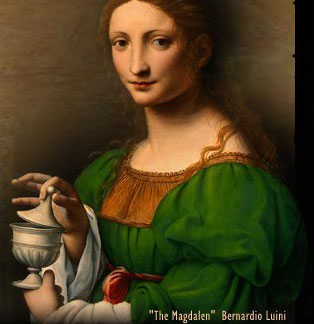
The Magdalene, Bernardio Luini; this shows the centuries-old confusion between Mary Magdalene and the woman with the alabaster jar
- Note: Throughout the centuries, Mary Magdalene was wrongly portrayed as a reformed prostitute: she was confused with the woman with the alabaster jar (see right), described in Luke 7:36-50. The woman with the alabaster jar is called a ‘sinner’, but not a prostitute; Luke uses a different word when he describes an actual prostitute in 15:30
- Mary Magdalene had a serious illness, but the nature of the illness is unspecified; later celibate male writers linked Mary’s illness, her ‘demons’, with her sexuality – which may have been more a comment about their own demons, not Mary’s
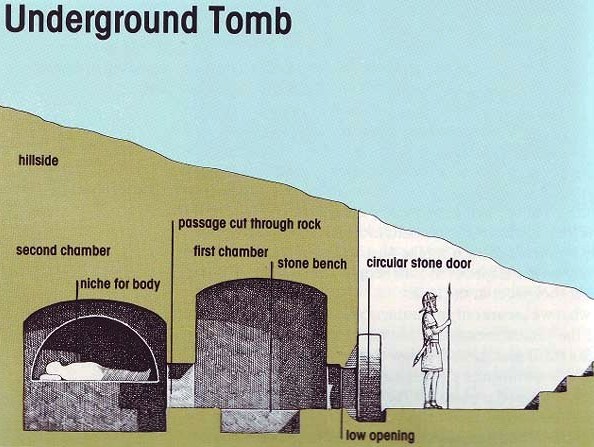
Cross-section of an underground tomb at the time of Jesus: guarded entrance with stone door; first chamber cut into the rock; second inner chamber with niche holding a body bound in linen cloth
Jesus warns Mary not to touch him
Mary saw and heard Jesus. She was the first witness of Jesus’ Resurrection
She was convinced that he was alive, although she was too distraught to recognize him immediately.
It is interesting that in this moment of extreme emotion she calls him rabbouni, the title his disciples would have used.
She did not call him by his own personal name of ‘Jesus’, which she surely would have done if she and Jesus had had the sort of intimate relationship that has been suggested in popular novels. She used the word she had always used as his name, rabbouni, teacher.
Mary Magdalene and grief
Jesus told Mary not to cling to him, but to let him go. He was telling her that their former way of life has ended, that she must let go and move on. They are words that are often said by those who seek to comfort and advise people who are grieving.
In a way the angel said the same thing: “Why do you seek the living among the dead?” Death had happened. Nothing would ever be the same. Your place is now with the living.
Mary Magdalene, first apostle of Jesus

Bible women arriving at the tomb, painting by He Qi
Mary Magdalene has been immensely popular with artists throughout the centuries. Go to Bible Art: Paintings of Mary Magdalene for about twenty-five famous paintings.

Read about other significant Bible women
Bible Study Resource
Mary Magdalene, first witness of the Resurrection
Apostle to the Apostles





Da Vinci Code:
true? false?
Interview with
Elizabeth Fletcher
Sinner or saint?
Famous paintings of
The Resurrection