Who was Elizabeth? What was her story?
Elizabeth’s story has 3 parts:
1 Elizabeth becomes pregnant, Luke 1:5-25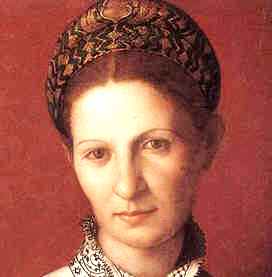
Elizabeth was an impressive woman. She was married to Zechariah, a priest at the Jerusalem Temple – so she was someone important, married to a respected man. She was not young – past menopause in fact, so she had given up hope of having a baby. Her husband was old as well. But suddenly she became pregnant, to the amazement of all (you can click on this link for the gospel passage)
2 Mary visits Elizabeth, Luke 1:57-66
While she was pregnant with the future John the Baptist, she was visited by her young cousin Mary of Nazareth. Mary was pregnant too, with Jesus – but Mary was in a much more dangerous position. She was unmarried, and may have been fleeing from her angry family – an unmarried pregnant girl was a terrible disgrace to the whole family. There would be few men, if any, willing to marry a pregnant girl when he knew he was not the father.
But when Elizabeth and Mary met, something extraordinary happened to each of them: they knew deep down that they and their children would be part of something very important.
3 Elizabeth has a son John, Luke 1:67-80
A few months later Elizabeth bore the son she had always longed for. She named him ‘John’. He was circumcised, as all Jewish boys were. Zechariah regained his speech and hearing. (Please do read poor Zechariah’s story further down this page – you’d have to feel sorry for a man in this very odd situation….)
Elizabeth becomes pregnant, Luke 1:5-25
First, Luke outlined Elizabeth’s family background (see Elizabeth in Luke’s gospel). She was descended from a long line of priests – Luke made this clear right at the beginning of his gospel, because he wanted to say, loud and clear, that John and Jesus both came from a respectable, well-connected family.
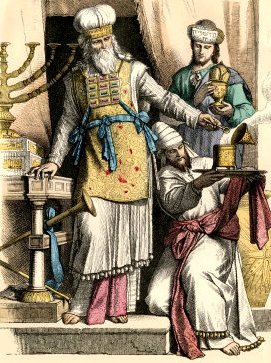
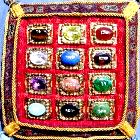
Reconstruction of the regalia worn by the Jewish high priest
He began by pointing out that not one but both John’s parents came from a priestly family, and that Elizabeth’s father was a priest – this is what is meant by ‘daughter of Aaron’.
What was her problem?
Despite her impeccable family background, Elizabeth was barren. In those days childlessness was not just a misfortune, it was a disgrace (see Genesis 16:4, 11; 29:32; 30:1, 1 Samuel 1:5-6, 11, 2:5, 7-8).
But in Elizabeth’s case this could hardly be so, since her reputation was blameless. Instead, there had to be some other reason.
Could it be that, like the great fore-mother Sarah (Genesis 18:11) and the childless Hannah (1 Samuel 1-2) she remained barren because God had a greater plan for her?
Luke now set the scene for the first dramatic event.
Why was Zechariah at the Temple?
Zechariah had been chosen by lot to enter the sanctuary of the Temple of Jerusalem and offer incense as part of the daily worship at the Temple – only the priest who had been chosen by random lot, and therefore by God’s hand, could enter the sanctuary.
It was a pivotal moment for Zechariah. There were about 8,000 priests at that time, so any priest could only expect to offer sacrifice once or twice in his lifetime.
Now it was Zechariah’s turn.
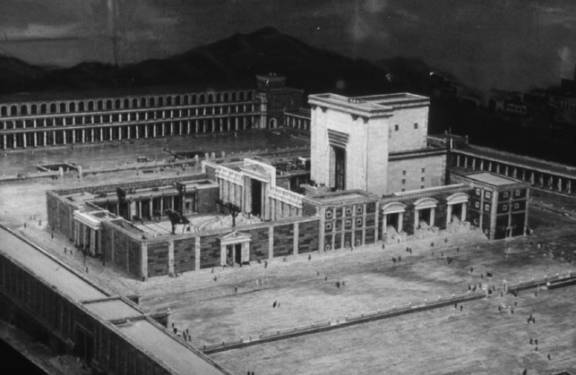
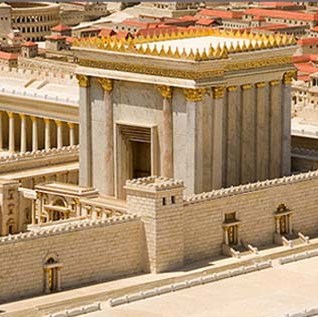
A model of Herod’s Temple. Zechariah offered sacrifice inside the doors of the main building, though not in the inner room called the Holy of Holies. Below: floor plan of the Temple enclosure
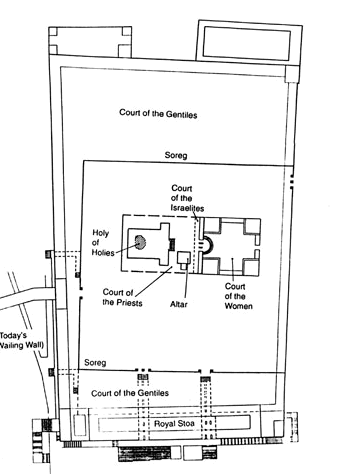
At about 3pm on this particular day he stepped forward into the sanctuary to offer incense. The people waited outside, as did the other priests.
At that moment, an angel (see What is an angel?) appeared at the right side of the altar in front of Zechariah.
Why the right-hand side? Because a favored courtier or royal family member always took this position in a royal throne room.
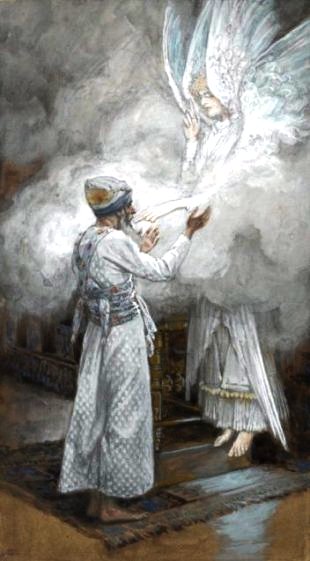
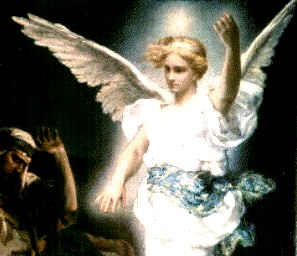
Zechariah and the Angel, James Tissot
But an angel? What exactly does that mean?
It’s hard to tell, but biblical writers seemed to use this word to show that a human being had received a message from God.
Our skeptical, must-have-proof world finds it hard to understand, but we would probably say the same thing in a different way:
- that a deep conviction of purpose settled on the person involved, guiding them towards a particular course of action.
The angel’s message
The angel spoke. It reassured the terrified Zechariah, telling him not to be afraid.
Then it gave him momentous news: his wife Elizabeth would conceive and have a son. Since the hand of God is clearly evident in what is happening, the listener/reader knows that this will be no ordinary child.
The angel was specific. The child would have four characteristics:
- he would be great in the sight of God
- he would drink no wine and thus live the ascetic life of a Nazarene, setting him apart from ordinary people
- he would be filled with the Spirit from his conception
- he would prepare for the Messiah and thus be a catalyst between Israel and God.
What was Zechariah’s response?
It’s hard to believe, but Zechariah quibbled! He expressed doubts that this could happen. He discreetly implied that
- he was no longer capable of sexual intercourse, and that
- his wife had ceased menstruating.
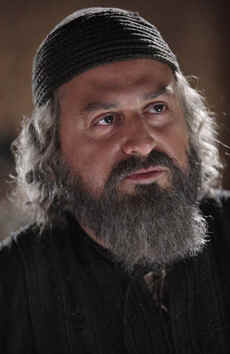 There was genuine confusion on his part here, but there was also the sense that he was objecting, as he asked for a sign – just as the great fore-father Abraham did (Genesis 15:8), and Gideon (Judges 6:36-40) and Hezekiah (2 Kings 20:8-11).
The angel responded by naming itself – ‘I am Gabriel. I stand in the presence of God’.
Can an angel be offended?
Only the highest officials in an oriental royal court stood in the presence of the king. Protocol demanded that most people bow or prostrate themselves, so Gabriel was telling Zechariah he had committed an offense in not believing the message.
As punishment for his lèse-majesté Zechariah was reduced to silence, probably becoming both deaf and mute.
- In one way it was a reassuring miracle,
- but in another it was a punishment, one that would last until the birth of the child set him free.
Zechariah is struck dumb
When Zechariah came out of the Temple he was unable to speak.
This was puzzling for the people around him. Why couldn’t he speak? Clearly something momentous must have happened.
The priests and people interpreted his silence as proof that he had had some profound religious experience, possibly a vision, but Zechariah could not tell them of his experience.
Frustrated by his inability to speak, he tried to explain by signing. This had limited success. He finished out his allotted service, then headed home.
Elizabeth pleases God
Zechariah had doubted but Elizabeth had not, and now she, not her unfortunate husband, moved into the spotlight.
Home at last, Zechariah found comfort in the arms of his wife. One thing led to another, and she became pregnant – to her surprise and the amazement of her family and friends.
When she realized she was pregnant, she went into seclusion. This meant she did not leave her house for any reason, nor receive any visitors. She stayed like this, leading a calm and quiet life, until her pregnancy became physically obvious to all who saw her.
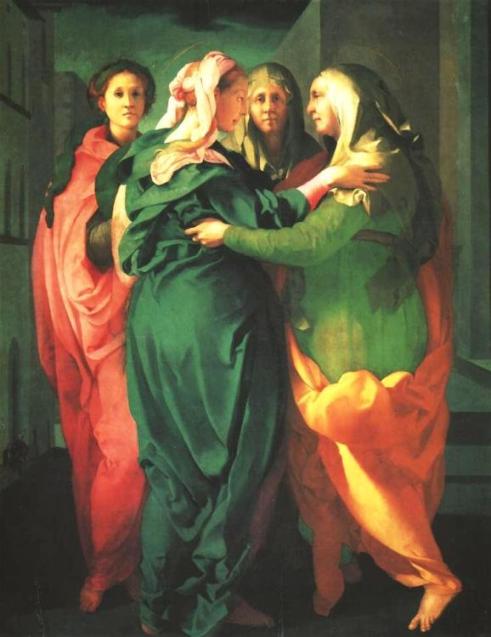
‘The Visitation’, by Jacopo Pontormo.
Green is the traditional colour of new life.
Mary visits her kinswoman Elizabeth
Meanwhile, the young Galilean woman Mary had been betrothed to Joseph of Nazareth with
- a formal witnessed agreement, legally binding, between the families of the young people,
- and a bride price paid to Mary’s family.
It was expected that the formal marriage would take place about a year later, when Mary would be taken to the home to Joseph’s family to live.
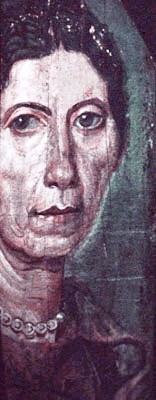
Accustomed as we are to benign images of the Annunciation, and of Mary and Joseph with the baby Jesus, we tend to blot out the reality of the situation: a young girl was pregnant, her fiancé knew he was not the father, yet the bride price had been paid.
In a Middle Eastern rural community at the time, this sort of situation could easily result in an honor killing of the young girl by her fiancé’s family.
Mary in danger
What few commentators seem to realize is that Mary’s visit to Elizabeth, about a hundred miles away in Judea, may have been a desperate attempt by her family to save her from this fate, to get her out of the way until some solution had been worked out.
Leaving Galilee and traveling south, Mary duly arrived at Elizabeth’s house in Judea after a journey of about three or four days.
See Galilee to Jerusalem – Bible Maps to trace the route of this journey.
At first glance, this might seem like a commonplace event as two kinswomen, both pregnant, meet each other.
But Luke was making oblique references to Old Testament precedents, alerting the reader to a deeper meaning in Elizabeth’s story:
- read Hannah’s story, 1 Samuel 1-2, Judges 13:2, about a couple like Elizabeth and Zechariah, unable to have children,
- and Sarah’s story, Genesis 18:11 which describes an elderly couple who thought they would never have a child.
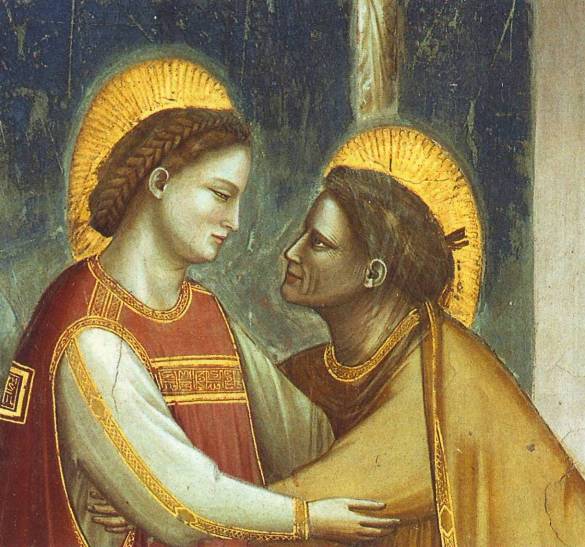
Mary’s visitation to Anne, by Giotto
The songs of Elizabeth & Mary
The two pregnant women met, and at that moment Elizabeth’s unborn baby responded by suddenly moving and kicking in her womb.
Twenty-eight weeks, the end of a woman’s second trimester, is the normal time to expect an unborn baby to kick in the womb, and this may well have been the first time Elizabeth’s unborn baby moved – an exciting moment for any mother.
She took this sudden movement, at this particular moment, as a sign.
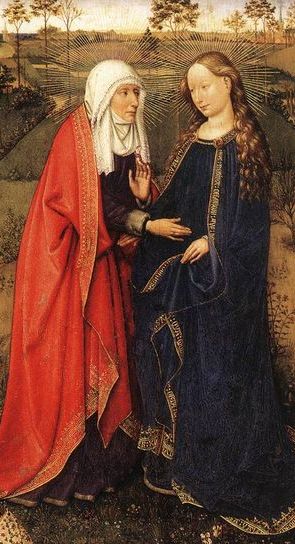 In a moment of penetrating spiritual clarity, Elizabeth recognized she was being visited by the mother of the expected Messiah. She pronounced a blessing on the younger woman:
‘Blessed are you among women, and blessed is the fruit of your womb. And why has this happened to me, that the mother of my Lord comes to me? For as soon as I heard the sound of your greeting, the child in my womb leaped for joy. And blessed is she who believed that there would be a fulfillment of what was spoken to her by the Lord.’
Mary responded with the words of the song called the Magnificat.
Scholars now guardedly say this was a hymn sung by the early Christians in their liturgies, implying that it may have had a composition date later than the moment of meeting between the two mothers.
They also imply that an illiterate peasant girl from Galilee would not have had the ability to compose such a hymn.
Did Mary really compose the Magnificat?
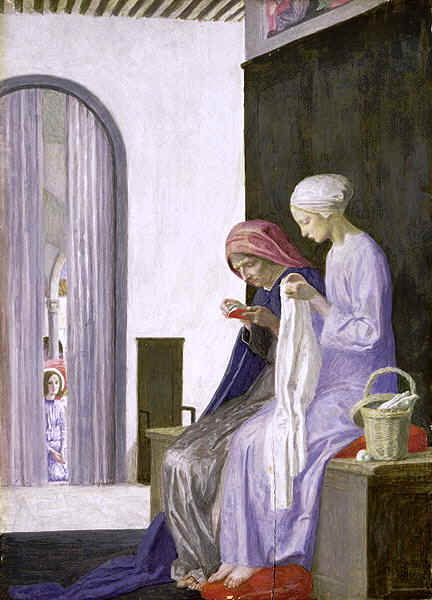
Mary and Elizabeth, by Robert Anning Bell. Notice the angel quietly watching from behind the curtain
But there is no reason to think that Mary could not have been capable of composing it herself. The Magnificat is closely based on the Song of Hannah in 2 Samuel 2:1-10, and Mary must have known this Song well.
- She certainly would have known the Song of Hannah by heart, since women at the time had a rich oral tradition, all of it memorized, and
- she would have thought the Song of Hannah appropriate, since Elizabeth’s pregnancy so late in life mirrored the pregnancy of Hannah.
Adapting passages from the Jewish Scriptures to suit current situations was a familiar part of the oral tradition, and Mary and her female relatives would have been familiar with this technique.
True, there is some evidence it was adapted along the way before Luke translated it into Greek, but surely Mary is the source of this glorious song.
Elizabeth gives birth to John
It is not clear from the text whether Elizabeth had the help of her young kinswoman when she gave birth to her baby. Commonsense and the lapse of time would suggest she did. Elizabeth would certainly have been surrounded by loving, concerned relatives and friends, especially since her advanced age must have made it a difficult birth.
Note: In ancient times, women hunched themselves over a hole hollowed in the ground, standing on bricks or stones placed at either side. They gave birth in a squatting position, with relatives and friends taking turns to support them under the arms. In the Roman world there were special birthing chairs with a U-shaped hole in the seat and supports for the feet and back, but we have no way of knowing whether this latest medical technology had reached Roman-era Jerusalem. Childbirth in ancient times

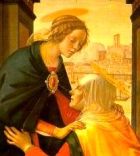
The Visitation, by Domenico Ghirlandaio
Elizabeth has a son John
Elizabeth had a son, and all her friends and relatives were overjoyed for her. She seems to have recovered well from the birth itself, because eight days afterwards she was up and around, ready to attend the circumcision of her son.
A baby was usually named on the day of his circumcision, and a common practice at this time was to name a first son after his grandfather.
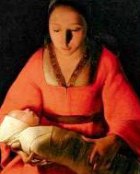
An elderly woman holding a new baby – as Elizabeth did
In this case however, Elizabeth’s extended family seemed to have decided that the baby would be called Zechariah, after his stricken father.
But Elizabeth stepped forward and briskly contradicted them. Her son’s name was to be ‘John’, she said.
Everyone disagreed with her, pointing out that there was no family precedent for the name ‘John’, but Elizabeth stood her ground.
She insisted so fiercely that, exasperated, the family members turned to Zechariah for support. Since he could not speak, he asked for a writing tablet – a small wooden tile with a wax surface. With a stylus he scratched a single sentence: ‘His name is John’.
Zechariah speaks
Immediately, to the amazement of the onlookers, he regained the use of his speech and hearing. A skeptic no more, his first words were in praise of God. The sound of his voice silenced even the most talkative of his neighbors.
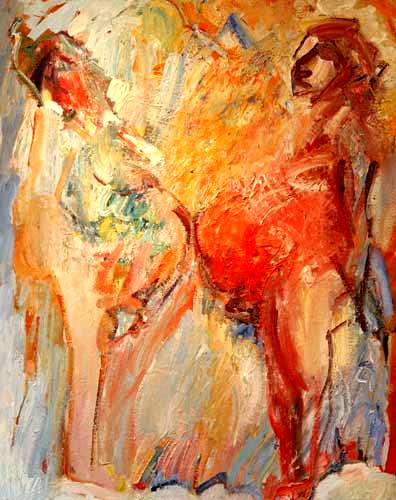
A modern take on the meeting between Elizabeth and Mary of Nazareth. The Visitation, by Dennis Creffield
They were awed and not a little frightened by what they were witnessing.
Like neighbors everywhere, they could not wait to pass on the story of what had happened, and discuss its meaning. The son of Elizabeth and Zechariah must certainly be destined for greatness – ‘the hand of God was with him’, and he would be different and unique.
Now the name ‘John’ seemed appropriate, since without any family precedent, it gave him an identity of his own that had nothing to do with the past.
Their assumption was cemented by the words Zechariah now spoke. This little child would one day be a prophet of the Most High, he said, preparing the way for the Messiah.
This scene is the last we see of Elizabeth. By the standards of the time, she was already elderly, and she may not have lived to see her son grow to manhood.
What happened to Elizabeth’s son John?
It has often been suggested that John, described as living in the wilderness (Luke 1:80), may have been a member of the Essenes at Qumran. This group was known to adopt young children and look after them, hoping they would become permanent members of their community.
If Elizabeth and Zechariah were both elderly and died soon after John’s birth, the Essenes may have done just this for John.
If so they were disappointed, since John broke away to forge his own ministry in the desert, preparing the way of the Lord.
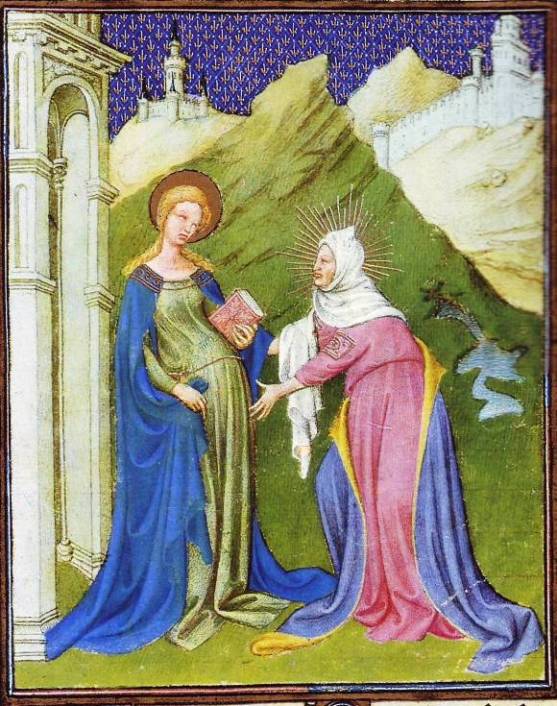
Names in Elizabeth’s story
Elizabeth is Eli-sheba. It means ‘God’s promise’, or ‘my God is generous’.
Mary means ‘wise woman’ or ‘lady’. It is a Greek form of the Hebrew Miriam or Mariamme, and was the most popular woman’s name at the time of Jesus.
John means ‘God has been gracious’.
Zechariah means ‘God has remembered’.
The main ideas in Elizabeth’s story
- The gospel-writer Luke used Elizabeth’s story to set the stage for the birth of Jesus. Both stories have an Annunciation by an angel and songs that praise God, eg the Magnificat.
- In the Old Testament, God’s power is often shown through a woman who prays and gives birth after everyone else has given up hope.
- Elizabeth marked her son as different when she insisted on a non-family name. This and the sudden illness and recovery of her husband Zechariah perplexed Elizabeth’s neighbors, but she stood firm against a doubting community.
- Inspired by God, she knew John was a child with a great destiny.
LEAPING FOR JOY
A Commentary on the Visitation by Fr. Gil Alinsangan
ln his infancy narratives Luke, both physician and artist, uses a style called diptych, where two stories are presented in parallel panels for easier comparison.
In his gospel, two birth narratives are being contrasted: that of John the Baptist and that of Jesus. A quick look at the first two chapters of the Gospel of Luke reveals parallel stories of annunciation, birth, circumcision and naming, witnesses of birth, and growth.
The Visitation story in Luke’s gospel is unique in the sense that it is not presented in diptych. Luke breaks the pattern.
After focusing on parallel events as they develop in separate scenes, Luke now brings the most important characters together in one setting
- we have Mary meeting Elizabeth (and Zechariah)
- but more importantly, the main protagonists — Jesus and John – meet even while both are still in the womb.
Underlined in today’s Gospel is the spirit of joy that sweeps through the atmosphere like a longed-for December breeze on a hot day in Australia. The Lord has come. This Lord now comes in the person of the baby yet to be born; thus Elizabeth feels privileged to be visited by Mary, the ‘mother of my Lord’.
Even John the Baptist leaps for joy. Luke will use this same image when he writes about the joy of the shushben or “friend of the bridegroom” when he hears the voice of the bridegroom (John 3:29).
ln the ancient world, the coming of a great ruler brought rejoicing to the populace. Rome grandiosely proclaimed September 23, the birthday of Emperor Augustus “the birthday of the god marked the beginning of the good news for the world”.
Luke contradicts this propaganda by saying that it is the coming of Jesus that is the real good news and the cause of true ioy. The Baptist feels it while still in the womb. The herald angel will announce it on the night Jesus is born.
Bible Study Resource for Women in the Bible:
Elizabeth, Mother of John the Baptist, Visitation of Mary