THE CRIPPLED WOMAN     RETURN TO HOME PAGE             
 

JESUS RAISES THE CRIPPLED WOMAN: Gospel of Luke, Women in the Bible


Bible  Study Resource: Women of the New Testament
The Crippled Woman Meets Jesus and is Cured

What the story is about:
An important part of the ministry of Jesus was the healing he gave to people who were disabled in a physical, emotional or mental way. The story of the crippled woman deals with physical healing, but it has a larger dimension. Her twisted body, permanently bent downwards, was a symbol of those who lack hope. The story suggests that, with Jesus’ help, we can raise ourselves so that our vision is upwards, to God.


ON THIS PAGE:

What the story is about:

Setting the Scene

The Woman is Cured by Jesus

Debate: healing on the Sabbath 

Summary

Attitudes to Women at that Time

Activities and Focus Questions

Interesting Websites


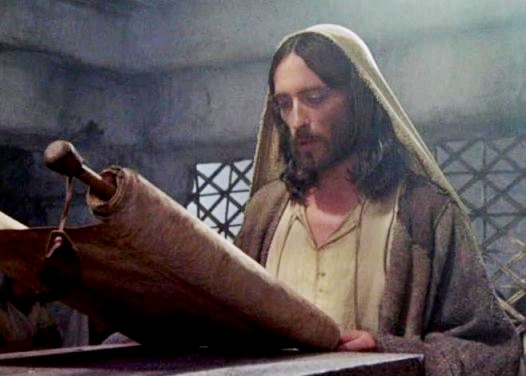
               Torah scrolls in a synagogue


CRIPPLED WOMAN: BIBLE WOMEN; TORAH SCROLLS


This story from Luke’s gospel occurs in one episode. 
‘Now he was teaching in one of the synagogues on the Sabbath. And just then there appeared a woman with a spirit that had crippled her for eighteen years. She was bent over and was quite unable to stand up straight. When Jesus saw her, he called her over and said “Woman, you are set free from your ailment”. When he laid his hands on her, immediately she stood up straight and began praising God. But the leader of the synagogue, indignant because Jesus had cured on the Sabbath, kept saying to the crowd “There are six days on which work ought to be done; come on those days and be cured, and not on the Sabbath”. But the Lord answered him and said “You hypocrites! Does not each of you on the Sabbath untie his ox or his donkey from the manger, and lead it away to give it water? And ought not this woman, a daughter of Abraham whom Satan bound for eighteen long years, be set free from this bondage on the Sabbath day?” When he said this, all his opponents were put to shame; and the entire crowd was rejoicing at all the wonderful things that he was doing.’
(Read Luke 13:10-17)


SETTING THE SCENE

Jesus was teaching in a synagogue, on the Sabbath. There were two places of worship in first-century Palestine:

  • the Temple in Jerusalem, where people worshipped God by making sacrifices. It was regarded as a sacred place and access was limited to those who purified themselves by washing (see BIBLE ARCHITECTURE: JERUSALEM for reconstructions, information and floor-plans of the Temple of Jerusalem)

  • the synagogues, where people gathered to read and discuss the Scriptures. There were thousands of synagogues through Palestine, public buildings in which people could meet, talk, pray, argue, share information and sing. Anyone might attend them. Visitors were welcome. Sacrifices were not offered in synagogues. (See below for information about women's lives.)


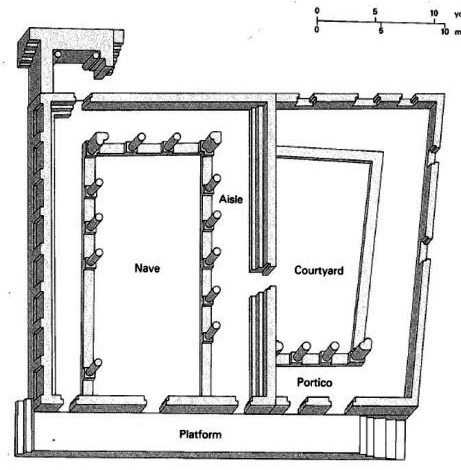
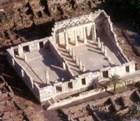
                                                                 Interior of an ancient synagogue, with recess for Torah scrolls


CRIPPLED WOMAN: BIBLE WOMEN;  ANCIENT SYNAGOGUE

Synagogues contained:
  *  a chest for the scrolls of the Scriptures
  *  a raised podium from which the texts were read
  *  a seat of honor in the center of the room
  *  rows of stone benches around the wall.

See BIBLE TOP TEN: BUILDINGS for a description of the synagogue at Capernaum. 
There might be a leader of the synagogue, but any man who could read, who knew the Scriptures, and who was respected by the community could be a speaker - Jesus obviously fitted this description. A leader, in this case Jesus, spoke from the middle of the room, reading the Scriptures and offering comments; then there was a general discussion of the text he had read.

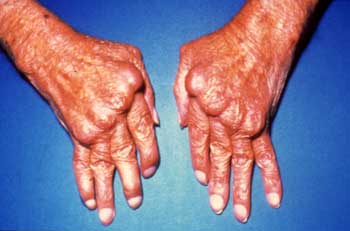
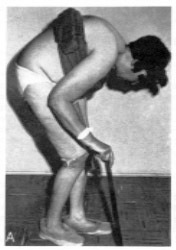
There was a woman there, listening to Jesus. She had been crippled for eighteen years with a spinal deformity that left her body twisted. She may have had acute arthritis. The people of the time thought that she was crippled because her body had been taken over by a spirit or demon.

Spirits and demons appear frequently in Luke’s gospel, in different guises. Jesus is conceived by the Holy Spirit (1:35); at Jesus’ baptism, the Holy Spirit descends on him in the form of a dove (3:21); Jesus is tempted in the desert by a spirit or demon (4:1-13); Jesus teaches that ‘the Spirit of the Lord is upon me’ (4:18); Jesus frees people from unclean spirits and from demons that cause cosmic disorder. Luke therefore shows Jesus as being
    *   inspired by the Holy Spirit
    *  able to control spirits that (Luke believes) cause illness, either mental or physical.

                                                   Arthritic hands; examples of spinal deformity


CRIPPLED WOMAN: BIBLE WOMEN;  ARTHRITIC HANDSCRIPPLED WOMAN: BIBLE WOMEN;  SPINAL DEFORMITYCRIPPLED WOMAN: BIBLE WOMEN;  DEFORMITY IN SPINE


THE WOMAN IS CURED BY JESUS

The woman in the story could not straighten her body, so she could not look upwards or forwards. The shape of her body, always bent over towards the ground, was a symbol of people who are stunted and distorted by ignorance, prejudice, anger or malice. As it was, she could see only the dirt at her feet, as many people can see only the bad side of things. She could not look up and see the possibilities before her. She could not see the smiles on people’s faces. She could not see the sky. She could only see downwards to the dirt.

Jesus called her over into the center of the synagogue, from the side where she had been standing. 
This was an unusual thing for a male religious leader of Jesus’ time to do. Women usually stayed in the side area of the synagogue, sitting on built-in masonry benches in rows against the wall. Jesus must have walked across and led her to the center of the room.
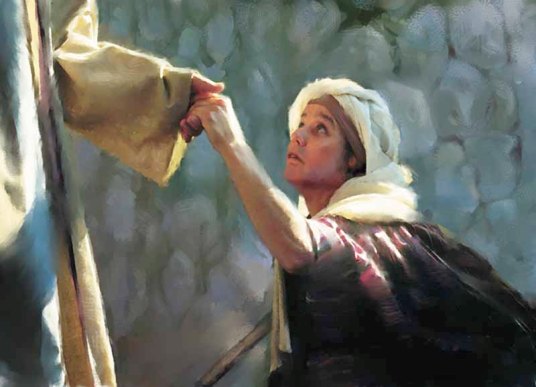
He told her that she was free from whatever had twisted her body into a deformed shape. He put his hands on her, and immediately she was able to straighten her body. She could look upwards, and she could see forwards. It was not just her body that was healed, but her soul as well. Her immediate response was to praise God.


wpe2.jpg (35632 bytes)

Jesus raises the crippled woman


THE DEBATE ABOUT HEALING ON THE SABBATH

The leader of the synagogue reminded Jesus that curing of the sick was only permitted on the Sabbath to save a life. After all, there were six other days in the week when healing could be done. The Sabbath should be kept special, set aside as a time for praising God, not to be used for anything else.
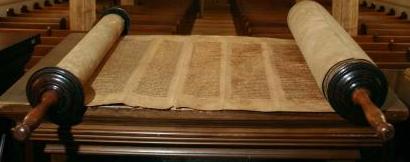
This type of debate was common in synagogues in first-century Palestine. Jews have always been fascinated by the precise meaning of the laws in the Torah (the first five books of the Bible) and the exact way that Jews ought to live their lives.

Jesus argued that if you could water an animal on the Sabbath (which was allowed) then you should be able to help a woman who was ill.
His argument is that the Sabbath is a day set aside for people to praise God. If what you are doing praises God, shouldn’t it be allowed?

Jesus was not alone in holding this opinion. Several other Jewish rabbis at that time taught that the Sabbath was made for people’s benefit, and should not be a burden for people.

The story finishes by noting that everyone was happy with the wonderful things that Jesus did. Everyone was rejoicing. Surely, says the author of Luke’s gospel, what Jesus did is right. He has observed the true purpose of the law, because people praise God as a result of what he has done.


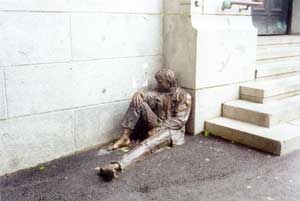
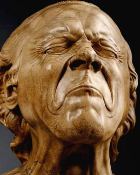
CRIPPLED WOMAN: BIBLE WOMEN;  HOMELESS, SCULPTURE

Summary

Luke’s story about the crippled woman was about hope. We should focus on that which praises God, that which is optimistic and hopeful. If we do so we shall, like the crippled woman, be inspired to straighten our selves to a standing position, where we see forward to the possibilities in life, and upwards to God for inspiration.


                                This modern sculpture suggests there are many different ways of being crippled


ATTITUDES TO WOMEN AT THAT TIME

Gospel stories are often discussed as if they happened in isolation, outside the real world. But in fact they occurred within a historical context, against a cultural background quite different to our own. Knowing about the world of the gospel gives the reader a better understanding of the stories.

Greek philosophy was greatly admired at the time of Jesus, and it had a profound impact on the way that people saw their world. One of the greatest philosophers, Plato, proposed the theory of dualism, suggesting that everything in the cosmos had an equal and opposite other. This theory had a profound impact on the way that women were viewed, and it was not to women's advantage. 'Woman' was placed in a category containing elements that were viewed as negative:CRIPPLED WOMAN: BIBLE WOMEN;  YIN AND YANG

    Man   -                 Woman
    Civilization   -      Nature
    Reason/logic   -  Emotion 
    Good   -               Evil
    Light   -                Darkness

Keep in mind that
     Civilization was the ideal; Nature was mistrusted and potentially dangerous
     Logic and reason were admired, and emotion was to be subordinated.
     Goodness was always preferable to evil.
     Light, especially in the pre-industrial world, was preferred to darkness. 


                                                                                                                                                                    'Sin', Franz Stuck


CRIPPLED WOMAN: BIBLE WOMEN;  SIN, FRANZ STUCKThese are examples only, but they show that Platonic dualism placed women in a negative category. They were seen as closer to the natural/animal world than men. By nature they were irrational and untrustworthy, and therefore unfit to make their own decisions and govern their own lives. They had to be looked after and controlled, never treated as equals.

This differed from the traditional Jewish way of looking at the world, which saw all things in creation as integrated and complementary, rather than as opposites of each other. An example of this is the creation story of Eve, which relates that the first woman was created from a rib taken by God from Adam's side, thereby suggesting that a man could never be fully complete unless he was in partnership with a woman. See BIBLE MEN AND WOMEN: ADAM for the story of creation, and WOMEN IN THE BIBLE: EVE for Eve's story.


Jewish and Jewish/Christian women resisted the ideas of Platonic dualism, which patronized them and diminished their status. While Christianity remained a Jewish sect, the status of  women within the Christian communities was high.

But as the ideas of Christianity moved out into the Gentile, Hellenised world, the first Christians found they had to use the Greek philosophical framework to explain their beliefs and be accepted. So Jesus' original ideal of mutual respect between the sexes was watered down and changed. Women found they were given roles that were acceptable in the outside, Hellenistic culture. In doing so, the Christian church stepped back from the radical ideals of the first Jewish/Christians.

Women were still powerful in the private sphere, but were shunted to the side in the public arena. This shows up, for example, in 1st and 2nd century re-tellings of the biblical stories. Where these stories had often had women as central characters, they now focused on men and male activities.


                                                                                                                                                               The ideal Roman matron


CRIPPLED WOMAN: BIBLE WOMEN;  ROMAN MATRON An example of this is the story of Moses’ birth in Josephus’ Antiquities (Josephus was a Jewish writer and historian of the 1st century BC).
In the original biblical telling of the story (in Exodus 1 and 2) the baby Moses is saved by the two midwives (see their story in BIBLE TOP TEN: HEROINES), by his mother, by his sister, and by Pharaoh’s daughter – all, obviously, women.

In Josephus’ retelling of the story written in about 94AD, the focus is largely on Moses’ father Amram. He performs many of the actions previously attributed to the women. Female characters in the story are changed. The mid-wives in Josephus’ retelling
     are Egyptian, not Hebrew
     are unnamed
     are not present at Moses' birth
     kill Hebrew babies, not save them.
The basic story of Moses’ birth remains the same, but the female dimension has been lost.

There were reasons for the changes Josephus made to the story. He was trying to counter the anti-Semitism that existed in Rome at the time, so he wrote about Jewish women who behaved like decent Roman matrons! This ideal of Roman womanhood had been vigorously promoted in a ‘back to basics’ program by the emperor Augustus and the Roman authorities. 

The ideal Roman woman, they said, was a mother of many children, content with her household duties. She kept to her traditional role, in the home, and did not speak assertively to the men in her family. She did not enter the public world. 

For additional information on the lives of women in the Bible, see

FAMILY, WORK AND RELIGION

MAJOR EVENTS IN A WOMAN'S LIFE - Puberty, menstruation, marriage, childbirth, death and burials

CLOTHING AND HOUSING 

________________________________________________________________


ACTIVITIES AND FOCUS QUESTIONS

Healing Today
Find out about the various ways that healing is done in our community today. Make sure that you include examples of emotional and mental healing as well as physical healing.
In groups, discuss
·     experiences you have had of healing
·     the advantages and disadvantages of different types of healing.

Coping with Illness
Recall a time in your life when you were ill or unhappy. What effect did your illness have on your emotions? On your work? On your relationships with other people? What helped you to recover? What could your friends or family have done to help you recover?
Did the illness/unhappiness result in any changes in the way you lived your life? Would you have suggestions for someone going through the same experience?

Exploring the Gospels
Explore the gospels to find other stories of healing by Jesus.
· What illnesses do these stories describe?
· How would they be treated today? 
· Are the illnesses or people in the story symbolic of larger issues? If so, what are they?  

Focus Questions for the gospel passages
1. What are the most interesting moments in the story? Why do these particular moments appeal to me?

2. In the story, who speaks and who listens? Who acts? Who gets what they want? If you were in the story, which person would you want to be friends with? Which person would you want to avoid?

3. What is God's interaction with the main characters? What does this tell you about the narrator's image of God? Do you agree with this image?

4. What is happening on either side of the story, in the chapters before and after it? Does this help you understand what is happening?

5. The narrator/editor has chosen to tell some things and leave other things out. What has been left out of the story that you would like to know?

6. Are the characteristics and actions of the people in the story still present in the world? How is the story relevant to modern life, especially your own?


______________________________________________________________________

INTERESTING SITES - stories, pictures, information

THE JERUSALEM TEMPLE CONTRASTED WITH THE MORE INTIMATE SYNAGOGUE
BIBLE ARCHITECTURE: JERUSALEM

RUINS OF THE SYNAGOGUE AT CAPERNAUM
BIBLE TOP TEN BUILDINGS

________________________________________________________________


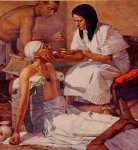
The practice of medicine in ancient Egypt


CRIPPLED WOMAN: BIBLE WOMEN;  PRACTICE OF MEDICINE IN ANCIENT EGYPT


________________________________________________________________
Bible Woman - Women of the New Testament
The Crippled Woman Meets Jesus and is Cured - Bible  Study Resource


Custom Search