
Who is the Adulterous Woman?
The woman’s story has two parts:
1 The woman is brought before Jesus (see John 8:2-3)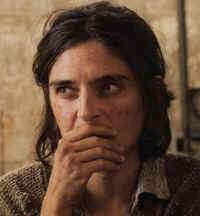
It is early morning, and Jesus is at the Temple, teaching. Some Jewish leaders bring a woman to him. She has been found guilty of adultery. Would Jesus condemn this woman, or let her go?
2 Jesus responds (see John 8:4-11)
The Temple leaders (scribes and Pharisees) challenge him to find a solution to a problem: what is to be done with this woman guilty of adultery, a capital crime? Jesus does not question her guilt, or condone it. He enigmatically refuses to speak, but instead writes in the gravel.
Then he straightens up, looking at the crowd of accusers: ‘Let the person who is without sin cast the first stone’. One by one the crowd melts away. Jesus tells the woman to go, and not to sin again.
The Adulterous Woman: a trap for Jesus
We are in Jerusalem, and it is not long before Jesus’ own death. He is probably spending his days in Jerusalem and his nights in the house at Bethany, traversing the valley and hill road between these two places each day.
This is an introspective Jesus, not the vigorous man who roamed the countryside of Galilee teaching anyone who would listen. This man knows he is in danger, and knows he is surrounded by enemies.
But instead of doing what the rest of us would do and heading back to safety in Galilee, he faces the danger head-on, in the Temple.
His presence here is a tacit statement that he will not back down from who he is and what he believes.
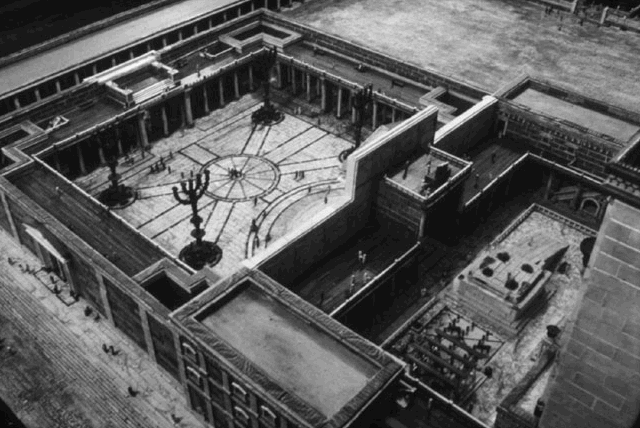
An aerial image of the Women’s Court (left, with patterned floor) and surrounding Court of the Gentiles in the Jerusalem Temple at the time of Jesus (from a reconstruction built by Alec Gerrard)
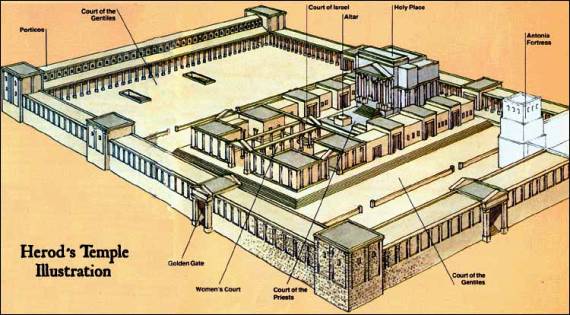
Early morning in the Temple of Jerusalem
It is early morning, and the place is only beginning to stir. There are not many people around, not the crowds that will gather later in the day. In this muted atmosphere, in the great open courtyard of the Temple, Jesus is approached by a group of people.
They are the scribes and Pharisees, the educated people of their day, cautious, law-abiding, economically prosperous. Most of them are lawyers and civil servants of one kind or another.
They know their worth. They have worked hard to get where they are, and take their responsibilities seriously.
One of these responsibilities is maintaining calm in a society that is prone to mayhem.
It is not easy to do. There have been frequent rebellions against the Romans who, if there is any trouble, will kill first then ask questions later.
The scribes and Pharisees, much denigrated in Christian literature, are in fact trying to maintain the status quo.
Why do the Pharisees approach Jesus?
 They see Jesus as a threat to stability. He constantly challenges the traditional authorities and appears to have a gang of followers who accompany him everywhere.
He disregards the normal Jewish ritual laws about eating, by sitting down to meals with known law-breakers.
With Passover now approaching and the crowds flocking to Jerusalem, he must be kept in check. Any hint of rebellion at this time will bring down the wrath of the Romans on a lot of innocent heads.
One way of containing him would be to discredit him as a teacher. If he is given an insoluble dilemma and fails to find a solution, his reputation will be undermined, and people will be less likely to flock around him.
This will diminish the danger he poses to himself, to them, and to others.
What should happen to the woman?
They hit on a problem they themselves are wrestling with: what to do when the Law of Moses and the edicts of the Romans challenge each other. Such a situation arises whenever they are commanded by the Law of Moses to impose the death penalty for a particular offense, such as adultery.
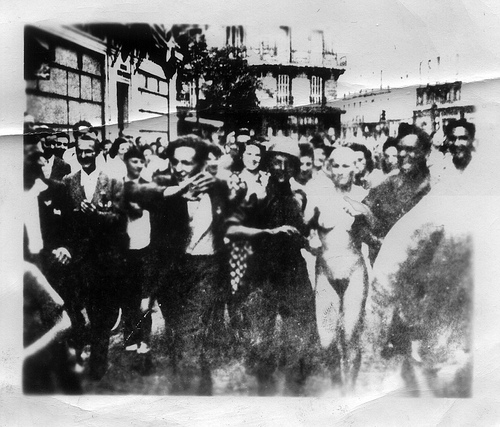
French woman accused of collaborating with a German soldier, France 1944
The Romans have authorized their appointee, the Governor, to impose the death sentence. No other person may do so.
What, the scribes wonder, is the right thing to do in this situation?
- Follow the Law of Moses which as Jews they are required to do, and risk the consequences?
- Or sensibly do what the Romans command?
Some-one hits on the idea of posing this question to Jesus. They have been arguing about what to do with a particular case, the case of a woman who has been charged with adultery, and would like to hear what he says. It can do no harm to try.
But there is also the possibility he will slip up when he responds, and if this happens they can organize some sort of accusation that will remove him from the public sphere, at least for the time being, at least until Passover is over.
They take the woman from her prison cell to the Temple precincts where Jesus is teaching, presumably in the outer courtyards of the Temple – the Court of the Gentiles or the Court of Women would be the only areas she could be taken, since a woman could not go any further into the holy area.
Where is the man taken in adultery?
Much has been made of the fact that they take the woman but not the man with whom she has committed adultery, suggesting that the man has not been charged.
This is not correct.
By law, both parties to the adultery were charged and punished. There was no leniency shown to the man, and in fact Rabbinic law held that he was more responsible for what happened than the woman.
As for the woman herself, it is generally acknowledged that she is a young married woman. Nothing is known of her appearance, her financial status, or her family background.
All we can surmise is that she was terrified, disheveled, and hopeless, since she had disgraced herself and her family, and now faced an horrific death sentence.
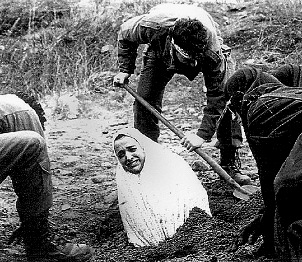
Death by stoning
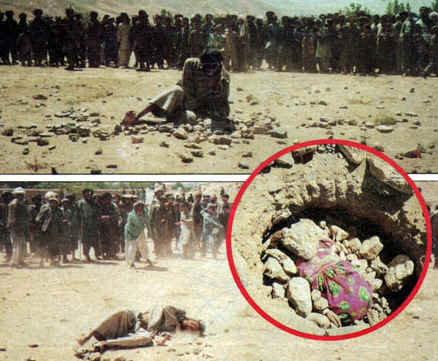
A modern-day stoning
Stoning was a particularly brutal form of execution, but a strangely logical one in the context of the times.
- The first stones had to be thrown by the witnesses to the adultery,
- and then after that each member of the community in which the two adulterers lived had to come forward and throw a stone.
The thinking behind this was that, since every person in the community threw a stone, no one person could be held responsible for the death of the pair.
This was important in a society that practised vendetta, and where pay-back would happen if a killing occurred.
The Dilemma, and Jesus’ Response to it
The scribes and Pharisees approach Jesus and present the dilemma. The woman is undoubtedly guilty of adultery, and according to the Law of Moses she should be punished by death.
The problem is that this cannot be done, since the Roman overlords have stripped Jewish leaders of the power to execute a criminal.
What is to be done?
 Jesus recognizes immediately that it is a set-up.
- He knows that if he pronounces the sentence of death on the woman, he is flouting Roman law.
- If he lets her off, he is flouting the Law of Moses. What is he to do?
Instead of answering, Jesus does something unexpected – always a good ploy. He bends down and writes with his finger on the stone paving of the courtyard.
What is he writing? Nobody knows. There have been many erudite theories on the subject, many clever suggestions, but no real answer.
The point is that he uses the time it took to write, and the act of writing, to unnerve his adversaries – and possibly to give himself time to think of a response, or calm his anger.
Remember that he was man as well as God, with all a normal human being’s doubts and uncertainties. Many people doodle when they are upset or deep in thought – perhaps he was one of them.
He may also have been trying to avoid confrontation by pretending to ignore it, another common human ploy.
What does Jesus say to the accusers?
But the questioners are not to be put off. They keep on demanding an answer, until Jesus straightens up and faces them.
Then he says the direct, devastating words that have shaped so much of Christian thinking: ‘Let anyone among you who is without sin be the first to throw a stone.’
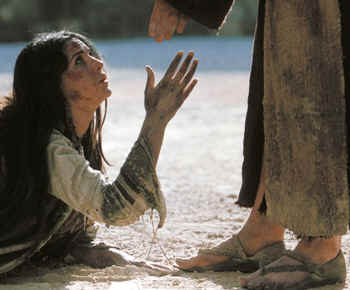 He bends down again and resumes tracing with his finger on the ground.
The authority of his words and presence obviously affects them. They are silenced at last. One by one, beginning with the most respected man among them, they melt away into the gathering crowd.
Eventually, Jesus is left alone with the woman still standing in front of him. He straightens up again, and speaks to her. ‘Where are your accusers?’ he asks. ‘Has no-one seen fit to condemn you?’ She simply answers ‘No-one, sir.’
‘Then I do not condemn you either’ says Jesus. ‘Go on your way, and do not sin anymore.’
What is the lesson in this story?
Jesus does not condone what she had done, or dismiss her sin as unimportant, or understandable. He knows, and she does too, that what she has done is wrong.
But he condemns the sin, not the sinner, and commands her not to sin again.
The woman is called to change, but the message is aimed directly at each one of us.
Main ideas in the adulterous woman’s story
-
 Christians and sinners. Pointing the finger at others has always been an easy way of shifting the blame. Many Christians register shock at social injustice in faraway places. They point to a tyrant in a foreign country or a rich man’s greed, and thank God they are not like that, ignoring tyranny in their own workplace or family, or their own runaway materialism. This story is an extension of the words of Jesus in Matthew 7:1-5, (‘You hypocrite, first take the log out of your own eye, then you will see clearly to take the speck out of your neighbor’s eye’).
 - The call to be saved. This story does not condemn the sinner, but calls the sinner to change, to be saved. Jesus wished each person there in the Temple courtyard that morning to see that they themselves were sinners, and that their chief responsibility was to mend their own ways.
Other interesting ideas
An extract from ‘Unapologetic: why, despite everything, Christianity can still make surprising emotional sense.’ by Francis Spufford
‘He arrives in a town just as a public execution is about to take place. The criminal is a woman ‘taken in adultery, which could mean that she’s been caught having literal sex with someone other than her husband. But it could also mean that she smiles at soldiers when she serves wine to them, or that she’s been seen chatting at the well with a boy who is neither her brother nor her cousin; or it could mean that she works in the brothel the town is ashamed it possesses, and has been servicing five burghers a night for a decade.
One way or another she has concentrated in herself the town’s fear and alarm about desire. And the good people have gathered to punish her. They already have in their hands the rocks the law stipulates, neither too small nor too big, which will crack her bones and mash out of her flesh the disturbance of her desirability.
Yeshua intervenes, which is not necessarily a very sensible thing to do, when virtue is breathing fast and looking forward to this kind of treat. He asks what she’s done. They tell him.
Oh, he says. Well then, the one of you who’s never wanted anything bad had better throw the first stone. And he raises his eyebrows and waits, and something in the gaze of his ordinary eyes makes the good people shuffle where they stand.
There’s a pause. Perhaps it helps that his friends have walked into town with him, equally dusty from the road, and that among the rag-tag of his followers, male and female, who’re hanging back to see what he does, there are some quite large and burly men.
But anyway there’s the hollow klok and klok and klok of stones dropping onto the ground, and the executioners slink away, and in a moment or two only the executee is left there with Yeshua and his friends. She is weeping. He helps her to stand up.’ (pages 120-121)
See the website about the Life of Jesus Christ
Bible Study Resource: The Woman Taken in Adultery
Women of the New Testament
Adulterous woman links




Famous Paintings