Pilate’s wife warned him, Pilate didn’t listen
What do we know about Pilate’s wife?
Very little, except that she was high-born, Roman, well-educated and wealthy – and the wife of the Roman governor, Pontius Pilate, at the time of Jesus’ death.
On the morning of the trial of Jesus, she sent an urgent message to her husband: ‘I had a troubling dream. Do not have anything to do with this man.’ Pilate ignored his wife’s advice and condemned Jesus to death, making his own name infamous.
Pilate’s wife is the only recorded person who spoke up against the decision to kill Jesus.
Who was Pilate?
Pilate was a politician and an administrator, probably in that order. He was always concerned about Rome’s opinion of him.
He had to be. His patron in Rome was Sejanus, who virtually governed Rome after the Emperor Tiberius retired to his villa at Capri. Pilate would keep his job only as long as he delivered relative peace and stability in the province he governed.
Judea was a difficult, rebellious part of the Roman Empire, and Pilate’s job was far from easy. Commentators call him cruel and oppressive, but this fails to take into account the hornets’ nest that was Jerusalem, especially at a time of one of the great festivals.
The city was jam-packed with hundreds of thousands of pilgrims, some of them law-abiding, some of them not. Rebellion was a constant threat, and Pilate no doubt saw Jesus of Nazareth as a potential rebel, who must be neutralized as quickly as possible.
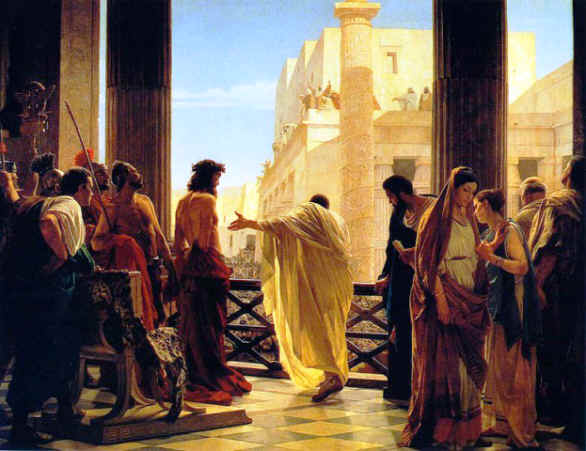
‘Ecce Homo’ (Behold the Man), Antonio Ciseri
What was Pilate’s relationship with her?
Pontius Pilate travelled constantly, keeping an eye of each area of Judea.
Judging by this story, his wife seems to have travelled with him. This may mean they were close, since life in the administrative center of Caesarea would certainly have been more comfortable for her.
Perhaps he was accustomed to seek out her advice on difficult matters; educated Roman women were often quite powerful figures behind the scenes – think of the Empress Livia’s relationship with her husband Augustus.
It depends on how you read the verse in Matthew’s gospel. On the one hand, you can see Pilate’s response to his wife as dismissive, patronising, impatient.
But is could also show a man who was affectionate, trying to reassure his wife that everything would be alright.
Who knows with a husband and wife?
Dreams and Omens – are they important?
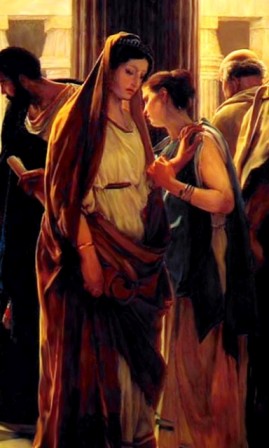
‘Ecce Homo’ (Behold the Man), Antonio Ciseri, detail of painting showing Pontius Pilate presenting Jesus to the crowd.
Pilate’s wife appealed her husband’s decision, quoting a terrible dream she had the previous night. This dream frightened and bewildered her so much that she felt impelled to act on it.
Dreams were given great significance in the ancient world, more so than they are now. Usually they were seen as a warning against some danger, or a prompt sent by God to persuade a person to do something.
The New Testament records several dreams that changed the course of history:
- the dream of the Magi, warning them not to return to Herod (Matthew 2:12)
- the dream of Joseph of Nazareth, warning him to flee to Egypt (Matthew 2:13)
- the dream telling Joseph to return from Egypt and settle in Galilee (Matthew 2:19 and 2:22)
All of these dreams appear in the gospel of Matthew, who was writing for a Greek, Jewish and Christian audience.
In his own way he knew about the promptings of the subconscious.
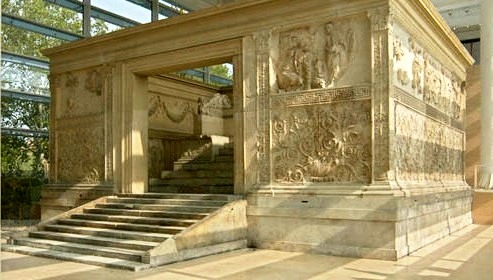
The Ara Pacis, an altar to Peace built by the Emperor Augustus. This was newly built at the time of Jesus’ death. The wife of Pilate must have seen this shrine, and perhaps attended a religious sacrifice there.
The Dream of Pilate’s Wife
So why does Matthew bother to mention the incident?
Perhaps because her dream is a warning to Pilate from someone he trusts. This makes it all the worse when he ignores it. So the gospel implies that he really was at fault when he rejected her advice.
In much the same way, Calpurnia is supposed to have warned Julius Caesar not to go to the Senate on the Ides of March. Both stories show a man who will not even take advice from a trusted person. The sin of pride is therefore worse.
Despite this, the gospel writers were going out of their way to present the Roman authorities in a good light.
This was sensible politics at the time, since the gospels were written not long after the disasterous rebellion against Rome, in which a good proportion of the Jewish population were annihilated (see this story at ‘Masada‘).
It was sensible (if you wanted to survive) to present the Roman authorities in a good light, and cast the blame on the Jewish hierarchy. This was only prudent.
But even so, the gospel writers would not concede that Pilate was blameless. They refused to exonerate him from guilt.
_____________________________________________
PILATE’S WIFE
by Carol Ann Duffy
Firstly, his hands — a woman’s. Softer than mine,
with pearly nails, like shells from Galilee.
Indolent hands. Camp hands that clapped for grapes.
Their pale, mothy touch made me flinch. Pontius.
I longed for Rome, home, someone else. When the Nazarene
entered Jerusalem, my maid and I crept out,
bored stiff, disguised, and joined the frenzied crowd.
I tripped, clutched the bridle of an ass, looked up
and there he was. His face? Ugly. Talented.
He looked at me. I mean he looked at me. My God.
His eyes were eyes to die for. Then he was gone,
his rough men shouldering a pathway to the gates.
The night before his trial, I dreamt of him.
His brown hands touched me. Then it hurt.
Then blood. I saw that each tough palm was skewered
by a nail. I woke up, sweating, sexual, terrified.
Leave him alone. I sent a warning note, then quickly dressed.
When I arrived, the Nazarene was crowned with thorns.
The crowd was baying for Barabbas. Pilate saw me,
looked away, then carefully turned up his sleeves
and slowly washed his useless, perfumed hands.
They seized the prophet then and dragged him out,
up to the Place of Skulls. My maid knows all the rest.
Was he God? Of course not. Pilate believed he was.
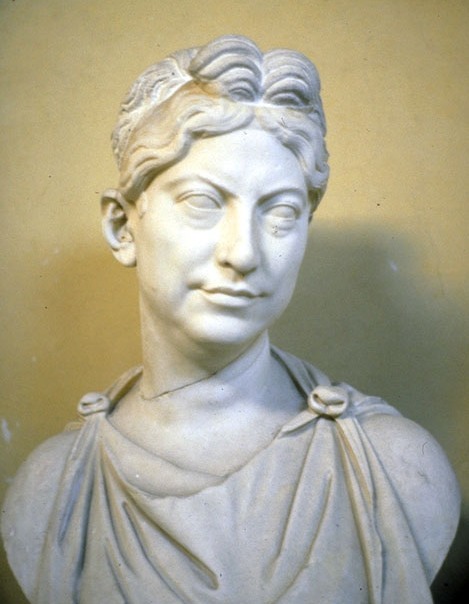
Marble bust of a Roman matron
Pontius Pilate’s wife is not named in Matthew’s gospel because naming a person makes them real, and that was not Matthew’s purpose.
 Why isn’t she named? Because Matthew wanted his listener/reader to focus on the incident and what it showed about Pilate, rather than on the person who was Pilate’s wife.
In later centuries she was called Claudia Procula, but it is impossible to tell whether this was her real name or an invented one.
‘Pontius‘ is a variant on the Latin word ‘pons‘, meaning ‘bridge’. It may also have been a family name linked to the ancient Roman province of Pontus in Asia Minor – at the eastern end of the Black Sea. The origin of ‘Pilate‘ is unknown. A similar Latin word is ‘pilum‘, or javelin.
Main themes in the story of Pilate’s wife
- Messages from God. People in the ancient world were aware of the subconscious mind. They believed dreams could carry a significant message from God – or in the case of this Roman woman, from ‘the gods’.
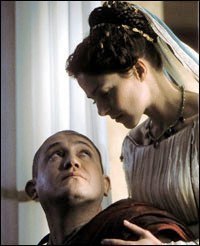
The wife of Pontius Pilate advises her husband
- We should listen for God’s voice in whatever guise it takes. Pilate’s wife called Jesus ‘this innocent man’. Through her, God gave Pilate a chance to do the right thing. Pilate ignored it.
- Listen to your own conscience. Pilate acted as he did because he cared so much about his Roman masters’ opinion. Yet for two thousand years he has been held in contempt by the whole Christian world for his fateful decision to condemn Jesus.
Bible study activities and questions

Scene from the film ‘The Passion of the Christ’, with Jesus being presented to the crowd by Pontius Pilate
Imaginative reconstruction
Imagine that you are a friend of Pilate’s wife, or her maidservant. When her message is ignored, Pilate’s wife hurries to the room where the seat of judgment is.
You accompany her. You catch a glimpse of the condemned man Jesus as he is led away. Now read Carol Duffy’s poem above, and spend time thinking about it.
Describe
- what Jesus looks like
- what he says, and what the people around him say: onlookers, soldiers, etc.
- your immediate response: what do you do and say?
- your own private emotions when you realize what is happening
- your thoughts a few days later, after Jesus has been horribly killed.
Present these descriptions and reponses in the form of a journal entry, or tell the group or a learning partner about your imagined experience.
Women in films
Identify recent films about the life and death of Jesus of Nazareth.
- What methods has the film used to present the story of Jesus?
- What was your response to these films?
- Favorable, unfavorable or both?
- Explain your ideas – to yourself, or a learning partner.
If you are interested in the way that movies present people from the New Testament, look at Modern Images of Jesus and Modern Images of Mary
Dozens of extra ideas at Activities for Bible Study Groups and Schools
RELATED SITES – stories, pictures, ideas
Crucifixion – ARCHAEOLOGICAL EVIDENCE
What rich women wore – ANCIENT JEWELRY
Trial of Jesus – CAIPHAS’ PALACE
Maps for events in Jesus’ life
Read about
more fascinating women of the Bible

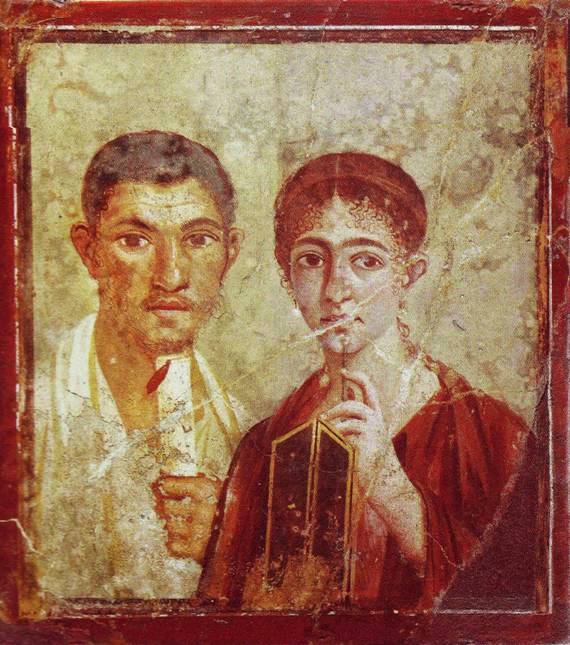
A real Roman couple: Terentius Neo of Pompeii, who lived just a few years later than Pontius Pilate and his wife
Bible Study Resource, Women in the Bible
Wife of Pontius Pilate, the trial, her dream, her warning