
Who was Mary Magdalene?
For a start, she was NOT the gorgeous red-haired woman so often shown in paintings of the crucifixion. Nor was she a repentant prostitute. Nor was she a rich and cultured European woman like the one shown below. Sorry about that.
Did Jesus & Mary have a love affair?
In a word: No
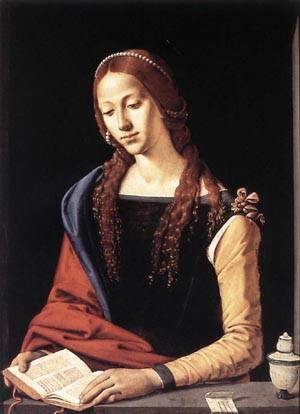
Mary Magdalene, Piero di Cosimo
How do we know?
Chiefly because his enemies never accused him of sexual misbehavior. In the years after his death, enemies of the early Christians accused Jesus of two things:
- being illegitimate; this was a serious charge, much more so than now, because a religious teacher had to have an impeccable family background, and have parents who were respected in their community
- being too fond of eating and drinking, especially with the wrong kind of people.
The first accusation
Two of the gospels (Luke and Matthew) go to considerable trouble to explain the unusual circumstances of Jesus’ conception and birth.
The second accusation
All of the gospels emphasize Jesus’ enjoyment of people and social gatherings, but are careful to place them within the context of his ministry to people, especially the disadvantaged.
The enemies of the first Christians would certainly have accused Jesus of sexual misbehaviour if there had been the slightest hint that this was a charge that would stick.
Yet there was not one charge of this kind ever laid against him.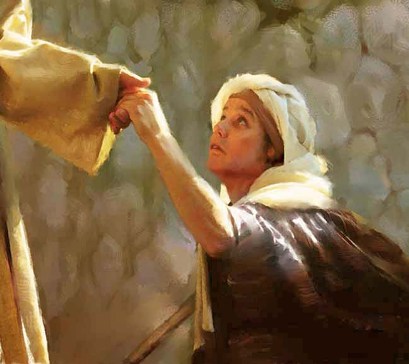
Another point: at the moment of extreme emotion when Mary sees Jesus for the first time after the Resurrection, she calls him ‘rabbouni‘, the title his disciples used.
She did not call him by his own personal name of ‘Jesus’, which she surely would have done if she and Jesus had had the sort of intimate relationship that has been suggested in popular novels.
In complete shock at the sight of a living man whose dead body she had seen only hours before, she used the word she had always used as his name, ‘rabbouni‘, teacher.
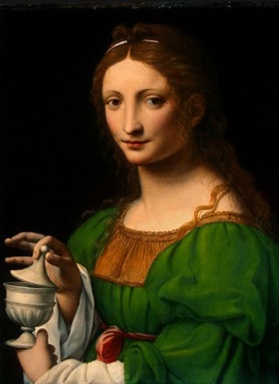
Mary Magdalene – the ideal, and the reality…
 |
 |
The truth about Mary Magdalene is…
- she was almost certainly a middle-class Jewish business-woman from the town of Magdala, a town noted for its dried fish and wool dyes. Nothing sexy there.
- she suffered a severe illness, which Jesus cured.
- she seems to have been financially independent, able to offer financial backing for the itinerant rabbi called Jesus of Nazareth and his group of disciples.
- she was the leader of the group of women who sometimes travelled with, or met up with, this group headed by Jesus. Men’s and women’s groups often traveled together, for example on the annual pilgrimage to Jerusalem, but they kept strictly within their own group. We know this from the story about the boy Jesus being lost in the Temple: Mary and Joseph, the parents of Jesus, did not realize for some time that the boy was missing, when he stayed behind in Jerusalem. Each separate group thought he was with the other.
All in all, Mary Magdalene was a competent, level-headed woman with organizational skills and a desire, through Jesus’ teachings, to make the world a better place.
Why Mary is not an ex-prostitute
- Mary Magdalene is confused with the woman with the alabaster jar, described in Luke 7:36-50. The story of this other woman comes just before Mary Magdalene is first mentioned. The woman with the alabaster jar has the characteristic features that were later transferred onto Mary Magdalene: long flowing hair, tears of repentance, and a ‘past’.
- She is described in Luke 7:37 as a ‘sinner’, a word which was interpreted by the early Church fathers as ‘prostitute’. That was a mistake. When Luke describes an actual prostitute in 15:30, he uses a different word altogether.
- Later celibate male interpreters of the gospels linked Mary’s illness, her ‘demons’ (Luke 8:2) with her sexuality. This might say more about them and their own ‘demons’ than it says about Mary.
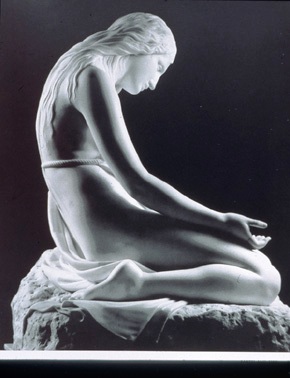
The penitent Magdalene,
sculpture by Canova - Mary is also confused with the woman who has committed adultery, in John 8:1-11. Someone recently argued that people at the time of Jesus knew that Mary Magdalene was his wife because they threw stones at her. It is hard to know how to counter this sort of argument, since the person making the statement has obviously never actually read the gospel story. The unnamed adulterous woman lived in Jerusalem in Judea, not Magdala in Galilee, where Mary came from. There would be no reason at all for anyone to stone a wife of Jesus, supposing he had been married. And the woman in the story is about to be stoned to death because she has been discovered in the act of adultery, not because she has married a popular rabbi.
- Showing Mary Magdalene as a beautiful ex-prostitute created a dramatic contrast to the Virgin Mary, the perfect virgin/mother. This contrast mirrored a philosophical idea popular during the period of the early Church: Platonic dualism. Plato had proposed that everything in the universe had an equal and opposite other, for example man/woman, logic/emotion, good/evil, light/darkness, etc, (see Platonic dualism in The World of Mary Magdalene). People of the time admired Greek thought and culture, so they copied these ideas.
In the centuries following Jesus’ death, Mary Magdalene was seen as everything the Virgin Mary was not:
- a flamboyantly beautiful ex-whore who was the perfect foil for
- the modest virgin/mother Mary.
Both images were legend, not truth.
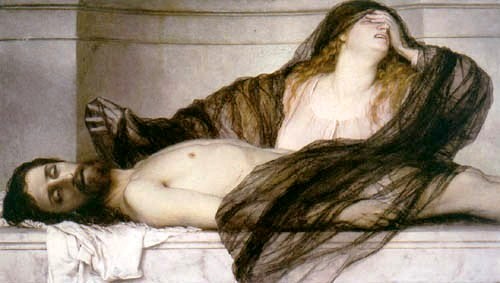
Mary Magdalene at the tomb of Christ, Trauer
Jesus was a noted rabbi & teacher
Jesus had a considerable following during his life, enough to make him a cause for concern to the Roman and Jewish authorities. The gospels often mention crowds of people who gathered to hear him teach. So he was a noted rabbi and teacher during his life.
But Jews expect a high standard of behavior at all times from their rabbis, who must be constant role models to their followers. The Jewish crowds would never have paid any attention to a rabbi who consorted with a woman who was not his wife, or who had a ‘secret’ marriage.
This would have instantly destroyed his credibility as a teacher.
If his disciples had doubted his integrity for even a moment, as they surely would have if he had been having any sort of illicit relationship with Mary Magdalene, they would have abandoned him and turned to some other teacher.
There were many rabbis and teachers in 1st century Palestine for them to choose from.
If Jesus married, would he hide the fact?
In a word, NO
At the time that Jesus lived, a wife would have been seen as a plus. Jesus was Jewish. The first commandment in the Jewish Scriptures is to ‘be fruitful and multiply’. Jews take this commandment so seriously that they have always endorsed marriage and sexual love.
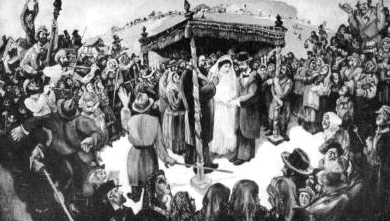
A Jewish wedding
A Jewish man did not consider he had properly fulfilled his obligations to God until he was married.
The only exception to this was a man who chose to devote himself to the study of the Scriptures, although even then he was encouraged to marry.
It is not impossible that Jesus had been married as a young man and was a widower.
It is more likely that he had chosen the second way of life, of teaching and studying Scripture, and had not married because his itinerant way of life made this impossible, in that culture at that time.
If Jesus had had a wife at the time of his ministry, he would have been proud of the fact. He would certainly not have tried to keep it hidden. There would have been no ‘secret marriage’.
Christianity in a later period endorsed celibacy as a way of life, but as a Jew, Jesus would have been perplexed by the idea of celibacy, seeing it as non-fulfillment of God’s command.
What about the gospel of Mary Magdalene?
This text was written at least a century after the events, and certainly not by Mary Magdalene.
It was written for a specific purpose, to promote the role of women in the church hierarchy of the time, by people who believed in the truth of their own dreams/ visions.
- Different translations of this piece of writing give different impressions of the vision described.
- The exact meaning of the words is much debated.
- The original remnant of manuscript is badly worn, tattered and difficult to decipher.
- Moreover, the words are open to different interpretations, eg does ‘kiss’ mean the common kiss of greeting, or a sign of unity and compassion, or a sexually passionate act?
- The manuscript does not make this clear, and describes what seems to be a symbol-laden dream/ vision, not a real act.
Bible Women: The Da Vinci Code
Why Mary Magdalene did not marry Jesus of Nazareth
Bible Study Resource
Mary Magdalene links









Bible study activities
has a list of movies about women like Mary Magdalene – who take a leadership role to support someone they believe in