
Who was Naamah in the Bible?
Wife of King Solomon, woman of mystery
 Naamah
- was wife of the dazzling King Solomon and
- mother of a foolish son Rehoboam, who squandered his inheritance.
She had a crowded life, yet there is virtually no trace of her. We know her name, where she came from, her husband’s and son’s names – and nothing else. Reconstructing her life is a detective game.
Naamah’s story: the basic facts
- Her husband Solomon reigned over Judah from about 962-922BC; her son Rehoboam from 922-915BC.
- She was a princess from Ammon, a state east of Jerusalem; the Ammonites were traditional enemies of Judah.
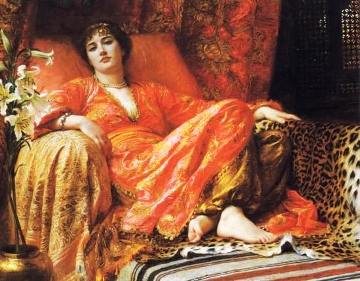
- She bore Rehoboam (who was inept) to Solomon (who was shrewd), and lived in Solomon’s large harem in Jerusalem.
If she lived past childbirth, she saw
- Solomon’s luxurious court
- the building of the Temple and palaces
- a shift from loose tribal rule to an established monarchy
- social strife: despite their popular image today, David and Solomon were by no means universally popular
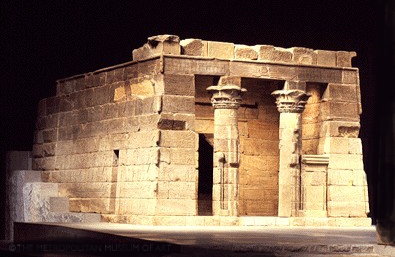
The Temple of Dendur, Egypt. Solomon’s Temple was probably similar in design
If she lived past Solomon’s death, she saw
- her son Rehoboam become king
- a breakway rebellion by the ten northern tribes
- Rehoboam mishandling the situation
- the country disintegrating into two separate kingdoms, Judah and Israel, with the much richer northern kingdom of Israel rejecting her son as king
- the Egyptian raid/invasion of Pharaoh Shoshank
- loss of the Jerusalem Temple and palace treasures, later replacement with less valuable facsimiles
- building of border fortresses
- uneasy facing off between Yahwist and Canaanite religious practices
What do we know about Naamah?
A royal woman’s status depended on her ability to bear a son to the king
Naamah was one of the many wives of Solomon – the biblical text says he had seven hundred wives and three hundred concubines (!), certainly an exaggeration of the real numbers but a graphic indication of how extraordinarily fond he was of women.
The biblical text (see below) says he loved them and clung to them, implying he was a man who enjoyed the pleasures of women above the duties of his position.
This may have been so, but Solomon also used marriage to cement relations between Israel and the surrounding territories and nations. He was not like his father David. He had a different vision of what a king should be: a hereditary political monarch rather than a popularly acclaimed leader.
His reign marks the historical mid point between two ways of selecting a leader –
- from messy, more or less democratic tribal election towards
- primogeniture, the orderly inheritance by the eldest son of the ruler, whatever his capabilities.
After Solomon’s reign primogeniture became the sometimes disputed but generally accepted principle of succession in Israel.
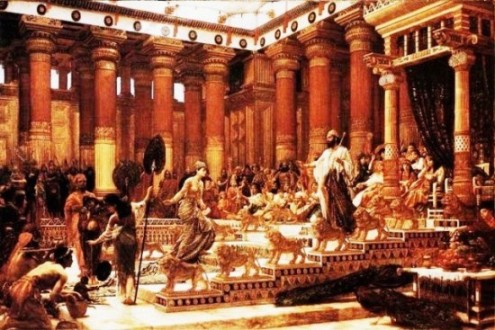
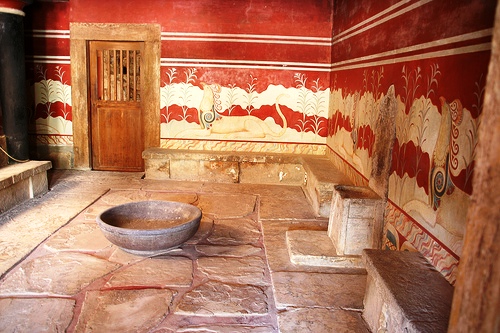
19th century artists painted Solomon in a lavish palace; in fact, Solomon’s palace in Jerusalem was relatively modest in size.
Above, the fantasy: Visit of the Queen of Sheba, Edward Poynter
Below, the more modest reality: Throne Room at Knossos
A Foreign Wife from Ammon
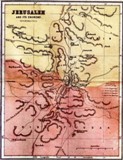
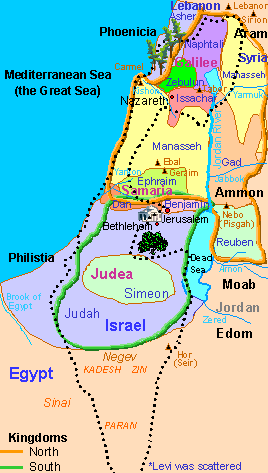 Naamah was from Ammon, a kingdom to the east of Jerusalem (see right center of map).
Presumably she was a princess of the royal house, but this is not mentioned. She is simply referred to as ‘the Ammonite’, in much to same way that Marie Antoinette was referred to as ‘the Austrian’, a disparaging title summing up the hostility of the common people to a marriage between their king and a princess from a country they mistrusted.
Ammon had an on-again, off-again relationship with Israel – it was anything but stable.
Despite this, her marriage was meant to encourage friendly relations between Solomon’s realm and Ammon, and Naamah was expected to use her influence to help the two states live in harmony.
In the Harem
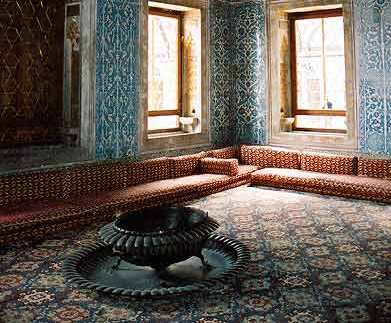
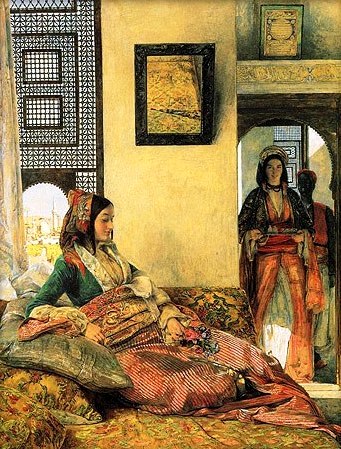
Harem room at Topkapi Palace, Istanbul
She stood out from the crowd of women in the royal harem, so she must have had
- a strong personality,
- an intelligent mind or
- a beautiful appearance –
- or perhaps all three of these.
She lived most of her life in a harem dominated by Solomon’s mother, Bathsheba – if Bathsheba lived into old age.
The mother of the king, not his wife (a king had many) was the one who ruled the roost in ancient Israel.
Mother of the King Rehoboam
Naaman was mother of Rehoboam, the king who succeeded Solomon.
If she lived to see his reign, she would have been the most powerful woman in the realm, the gebira or Queen Mother. She would
- dominated the royal harem and the women within it,
- act as an adviser to her son,
- exert considerable influence at all levels of society,
- and possibly become a cult leader, a high priestess, in the worship of deities like Asherah.
What does the Bible say about Naamah?
1 Kings 14:21-28
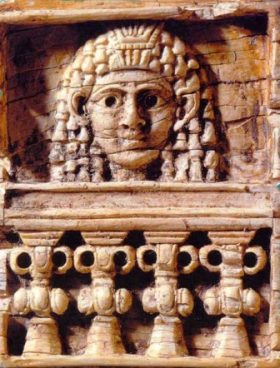
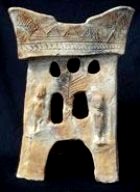
Woman at the Window – ancient pagan ivory carving
21 And Rehoboam the son of Solomon reigned in Judah. Rehoboam was forty-one years old when he began to reign, and he reigned seventeen years in Jerusalem, the city which the Lord did choose out of all the tribes of Israel, to put his name there. And his mother’s name was Naamah an Ammonitess.
22 And Judah did evil in the sight of the Lord, and they provoked the Lord to jealousy with their sins which they had committed, worse than their fathers had done.
23 For they also built high places, and images, and groves, on every high hill, and under every green tree.
24 And there were also sodomites in the land: and they did according to all the abominations of the nations which the Lord cast out before the children of Israel.

A stone relief of Shishak of Egypt
25 And it came to pass in the fifth year of king Rehoboam, that Shishak king of Egypt came up against Jerusalem:
26 And he took away the treasures of the house of the Lord, and the treasures of the king’s house; he took away all: and he took away all the shields of gold which Solomon had made.
27 And king Rehoboam made in their stead brass shields, and gave them to the chief of the guard, which kept the door of the king’s house.
28 And it was so, when the king went into the house of the Lord, that the guard bore them, and brought them back into the guard chamber.
Naamah’s World: The City of Jerusalem
If Naamah lived into old age, she saw the building of Solomon’s Temple and the Jerusalem palace.

The walled fortress of Jerusalem at the time of King David (lower right of the image). The upper area had houses, but was not fortified.
At the beginning of her marriage Jerusalem was not really a city, not like Troy, even though the site Jerusalem stood on had already been occupied for at least a thousand years.
The city started life as little more than a guard house keeping watch over the threshing floors on the large flat areas of rock on what is now the Temple Mount.
But over the years it grew in importance and Solomon transformed it, so that it became the scene of luxury and comfort.
Then as now, luxury and comfort were perks of the rich and highly placed.
But things were not so easy for ordinary people, and Naamah witnessed a period of extraordinary social transition.
Before the consolidation of the Hebrew tribes, there had been
- few taxes,
- no forced labor, and
- no foreign mercenaries.
But the population had tripled in the past two centuries, and more land had to be opened up for farming.
This took large amounts of money and careful organisation, which were things only a central administration could provide.
- Crops like olives and vines generated trade with other countries, again entailing central organisation.
- As the land value increased it became more attractive to neighboring kingdoms, and a central leadership had to counter attacks from outside.
To pay for all this, more taxes were necessary. Organizing taxes needed a central political administration, which required officials who had to be supported, so taxes were raised. And so on and so on and so on.
 Now the tribes had a permanent king.
The aim of his wars was no longer to save Israel but to control trade routes and subjugate surrounding nations, taking over their land and using their people as forced labor.
Was life now much different from Egypt, where they had been the slaves of Pharaoh?
Naamah, therefore,
- lived through a period of massive social dislocation,
- and if she survived the birth of her youngest child and lived into old age, she saw the beginnings of the disintegration of the united kingdoms of Israel and Judah.
Foreign Gods
People blamed much of this social upheaval on the power and influence of Solomon’s foreign wives, among whom Naamah was prominent. We suspect she was never a committed worshipper of Yahweh, and that she probably supported and took part in worship of foreign deities from Ammon.
This would have caused resentment among the priests of Yahweh, who were extremely powerful.
She and the other wives were blamed for Solomon’s religious laxity. He not only tolerated worship of the foreign deities favoured by his wives, but took part in it.
People felt this had resulted in
- loss of Yahweh’s protection and
- division within the kingdom which would ultimately bring ruin for Israel and Judah.
Women like Naamah were blamed.
The Bible’s take on foreign wives
1 Kings 11:1-8
‘King Solomon, however, loved many foreign women besides Pharaoh’s daughter—Moabites, Ammonites, Edomites, Sidonians and Hittites.
 They were from nations about which the LORD had told the Israelites, “You must not intermarry with them, because they will surely turn your hearts after their gods.” Nevertheless, Solomon held fast to them in love.
He had seven hundred wives of royal birth and three hundred concubines, and his wives led him astray.
As Solomon grew old, his wives turned his heart after other gods, and his heart was not fully devoted to the LORD his God, as the heart of David his father had been.
He followed Ashtoreth the goddess of the Sidonians, and Molech the detestable god of the Ammonites.
So Solomon did evil in the eyes of the LORD; he did not follow the LORD completely, as David his father had done.
On a hill east of Jerusalem, Solomon built a high place for Chemosh the detestable god of Moab, and for Molech the detestable god of the Ammonites.
He did the same for all his foreign wives, who burned incense and offered sacrifices to their gods.’
Some tantalizing questions
The question still remains: why are we given so little information about Naamah?
- Did she die young? Was there a lack of information because her life was cut short in childbirth?
- Did her origins as an Ammonite make her so unpopular that it was better to simply gloss over her story, ignore her, pretend she hardly existed?

- What was her relationship with her powerful mother-in-law Bathsheba?
- Did it effect the way her story was told? Many scholars believe Bathsheba had a hand in the writing and editing of the stories about David and Solomon. Could Bathsheba simply have edited her daughter-in-law out of history? Was this the ultimate pay-back of a mother-in-law who blamed Solomon’s foreign women for ruining the kingdom?
- Or did later editors of the text decide that the less said about Solomon’s wives the better?
These are the tantalizing questions we cannot answer.
Women in the Bible – the Royal Women of the House of David
Naamah – Ammonite princess, wife of King Solomon, mother of King Rehoboam


Click here to add your own text