Priscilla-Prisca, early Christian
Who was Priscilla-Prisca?
- Priscilla and her husband Aquila were close friends and supporters of Paul, and were founding members of the Christian Church. Paul’s letters record their long friendship, from first meeting to the agonizing farewell not long before his execution.
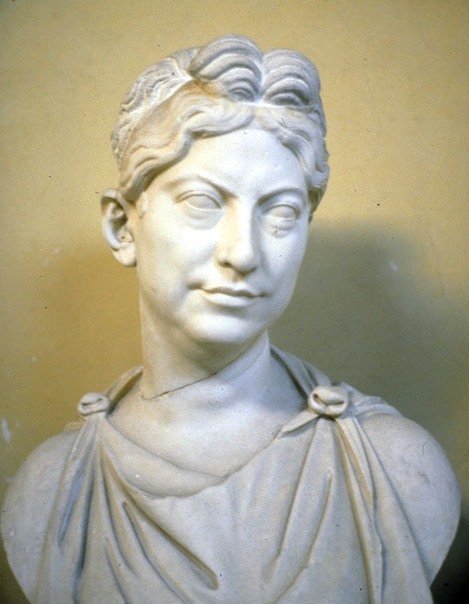
Priscilla, Bible woman
Marble bust of a Roman matron - Priscillaa seems to have been the dominant partner in the marriage, something of a mover and shaker. She was strong-minded, fervent in her love for God and Jesus Christ, and loyal to her husband.
- She was trusted by Paul to manage the infant church he left behind, and she taught the gospel as Paul had done. Neither of them had met Jesus of Nazareth, but their faith was strong. Without them to teach and organize, the church might not have blossomed as it did.
Priscilla: a woman co-founds the Church
Read Acts 18:1-3
St Paul was travelling around ancient Asia Minor, teaching about Jesus and converting Jews and Gentiles. See Map of Paul’s journeys at end of this page.
When he appears in this part of Acts, he is fresh from Athens, where he had a difficult time. Athens was no longer filled with intellectual giants as it once had been, but Paul met some stiff opposition and was hauled before the Court of the Areopagus to explain his teachings.
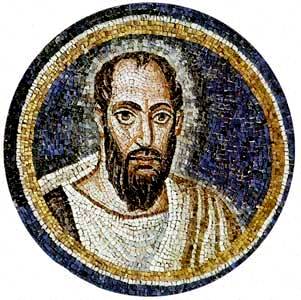
St Paul, by Spanish artist El Greco
He moved to Corinth, a great commercial city with a double harbour. It was not the sort of place you would expect to find a follower of Christ. It had a reputation for licentiousness and immorality, something of which Paul was well aware.
How did Priscilla meet Paul?
But the inhabitants were not all like this. Paul met a married couple, Priscilla and Aquila, who were only recent arrivals.
Priscilla and Aquila had been ejected from Rome by an edict of the Emperor Claudius, expelling all Jews from Rome (the idea that anti-Jewish feeling has only begun in the Christian era is nonsense; the Book of Esther describes a nation-wide pogrom centuries before the birth of Christ, and Claudius’ expulsion of Jews from Rome in 49-50AD happened when Christianity was still in its infancy).
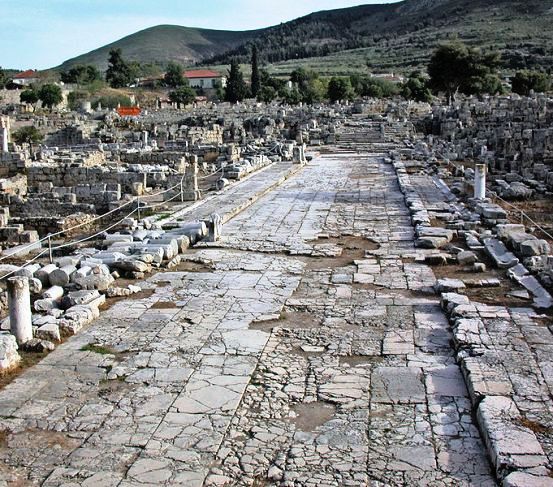
A main thoroughfare in the ancient city of Corinth
Priscillaa, Aquila and Paul almost certainly walked along this street
Paul heard about Priscilla and her husband Aquila, and sought them out. They welcomed him into their home.
They appear to have been people of some means, having their own business.
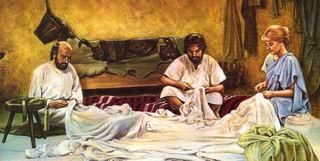
Priscilla, Aquila and Paul depicted as tent-makers; it is more likely that they were manufacturers of leather goods
They are usually described as tent-makers, but this would have been a strange occupation for settled townspeople in the 1st century Roman empire. There would not have been much call for tents.
Translators have argued that it is more likely that they, and Paul, were workers in leather goods.
The words of Acts 18:3 record that ‘by trade, they were tentmakers (or leather-workers). Notice the word ‘they’. She was actively involved in the family business.
They offered Paul work, and shelter in their home as well.
They proved to be generous, loyal friends.
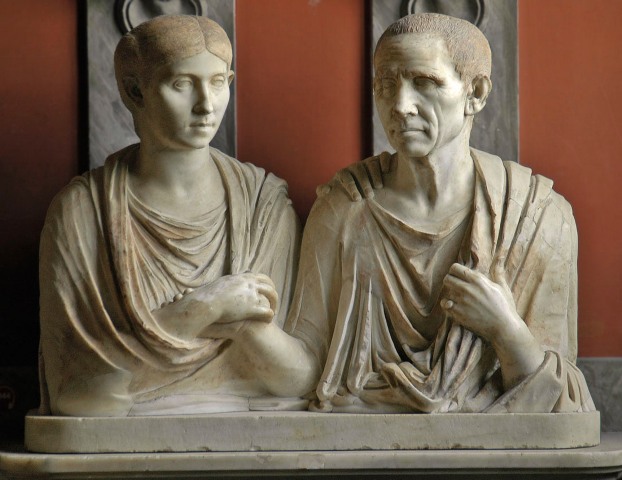
These 1st century Roman statues are of Gratidia and Gratidius Libanus, not of Prisca and Aquila, but they are a beautiful image of love and mutual support between husband and wife. The woman in particular radiates strength and calm.
Priscilla instructs Apollos
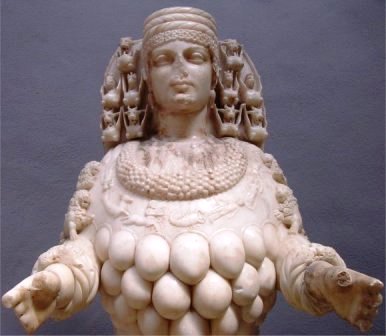
Statue of the Ephesian goddess Artemis, patron goddess of mothers and pregnant women
Read Acts 18: 18-26
No reason is given for their next move: Priscilla and Aquila travelled with Paul to Syria. After a short stay, he travelled on to Jerusalem, but they remained in Ephesus and settled there.
This time, Priscilla had a mission. Ephesus was steeped in religion and philosophy. It was the center of worship of Artemis, the mother goddess who was patron of pregnant women.
But in this city devoted to so many ancient gods and goddesses, Priscilla taught anyone who would listen about the crucified prophet Jesus, and there is no doubt she was successful.
Priscilla’s home church
So successful was she that she and Aquila set up a church in their own home. Now they were leaders of the growing Christian community. As such they became authorities about the teachings of Jesus.
A man from the Jewish community in Alexandria, Apollos, came to Ephesus. He was a scholar, and an eloquent and persuasive speaker. He spoke in the synagogue, and when Priscilla heard him she realized that, learned as he was, he did not know the full story of Jesus.
She took him aside and taught him about Jesus – what Jesus did, said, and taught.
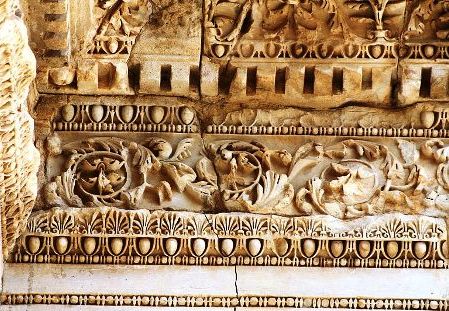
Roof/ceiling of the Celsus Library in Ephesus; it is from a slightly later period than Priscilla’s visit to the city, but gives an idea of the sumptuous sophistication of the city
It was recognised by all that she was the real authority on the teachings of Jesus, and that as such she had a responsibility to pass on her knowledge to others.
Aquila is mentioned, but in a secondary capacity. It is clear Priscilla was the one in charge.
Eventually she had to let her pupil go, hoping that her teachings would be faithfully passed on. This happened. Apollos was skilled at talking and arguing, and he passed on her teachings to the Jews in the public arena – something she as a woman could not do.
Prisca-Pricilla returns to Rome
Read Romans 16:1-3
Travel in the ancient world was swift and frequent, thanks to Roman roads and relative world peace (though travel by ship was limited to certain months of the year, because of storms in the Mediterranean.)
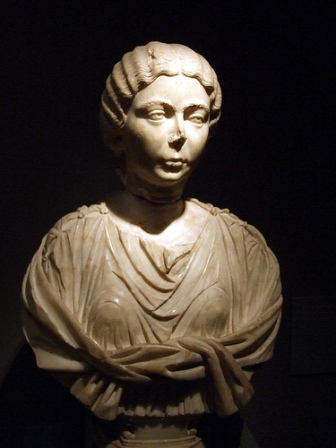
Statue of a Roman woman,
2nd century AD, Barcelona
The Jews of the 1st century AD were a commercial and migratory people. They moved along the trade routes and followed the markets.
So we next find Priscilla in Rome, where she and Aquila were greeted in one of Paul’s letters, Romans 16.
This letter has been called the ‘picture gallery’ of New Testament believers, since it lists so many members of the infant Church.
The greetings were varied. One third of the names on this roll were women, showing the prominent place women held in the church at that time in Rome.
Paul was a pioneer in the recognition of the function of women in Christian service – and the women of the time were ready to respond to the call of Christ.
What did Paul write about Priscilla?
In the roll call of friends mentioned in Romans 16, Paul gave a short description of each one. Of Priscilla, he mentioned the fact that she and her husband had risked their lives to help him. We do not know what incident this refers to, but it had certainly impressed Paul.
Whatever the incident was, it seems to be well-known to ‘all the churches’. He took for granted that all these churches were united with him in his heartfelt expression of gratitude. Again, Priscilla’s name preceded her husband’s.
‘The church in their house’ that Paul mentions refers to the fact that in the early church there were few, if any, church buildings. Groups of Christians met in houses of prominent believers or in other available rooms.
This is the first of five groups of believers in Paul’s list, but the only one referred to definitely as a church.
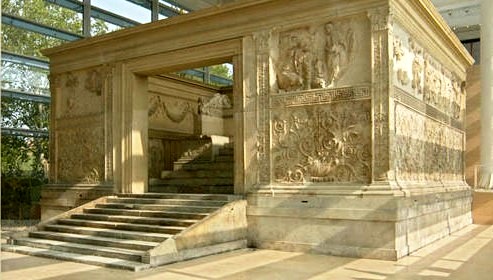
The Ara Pacis, an altar to Peace built by the Emperor Augustus.
This was newly built at the time that Priscilla was living in Rome.
She must have seen this beautiful structure
Paul’s letter to old friends
1 Corinthians 16:19
In this letter, Paul addressed Prisca and Aquila directly. He not only greeted them, but greeted them ‘warmly’.
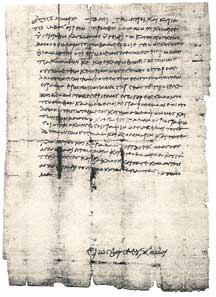
A preserved ancient scroll, written in Greek; Paul’s letters would have looked something like this
This added phrase suggests real affection between old friends. They shared memories of past times, good and bad, but more importantly they had a common zeal for the spread of Christian teachings – ‘the Way’
Good-bye, old friend
2 Timothy 4:19
Prisca stays faithful to her friend Paul to the bitter end, as we learn in 2 Timothy 4:19.
It is a sad, lonely letter, written just before the end of Paul’s life. He was in prison, probably in Rome, seemingly abandoned by all but a few of his friends and now facing imminent death.
In the letter, he said good-bye to the few friends who have stayed loyal to him – and Prisca heads the list. She must have wept to read his final words to her.
Names in Prisca’s story
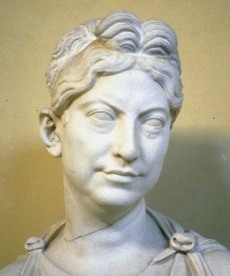
Bust of a Roman matron
The name ‘Priscilla’ was a nickname, a pet name. ‘Prisca’ was her formal name.
Aquila was her husband and co-worker in the early Christian Church.
Paul had been Saul, but after his conversion he changed his name to Paul.
Note: When the husband and wife in this story are mentioned in the New Testament, Priscilla’s name is frequently listed before Aquila’s. Despite this, Concordances of the Bible place Priscilla under the heading of her husband’s name ‘Aquila’.
Priscilla’s story in Acts of the Apostles
There are five references to Priscilla in the New Testament:
- Acts 18:1-3. Priscilla and Aquila are introduced to the reader
- Acts 18: 18-26. Priscilla instructs Apollos, an influential scholar
- Romans 16:3. Priscilla returns to Rome
- 1 Corinthians 16:19. Old friends greet each other
- 2 Timothy 4:19. Paul says a lonely farewell as he faces death
Activities and questions
Imaginative reconstruction
Imagine that you are Priscilla when Paul arrives in your house. He is shaken to his core by his experience in Athens. Describe
- what he looks like
- what he says
- your immediate response: what do you do and say?
- your own private emotions when you realize what has happened to him
- your thoughts a few days later, as he begins to recover his aplomb.
Present these descriptions and responses in the form of a journal entry, or assume the persona of a bystander and tell the group or a learning partner about your experience.
Map of Paul’s journeys
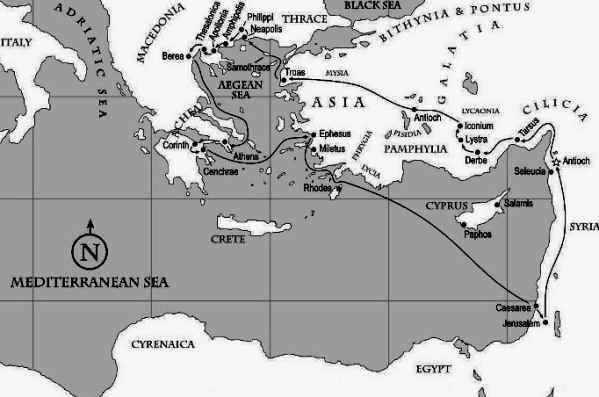
The route of Paul’s Second Missionary Journey, on which he met Priscilla and Aquila
Women in films
Identify recent movies that highlight relationships between friends who try to support each other.
What methods has the film used to present the relationship? Has the relationship been favorable, unfavorable or both? Explain.
If you are interested in the way that modern films present people from the New Testament, have a look at Modern Images of Jesus and Modern Images of Mary
Know your own worth
It’s said that women are better team players than men. This may or may not be true. Ask yourself these questions:
- What teams are you part of?
- What do you contribute to them?
- How do you encourage the people around you?
- How can you make your leadership and participation more effective?
- Make a list of prompts for yourself, put it somewhere you will see it often, and carry out your own suggestions to yourself.
Focus Questions, Bible Study
1. What are the most interesting moments in the story? Why do these particular moments appeal to me?
2. In the story, who speaks and who listens? Who acts? Who gets what they want? If you were in the story, which person would you want to be friends with? Which person would you want to avoid?
3. What is God’s interaction with the main characters? What does this tell you about the narrator’s image of God? Do you agree with this image?
4. What is happening on either side of the story, in the chapters before and after it? Does this help you understand what is happening?
5. The narrator/editor has chosen to tell some things and leave other things out. What has been left out of the story that you would like to know?
6. Are the characteristics and actions of the people in the story still present in the world? How is the story relevant to modern life, especially your own?
Dozens of extra ideas at
Activities for Bible Study Groups, Schools
Read about
more fascinating women of the Bible
For additional information on the lives of women in the Bible, see the links to
FAMILY, WORK AND RELIGION: the tribe, the family, slaves, women’s tasks, beliefs
MILESTONES IN A WOMAN’S LIFE: Puberty, menstruation, marriage, childbirth, death, burials
Prisca-Priscilla – Bible Woman – Women of the New Testament
Bible Study Resource: founding of the early Christian church
Paul’s admiration and affection for Prisca and Aquila