
Ruth and Naomi, women in the Bible
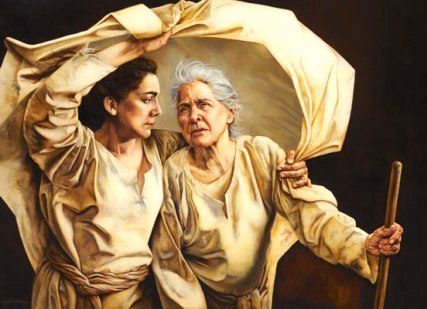 Who was Ruth in the Bible? A young Moabite woman who stayed faithful to her Israelite mother-in-law through every sort of trouble.
She was rewarded for her loyalty when the mother-in-law, Naomi, showed her how to win a rich and loving husband, Boaz.
What’s important about her story?
- Despite being a Moabite, Ruth was a forebear of the Bible hero King David.
- Her story is a protest against laws forbidding Jewish men to marry foreigners. Her loyalty to Naomi is what matters, not her nationality.
Ruth’s story has four parts:
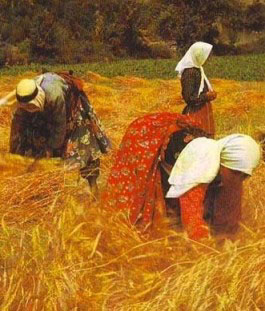
Gleaning in the fields at harvest
1 Naomi and Ruth go to Bethlehem. Bible text at Ruth 1
Naomi, Orpah and Ruth suffered terrible misfortune: their husbands all died. Marooned in Moab, Naomi decided to return to her home in Bethlehem. Ruth, though a Moabite, decided to go with her. They set out on the long journey, arriving in time for the barley harvest.
2 Ruth meets Boaz. Bible text at Ruth 2
In Bethlehem Ruth met Boaz, a rich land-owner and relative of Naomi. It seems to have been love at first sight for him, and he ordered his workers to treat Ruth well when she worked in his fields. Naomi saw immediately what had happened, and encouraged Ruth to keep on working in Boaz’s fields.
3 Ruth proposes marriage to Boaz. Bible text at Ruth 3
Shrewdly, Naomi advised the young woman how to catch her man. Ruth approached Boaz during the night at the threshing floor, and the text obliquely suggests that there may have been some sexual hanky-panky. The next morning, Ruth suggested that they marry, reminding Boaz of his obligation to her as her nearest male kin. Boaz promised to do all he could.
4 Ruth and Boaz marry – happy ending. Bible text at Ruth 4
Naomi’s plan succeeded. Boaz proved as good as his word, and he and Ruth were married. She had a son called Obed, and Naomi cared for the child, who grew to be the grandfather of King David.
Migrants Arriving in Sydney – 1966, David Moore
Ruth has special significance for Christians:
Matthew’s gospel lists four women who were ancestors of Jesus (Matthew 1:2-17). Ruth is one of them.
Why do Naomi & Ruth go to Bethlehem?
Click here for Bible text: Book of Ruth, Chapter 1
Naomi was an Israelite woman, but during a famine she had gone with her family to live in the country of Moab (see the map below). When her husband and two sons died, she decided to return to her home town, Bethlehem. She had two daughters-in-law, Ruth and Orpah. All three women were widows.
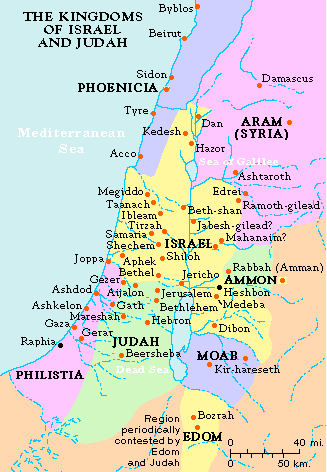
Ruth was from Moab, east of the Jordan; Naomi was from Bethlehem, south of Jerusalem
It would be interesting to know why all three died; it’s unusual for all the men in a family to die at more or less the same time. But it’s not really important to the story, so the Bible leaves it out.
What is important? That their death leaves Naomi, Ruth and Orpah stranded, without protection. They could not seek a widow’s pension – there was no such thing. They had to find a refuge, or starve.
What’s the main problem for Ruth and Orpah? They were Moabite women, not Israelites. The Moabite people were traditional enemies of the Israelites. There was frequent warfare between the two groups.
According to the Israelite belief, Moabites came from the act of incest between Lot and his older daughter (Genesis 19:30-38), and so the whole nation was tainted and inferior. The 1960’s movie RUTH shows this well, though it can’t resist throwing in some Hollywood touches to the story.
Naomi assumed that Ruth and Orpah would not want to return to Bethlehem with her, even though the women respected and loved each other.
What do Ruth and Orpah decide? One of them, Orpah, decided to return to her people and the Moabite way of life, but Ruth could not be budged. She had shared loneliness, anxiety and grief with Naomi, and now that the older woman was completely alone, Ruth stood by her and returned to Bethlehem.
This part of the story contains Ruth’s famous speech of loyalty to her mother-in-law Naomi.
Read Ruth 1:16-17
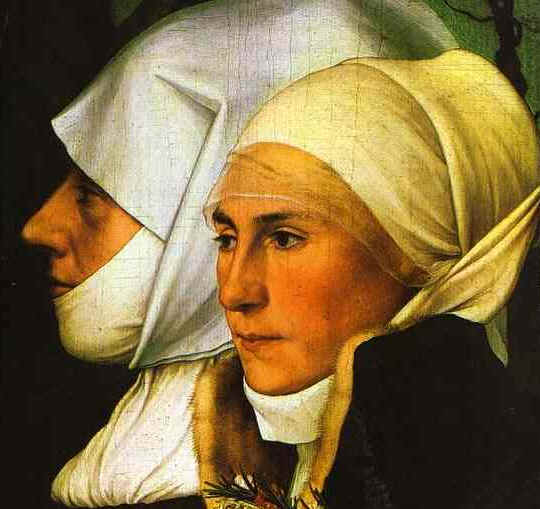 ‘But Ruth said,
“Do not press me to leave you
or to turn back from following you!
Where you go, I will go;
Where you lodge, I will lodge;
Your people shall be my people and your God my God.
Where you die, I will die
There I will be buried.
May the Lord do thus and so to me
And more as well
If even death parts me from you!”’
So the two women returned to Bethlehem in time for the autumn harvest of barley.
Ruth meets Boaz, who is instantly smitten
What advantages do Naomi and Ruth have?
- They are resourceful women.
- Naomi may be destitute, but she has good family connections.
- Furthermore, both she and Ruth were women of initiative. They did not believe in sitting down and letting events simply happen.
They knew that women took an active part in all stages of food production – see Work in Bible times, and Ruth decided she would help to glean the barley in the fields, to feed herself and Naomi and to get a store of grain for winter.
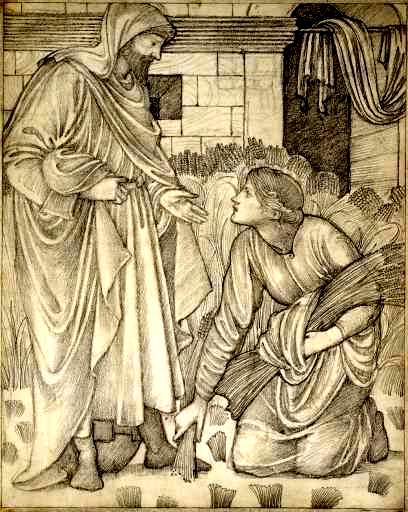
Ruth meets Boaz, drawing by Edward Burne-Jones
Gleaning was a common practice in ancient Israel. It was a form of charity for the disadvantaged (see Leviticus 23:22 and Deuteronomy 24:19). Recognized groups of the poor, such as widows, orphans and foreigners, could walk behind the harvesters, picking up what was left. This is what Ruth did.
‘Now Naomi had a kinsman on her husband’s side, a prominent rich man, of the family of Elimelech, whose name was Boaz. And Ruth the Moabite said to Naomi “Let me go to the field and glean among the ears of grain, behind someone in whose sight I may find favor”. She said to her “Go, my daughter”. So she went. She came and gleaned in the field behind the reapers. As it happened, she came to the part of the field belonging to Boaz, who was of the family of Elimelech. Just then Boaz came from Bethlehem.’
Read Ruth 2:1-7
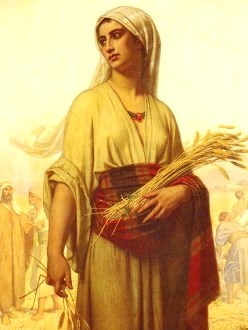
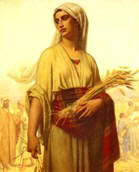
Ruth in the fields,
Merle Hugues, 1876
Ruth 2:3 says that ‘as it happened’ Ruth went to the field of Naomi’s rich relative, Boaz. This phrase is often used in the Bible to suggest that God is setting the scene for something significant.
It also implied, with a touch of Jewish humour, that Naomi and the people of Bethlehem saw a good match for Ruth and edged her into meeting Boaz.
A solution to their problems? Naomi knew that Ruth was beautiful and respected, and she knew that a rich husband for Ruth would solve all their problems.
Boaz was the ideal choice. He was available, childless, well respected and rich. He was also a relative of Naomi’s through her husband’s family, so he had a legal obligation to help Naomi. Boaz was second in line to the position of go’el in Naomi’s, and therefore Ruth’s, family.
In English, the word go’el is often translated as ‘nearest kin’, but in ancient Judah it meant much more than that.
- A go’el was a close male relative with the duty of looking after a family when the male head of the family was absent.
- In earlier times, the go’el of the family was expected to marry the widow of an Israelite man if she wished it (Deuteronomy 25).
- Ruth, who may not have understood the niceties of Israelite law, called Boaz go’el.
Read Ruth 2:8-23

Love was in the air…
By great good luck, Boaz seems to have been smitten with Ruth from the outset. He went to great lengths to get extra grain for Ruth, to protect her from young men who might harass her, and to see that she was properly fed.
‘At mealtime Boaz said to her “Come here, and e at some of this bread, and dip your morsel in the sour wine”.
So she sat beside the reapers, and he heaped up for her some parched grain. She ate until she was satisfied, and she had some left over.’
What’s the point of this part of the story? That it was not just love or luck, but God who nudged them into their destiny.
Ruth proposes marriage to Boaz –
——-yes, Ruth proposes…
Click here to read the Book of Ruth Chapter 3
 This part of the story took place at the threshing floor, at a golden time of the year when the harvest had been brought in and the weather was still warm. Love was in the air, with the fertility of Nature reflected in the lives of the characters.
Naomi was a shrewd older woman who had seen a lot of life, and she now devised a plan to prod Boaz into proposing to Ruth. She knew men, and she gave Ruth specific instructions on everything she must do.
How did Ruth respond? Fortunately, she had the good sense to heed the older woman. She perfumed herself and dressed in her most becoming clothes. Then she waited until Boaz had eaten a good meal – both women knew a man with a full stomach was easier to handle.
Then what did Ruth do? When Boaz finally lay down to sleep, she approached him where he lay on the threshing floor – someone always slept there at night until the grain was removed, to guard against thieves.
‘When Boaz had eaten and drunk, and he was in a contented mood, he went to lie down at the end of the heap of grain. Then she came stealthily and uncovered his feet, and lay down.’
Why did Ruth do this? Her action would seem strange unless you knew that in ancient times ‘foot’ was a euphemism for the male genital organ, as ‘sandal’ was for the female organ.

An ancient threshing floor
Threshing floors at harvest time were often the scene of sexual shenanigans, what the old Irish priests used to rail against as ‘fockin’ in the fields’, a time for license forbidden at other times.
What happened then between Ruth and Boaz? Lying beside Boaz, Ruth suggested that he, as the go-el of Naomi’s family, should ‘cover her with his blanket’, a euphemism for marriage. She had the right to demand marriage of the go-el of her family, so that she could have the children that Israelite women longed for.
Boaz happily agreed, but pointed out to her that there was another man who had that right, a closer relative even than himself.
Boaz had to square matters with him before he could marry Ruth. He seems to have been at pains to do everything correctly, so that there could be no question about the legality of the marriage.
Ruth stayed beside Boaz until morning, stealing away before first light to return to Naomi, who pounced on her and demanded to know how things had gone, and whether the plan had worked.
Was Ruth to be married or single? The two women waited impatiently to see how events would unfold.
Ruth and Boaz marry. The happy ending…
Click here for the Book of Ruth Chapter 4
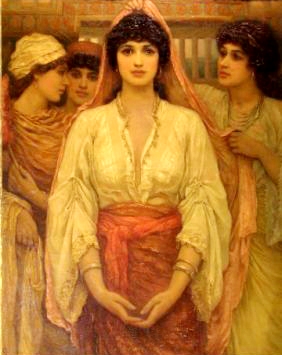
The Bride, Frederick Goodall
Of course, the townspeople were well aware of what was happening, as people in small towns usually are. When Boaz went next morning to the meeting place at the gate of the town, he was met almost immediately by the official go-el of Naomi’s family – and probably by a good many interested onlookers as well.
Some complicated negotiation went on regarding a small parcel of land that Naomi either owned outright or had put up for sale at some previous time, but this was just a formality. The outcome of this story was never in doubt.
‘So Boaz took Ruth and she became his wife. When they came together, the Lord made her conceive, and she bore a son. (See Childbirth in the ancient world)
Then the women said to Naomi “Blessed be the Lord, who has not left you this day without next of kin. May his name be renowned in Israel! He shall be to you a restorer of life and a nourishment for your old age. For your daughter-in-law who loves you, who is more to you than seven sons, has borne him”.
Then Naomi took the child and laid him in her bosom, and became his nurse.’ Read Ruth 4:1-22
Summary: Ruth, Naomi & Boaz
Ruth and Boaz were married, and she had a son, Obed. Eventually Ruth would be the great-grandmother of King David.
The marriage of Ruth and Boaz created a family with a good chance of success, because
– Naomi was shrewd, brave and persevering
– Ruth was intelligent, loyal and level-headed
– Boaz was a good manager of people, and not afraid to get his hands dirty
What are the main themes of Ruth’s story?
- Friendship: Ruth was poor and a foreigner, but she listened to the advice of an older, wiser woman. In turn, Naomi was rewarded by Ruth’s unfaltering loyalty. The message? Courage and loyalty triumph over misfortune.
 Family: The story of Ruth celebrates the family and the way it continues through many generations. Ruth, a childless widow at the beginning of the story, became the great-grandmother of Israel’s great king, David.
- God’s plan: The story of Naomi’s family and the way it endured is a universal theme. Even Ruth, a foreigner from the despised Moabites, could move God’s plan towards fulfillment.
Names of the people in Ruth’s story
Ruth means ‘lovely friend’.
Naomi means ‘pleasant’, but the name she called herself later was Mara, meaning ‘bitter’.
Boaz means ‘powerful’ or ‘strong’.
Mahlon is ‘sickness’. Chilion is ‘used up’.
Orpah means ‘back of the neck’; she turned her back on Naomi.
Elimelech means ‘my God is king’.
The full Bible text of the Book of Ruth is available here.
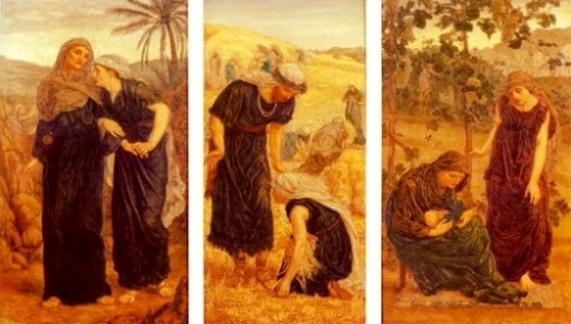
The Story of Ruth, Thomas Matthews Rooke, 1876
Read about more fascinating women of the Bible
Bible Study Resource for Women in the Bible: Women of the Old Testament
Ruth, Naomi and Boaz: a story of loyalty and love
Questions about Ruth
What’s Ruth’s story about?
Why was it written? To warn? explain? comfort?
Why did Ruth’s story appeal to people?
Can you relate it to your own life?
_______



Bible Heroines
Ruth, Naomi
Bible Women’s Lives
Choosing a husband, marrying him


Young Bible People
Ruth, David, Samuel…
Ancestors of Jesus
Ruth, Tamar, Rahab
& Bathsheba
Movies

Modern films often tell a story like Ruth’s. In ‘As Good As It Gets’ an over-burdened young woman finds love with a wealthy older man.
Make a list of films with similar themes.
Meditate on Ruth’s story


Ruth could not be budged. She had shared loneliness, anxiety and grief with Naomi. Now that the older woman was completely alone, Ruth would not abandon her.
Young People
in the Bible