
The first ‘cleansing’ of Jewish people
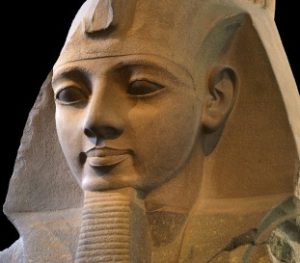 There were large numbers of Hebrew people in ancient Egypt, and the Pharaoh at that time, Ramses II, grew concerned. They were getting too powerful.
He decided to limit the Hebrew population by ordering midwives to kill all male babies born to Hebrew women – drowning them.
It was his ‘final solution’.
Did the pogrom work?
Two of the Hebrew midwives were woman called Shiprah and Puah. They would not co-operate with the Pharaoh’s order, but instead let the babies live. When questioned, they said that the Hebrew women were vigorous and strong and gave birth before a mid-wife had time to arrive.
You can read their story at Bible Heroines: Shiprah and Puah
In this way the Hebrew midwives ignored the Pharaoh’s command. He responded by ordering that all male babies be thrown into the Nile river.
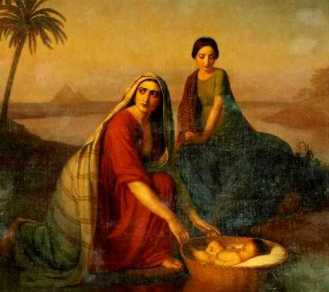
Moses about to be cast out onto the water of the Nile: Miriam watches over him
Now a man from the house of Levi went and married a Levite woman. She conceived and bore a son, and when she saw that he was a fine baby, she hid him for three months.
When she could hide him no longer, she got a papyrus basket for him, plastered it with bitumen and pitch, then put the child in it and placed it among the reeds on the bank of the river.’
Read Exodus 2:1-10
Miriam saves her brother Moses
The baby was Moses, and the Hebrew woman, Jochebed, and her daughter Miriam saved him by hiding him among the reeds at the edge of the river.

Read what modern Bible scholars say about Miriam
He was found by Pharaoh’s own daughter, who adopted him.
Cleverly, Miriam arranged that the real mother of the baby should be a wet-nurse for the baby.
So the future leader of the Hebrew people, Moses, owed his life to five women:
- Shiprah and Puah, the midwives who disobeyed Pharaoh’s edict to kill all male babies. Their disobedience was the first step in the Exodus, and in its own small way was the first act of rebellion against Pharaoh
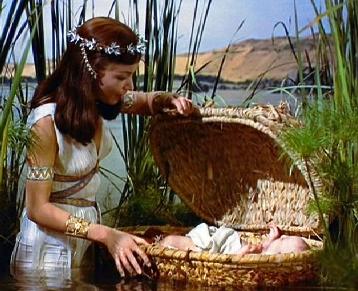
Pharaoh’s daughter finds the baby Moses hidden in the bulrushes
- Jochebed his mother, who wove the basket so that she could save her baby; she was the mother of three outstanding leaders
- Miriam his sister, a competent and self-possessed girl who followed and watched over him, and saved his life
- the daughter of Pharaoh, who pitied the baby and defied her father’s edict. She probably guessed that Jochebed was the baby’s mother.
One way or another, the women in this story were all life-givers.
The Song of Miriam
Miriam’s role as a leader of the Hebrew women was obviously more extensive than is shown in the biblical text. Despite her personal charisma and power, her story has to a large extent been subsumed into the story of her brother Moses.
Rulers in the ancient world led through force of arms and military might. Miriam and Moses proposed a different model of leadership. They
- led by example
- served their people rather than ruled them
- did what they believed God wanted rather than serving their own ends.
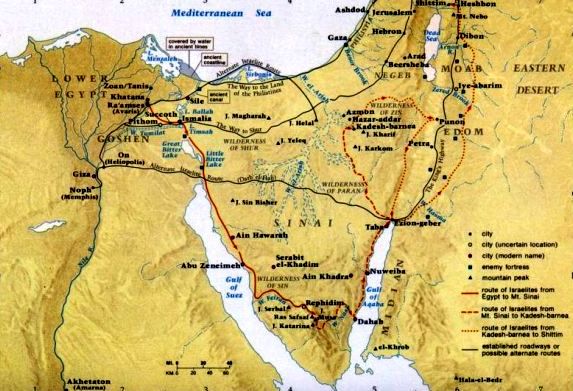
Possible route taken by Miriam and Moses in the Exodus from Egypt to the Promised Land
When the Hebrews were escaping from Egypt, they crossed what was probably a large papyrus marsh, called the Red Sea in the biblical text. They were led by Moses, Miriam, and her second brother Aaron.
The Egyptians had commanded that Hebrew babies be drowned. Now it was the Egyptians who were drowned, as the soggy ground of the marshland gave way under the hoofs of the horses and the wheels of their chariots.
When this happened, the Hebrews expressed their jubilation by composing songs of victory. A remnant of the song composed by Miriam appears in the Bible:

Then, as now, warriors were honoured when they returned from battle, greeted with an acknowledgment of their courage and self-sacrifice
‘Then the prophet Miriam, Aaron’s sister, took a tambourine in her hand; and all the women went out after her with tambourines and with dancing. And Miriam sang to them:
“Sing to the Lord, for he has triumphed gloriously;
Horse and rider he has thrown into the sea.” ‘ Exodus 15:20-21
Ritual singing by women was common in ancient Israel. Women sang particularly at victory celebrations, going out to meet returning warriors and greeting them with songs which expressed their relief, joy, and jubilation at the defeat of enemies.
The particular song that Miriam and the women sang may well have been a back-and-forth chant between the men and the women.
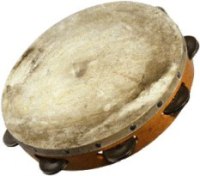
A well-used tambourine
Philo of Alexandria (On A Contemplative Life), described Jewish women standing in rows, swaying and moving their arms and bodies in harmony, chanting rhythmical songs together.
They accompanied their swaying movements with the metallic jingle of tambourines. Other musical instruments used at the time were gongs, harps, pipes and flutes, shofars (made from a ram’s horn), trumpets, lutes and lyres.
You can see what these looked like at Ancient Musical Instruments.
Miriam’s Ordeal
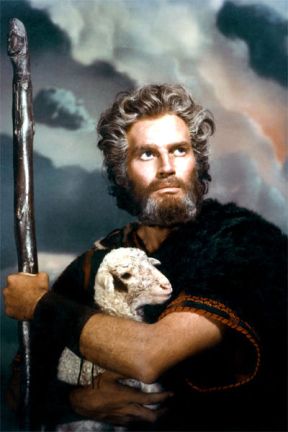
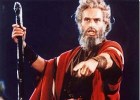
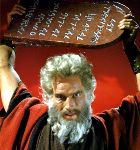
‘The Ten Commandments’, with Charlton Heston as Moses
This part of Miriam’s story described an incident at Hazeroth, as the Hebrew people wandered in search of their promised land.
Miriam and Aaron were troubled about two matters:
- They questioned his marriage to the Cushite (Ethiopian or Midianite) woman, not because of any personal rivalry, but because Hebrews condemned marriage with any foreigner
- They questioned Moses’ authority over them, since Moses was the youngest of the three. The firstborn son usually had the most authority in a family. Moreover, since God had communicated with all three of them, why should Moses dominate the other two?
‘Has the Lord spoken only through Moses? Has he not spoken through us also?’ And the Lord heard it and said to Moses, Aaron and Miriam ‘Come out, you three, to the tent of meeting.’
Read Numbers 12:1-9
As leader of the women and sister of Moses, Miriam had an unusually influential position in the community. This made her words and ideas important, because they were listened to, and they affected many people.
This seems to be why her questioning of Moses was followed immediately by what the text calls leprosy, shocking to all who witnessed it.
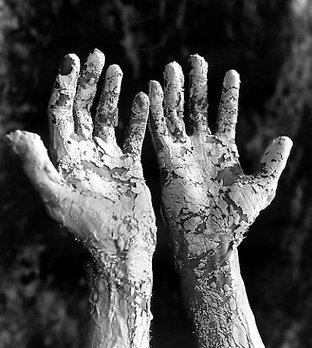
Hands with skin whitened with leprosy
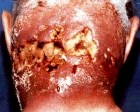
One of the Ten Plagues of Egypt was boils and skin sores – it may have been what Miriam had.
‘When the cloud went away from over the tent, Miriam had become leprous, as white as snow.’ Her skin was likened to that of a stillborn foetus when it comes out of its mother’s womb.
In fact, the term ‘leprosy’ was used for a wide variety of skin diseases at that time; some of them were curable, some were not. Leviticus 13 and 14 give precise details of symptoms and treatments, both spiritual and medical.
In whatever guise it appeared, leprosy was seen as a punishment from God for some wrong-doing.
That being so, it was necessary to repent and reform – which Miriam had to do. She suffered the punishment of God, and atoned for her challenge to Moses’ authority.
Miriam’s leprosy was interpreted by the people as a dramatic sign that Moses was God’s chosen leader, and that Miriam’s and Aaron’s authority, while still important, was less than Moses’.
Miriam’s Death

Miriam, with her brothers Moses and Aaron, led the Hebrew people throughout the forty years when they reverted to the nomadic life, searching meanwhile for a land where they could settle – the Promised Land.
For maps showing the route they took as they journeyed into Canaan, see Maps for Bible study.
The life they led was hard, and they must often have yearned for the stability and settled life they had left back in Egypt.
- Water was always scarce,
- the food supply was unreliable, and
- the physical living conditions were rigorous.
Eventually these conditions took their toll on Miriam, and she died.
‘The Israelites, the whole congregation, came into the wilderness of Zin in the first month, and the people stayed in Kadesh. Miriam died there, and was buried there.’
Read Numbers 20:1-2
Water, the symbol of life, had played quite a large part in Miriam’s life:
- she saved her brother from the water
- she led the song of victory after the parting of the Red Sea
- she died in a waterless place.
Immediately after her death, God gave abundant water to the people, in the form of a spring.
What do the names in this story mean?
 Miriam means ‘prophetess’ or ‘lady’; Miriam was the revered sister of the tribal leader Moses, but she was also the acknowledged leader of all the women who fled from Egypt with their families.
Moses’ name appears to be Egyptian, as in Thutmoses (child of Thut); or it may simply mean ‘child of the water’. The Hebrew word mosheh also means ‘pulled out of’, as in pulled out of the water.
Aaron means ‘honored or exalted one’ – Aaron was the older brother of Moses, and a revered leader of the wandering tribes.
What are the main themes of Miriam’s story?
 Water. This symbol of life was important in Miriam’s story: she saved her brother from the waters of the Nile, she led the song of victory after the waters of the Red Sea parted, and God gave abundant water to the people, in the form of a spring, immediately after she died.
- Exodus. She and the Hebrew women were an essential part of the Exodus, the great founding event of the Jewish people. The Exodus had three themes: an eternal covenant between God and his people; a journey cycle involving exile, wandering and return to a Promised Land ; and the responsibility to fight injustice – ‘free my people’.
Miriam’s story has four episodes (links to Bible text):
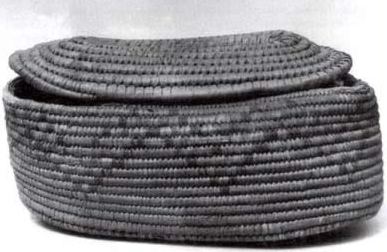
Covered basket made of split reeds and palm fibres, possibly from the 18th dynasty period of Egyptian history
1 Miriam saved her brother Moses, Exodus 2:1-10. She was his older sister, and she watched over him when he was placed in a basket on the River Nile. The survival of the leader of the Exodus, Moses, depended on the courage and ingenuity of his sister Miriam.
2 The song of Miriam, Exodus 15:20-21. Miriam became the leader of the Hebrew women when they and their families escaped from Egypt. On one occasion she and the women sang the Song of Miriam; it is one of the few poems that survive from the ancient world.
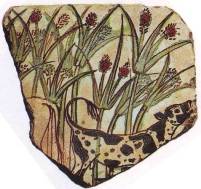
Fragment of ancient Egyptian pottery showing bulrushes
3 Miriam’s ordeal, Numbers 12. Miriam and Aaron were both popular leaders, but they were bound by the Law, represented by Moses. Miriam questioned Moses’ authority, and was punished with a disease that turned her skin white and leprous. Nevertheless she continued searching with Moses for the Promised Land.
4 Miriam’s death, Numbers 20:1-2. Miriam died in a waterless place in the wilderness, but afterwards God caused water to appear there.
Summary of Miriam’s story
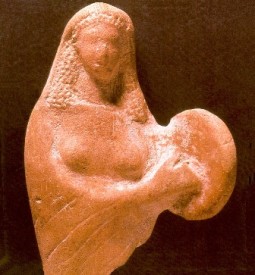
Ancient statue of a woman playing a tambourine
Miriam’s life had been one of service and leadership.
She expressed all the robust qualities that are best:
- courage and ingenuity in a dangerous situation
- loyalty to her family
- a love of music, story-telling and dance
- intellectual enquiry into questions about authority and social responsibility.
She remains a model for women and men today.
Read about more fascinating women of the Old and New Testaments
Miriam – Bible Woman – Women of the Old Testament; Bible Study Resource
Miriam, Moses and Aaron – From Slavery to Freedom
Miriam links


Movies

Modern films often tell a story like Miriam’s. In ‘Norma Rae’ a young woman fights for justice for her oppressed co-workers.
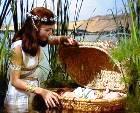
The little basket floated for a while then lodged in the shallows of the river. Miriam was following, and saw it was not far from a bathing party. Pharaoh’s daughter was there with her retinue. The royal women saw the basket and investigated: it was a live baby, crying with hunger…